
Ah, SEO. The buzzword that strikes fear (or joy) into the hearts of millions each year. Well, is SEO dead, finally? No, but there’s a lot more nuance to this one.
For well over a decade, SEO was like the early days of the gold rush for bloggers, startups, and creators of all types. Without much knowledge or experience, you could pretty quickly get the hang of this whole rank my content high in Google search results thing. Times have-a-changed, my friend.
🔑 Is SEO dead in 2026? No — but the old way of SEO is dying faster than ever, and the data backs it up. Zero-click searches now make up 64.82% of all Google queries. AI Mode searches return zero clicks 93% of the time. AI Overviews appear on nearly half of all SERPs and have cut organic CTR by 61%. The good news: SEO has evolved into something more sophisticated (now often called GEO — Generative Engine Optimization), and content that genuinely helps people is winning bigger than ever.
SEO has gotta be one of the greatest love-hate relationships of the 21st century in Internet-land. And here we are in 2026, navigating increasingly dramatic updates to Google’s search algorithm, the full rollout of Google AI Overviews (which replaced what Google previously called SGE — Search Generative Experience), the launch of Google’s standalone AI Mode, and the rapid growth of ChatGPT, Perplexity, and Bing Copilot as alternative search destinations. Here’s an example of what AI-driven search results look like today:

For over a decade, I’ve been running this blog. I get hundreds of thousands of monthly readers, almost entirely from organic search (SEO is my jam). I’ve been hired by dozens of the world’s top startups and Fortune 500 brands to plan, implement, and recover organic traffic growth initiatives. So I keep my finger close to the pulse on SEO — and watching what’s happening in 2026 has been the most dramatic shift I’ve seen in the discipline.
It’s time to grab your favorite snack and buckle up, because we’re diving deep into the nuance of this complex topic. And let me tell you, while SEO is still very much alive and thriving—it requires a shift away from the “old ways” of doing things.
Now, let’s explore all the ways SEO is changing today and how you can position yourself for long-term success as a creator.
Use My 50+ Powerful Free Blogging Tools Today
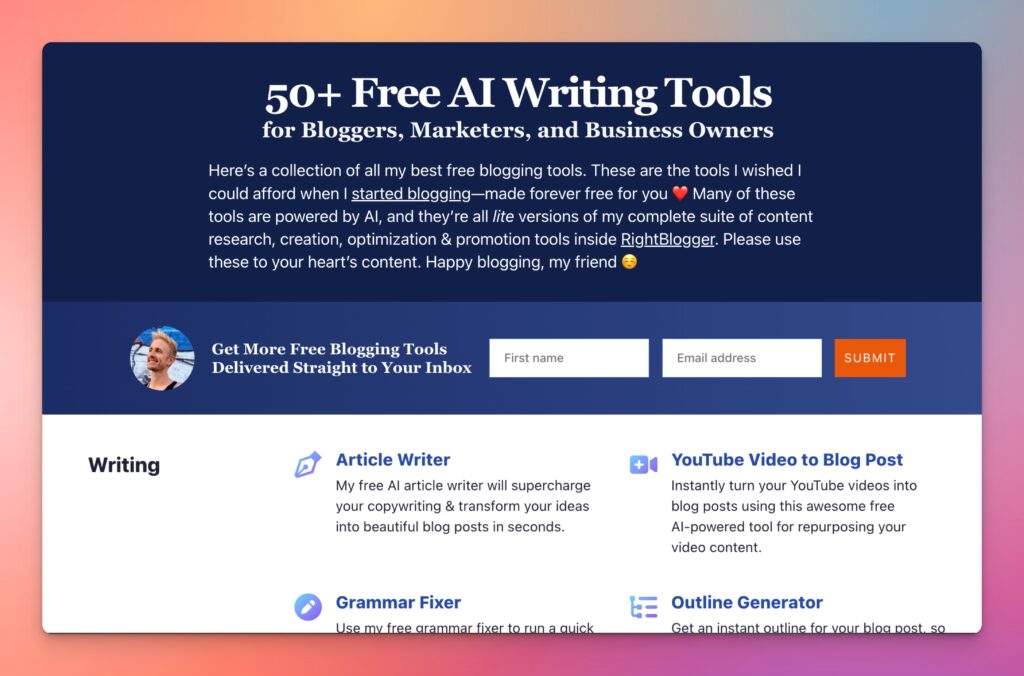
When I first started blogging, I couldn’t afford fancy tools. That sucked. And that’s why I’ve built a stable of powerful free blogging tools ranging from keyword research to an AI article writer, blog idea generator and more. Forever free for all to use—no strings attached.
What the 2026 Data Actually Says About SEO
Before getting into opinions, let’s look at the hard numbers — because the data tells a story that’s genuinely concerning if you’re relying on traditional organic search clicks (but also encouraging if you adapt fast):
- Zero-click searches are at 64.82% in 2026 (up from 50% in 2019), according to multiple search behavior studies. Most people who search Google never click through to a website.
- Google AI Mode produces zero clicks 93% of the time, per Semrush data updated September 2025. When users opt into AI Mode, they almost never click an external link.
- AI Overviews appear on 48% of all SERPs and have cut organic CTR by an average of 61% on the queries where they appear.
- “How to” queries are 99.9% cannibalized by AI Overviews — meaning if you publish how-to content targeting informational queries, AI is answering the question directly inside Google’s interface.
- Commercial queries are barely affected. Searches like “buy X,” “best X for Y,” and “price of X” trigger AI Overviews only 3-4% of the time. People with money-on-the-table intent still click through to read reviews and compare options.
- Brands cited inside AI Overviews see a +35% CTR boost compared to non-cited brands (Seer Interactive data). Getting cited matters more than getting ranked for many query types.
- Only 38% of AI Overview citations come from pages ranking in Google’s top 10 — down from 76% earlier in 2025 (Ahrefs analysis). AI is increasingly citing pages that don’t rank traditionally.
Translation: Generic “how to do X” content that used to be SEO’s bread and butter is getting eaten alive. Commercial / transactional content is still mostly safe. And there’s a new playing field for getting cited by AI engines that doesn’t require traditional top-10 rankings.
This is why anyone telling you “SEO is dead” or “SEO is fine, nothing changed” is wrong — the truth is that SEO has split into multiple distinct disciplines, and the strategy that works depends entirely on what kind of content you’re creating and what you want from it.
Old SEO vs New SEO (in 2026)
Remember the good old days when keyword stuffing was the holy grail, and Google’s algorithm was seemingly easy to manipulate? Those days are long gone, despite the anecdotal examples to the contrary that’ll always exist (usually on extremely high authority sites that’ve been around for a long time).
Things like high quality backlinks still matter in boosting the authority of your website as a whole (and on an individual post/page level), but much of what “worked” in the past decade, is shifting in a big way. Here’s a checklist of how to think about old SEO vs new SEO:

Here’s what matters most when it comes to generating more organic traffic from search engines like Google today:
- Value-centric content (that genuinely serves and impacts readers)
- Content that’s written for humans first, and lightly optimized for SEO
- Meeting user-intent, expectations and delivering on your promise
- Clear, helpful headlines that aren’t over-optimized for keywords
- Expressive meta titles and meta descriptions that don’t overdo it
- Skimmable headings and sections that help readers navigate easily
- Formatted for readability with lists, header sections, and images
- Natural keyword use where applicable (instead of keyword stuffing)
- Internal and external links to help readers go deeper
- Websites that are mobile-first optimized and load quickly for users
The only bonus I’ll add to this list, is a reminder that while Google Search higher-ups like John Mueller frequently state that backlinks don’t matter as much in SEO these days, my experience has shown me that’s not necessarily the case.
There are a whole lot of benefits I still experience from naturally getting high quality links from other authoritative websites through activities like guest blogging and being a guest on podcasts. Low quality links, on the other hand, can do more damage than good.
Here’s the deal—SEO is far from being dead. What SEO is and how we do it in the age of AI, is transforming rapidly today.
Which Queries Are Dying vs. Which Are Thriving in AI Search
One of the biggest misconceptions about the “is SEO dead?” debate is treating SEO as one monolithic thing. It isn’t — different query types are being affected in totally different ways. Here’s how to think about which content categories are in trouble vs. which are still humming:
Query types getting hit hardest in 2026
- “How to do X” queries: 99.9% cannibalized by AI Overviews. If your blog’s traffic strategy is built on “how to X” content, you’re probably seeing 30-60% organic traffic declines right now.
- Simple “what is X” definitional queries: AI answers these completely in the SERP. Generic glossary-style content has been crushed.
- “Why does X happen” explanatory queries: AI Overviews give the explanation directly. Click-through rates have collapsed.
- Generic listicles without first-hand experience: AI can generate “10 best X” lists instantly from public data. Listicles only work now if they include real testing, original photos, or genuine expertise.
Query types still thriving in 2026
- Commercial / transactional queries: “Best X for [specific use case],” “X vs. Y,” “X review,” “buy X” — these queries only see AI Overviews 3-4% of the time because users want to read multiple sources before spending money. People click through.
- Brand and navigational queries: When someone searches your brand name or a specific company, they’re going to that site. AI rarely intercepts these.
- Local search: “Plumber near me,” “best coffee shop in [city]” — local results are largely unaffected because they require map data and proximity. AI Overviews don’t replace this.
- Visual and shopping queries: Product searches with images, “things that look like X,” and visual inspiration queries still drive traffic to publishers and retailers.
- YMYL queries with high stakes: Health, finance, and legal queries where users need authoritative sources still see strong CTR — though AI Overviews appear more often, users distrust AI for important decisions and click through to vetted sources.
Practical implication: If you’re running an affiliate-driven content site, your traffic is probably more resilient than you think — most of your money posts target commercial queries. If you’re running an ad-driven informational content site (the “how to X” model), you’ve been hit hard and need to diversify into commercial content, video, email lists, and direct audience-building.
GEO: The New Discipline of Getting Cited by AI Search
The new acronym you’ll hear constantly in 2026 is GEO — Generative Engine Optimization. It’s the discipline of optimizing your content to be cited as a source by AI search engines (Google AI Overviews, ChatGPT search, Perplexity, Gemini, Bing Copilot), not just to rank in traditional results.
The key insight: getting cited inside AI Overviews drives a +35% CTR boost vs. uncited brands (Seer Interactive data). And since only 38% of AI citations now come from top-10 ranking pages (down from 76%), there’s a real opportunity for pages that don’t rank traditionally but get cited because of how they’re structured.
What’s actually working for AI citations in 2026:
- Direct, scannable answers near the top of each section. AI lifts these as quotable snippets.
- Specific factual statements with numbers, dates, and names. Vague generalizations don’t get cited.
- Structured data (schema markup) boosts citation rates by 61% according to recent studies.
- Strong E-E-A-T signals — named author with bio, visible publication dates, inline references and citations.
- FAQ sections with clear Q&A pairs. AI loves to lift these.
- First-hand experience language — phrases like “in my testing,” “when I tried,” real screenshots and case studies. AI engines preferentially cite content with demonstrable expertise over AI-generated rewrites.
- Submit your sitemap to Bing Webmaster Tools — ChatGPT’s web search uses Bing’s index, so being well-indexed in Bing is now essential for ChatGPT visibility (separate from Google).
Each AI engine has slightly different selection logic. Recent analysis found that only 11% of domains are cited by both ChatGPT and Perplexity — meaning getting cited in one doesn’t guarantee citation in the other. Tools like Otterly.ai, Semrush AI Toolkit, Ahrefs Brand Radar, and Profound now track AI citations separately across each platform if you want to measure it.
The Foundation of New SEO: Genuine Content & Connection
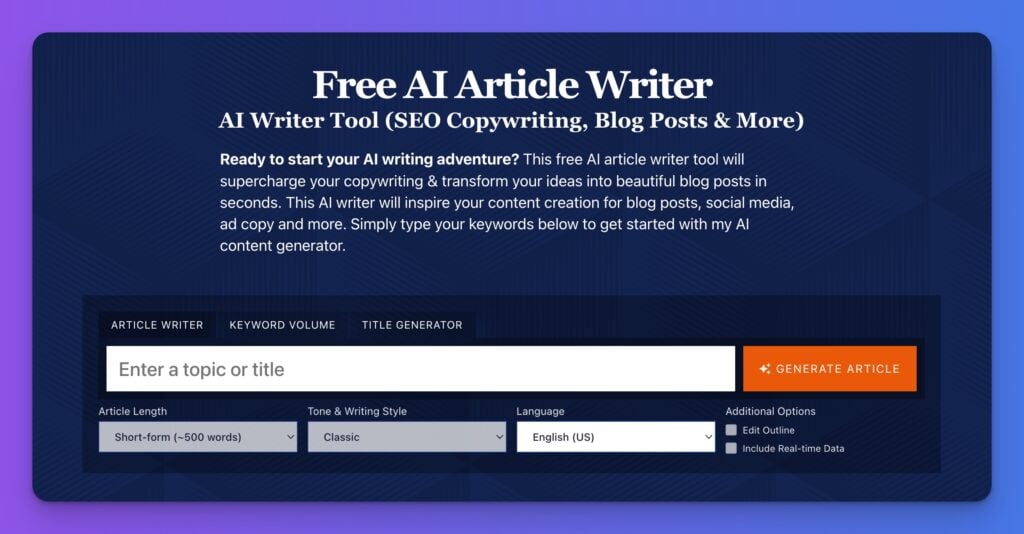
At a time when even my own free AI article writer can churn out a pretty great first draft blog post in just a few seconds, the real challenge is learning how to create content that actually connects and resonates with real humans.
We’ve long been in a race to the top, but the stakes are getting higher. Average content is falling by the wayside faster than ever—and being replaced by blog posts, podcast episodes, and videos that actually make people feel seen, heard, and understood.
The goals of content creation are no longer as easily tied to conversion as they once were.
Instead of expecting a blog post or landing page to immediately convert someone new to your blog, brand, or show—into an excited customer on that first interaction, aim for these objectives:
- Awareness: Content is and always will be useful for attracting a new audience & reminding them you’re here. It’s a numbers game, so you have to show up with value for your audience, often. That’s why it pays dividends to create in a niche you truly love.
- Affinity: Making your audience feel seen, heard, and understood creates a powerful sense of closeness. Do this well, repeatedly over time, and you won’t have an audience, you’ll have fans that eagerly anticipate what’s coming next from you. Companion content is a great way to plant the seeds for blossoming these relationships today.
- Education & Entertainment: Invest deeply into creating content that teaches (and captivates) your audience about everything they need to know within your subject matter. This is where a video-first content creation process really shines through. Platforms like YouTube, Instagram & TikTok are great for both discoverability and relationship building with your audience—these are some of the best places to spend your creation time today. Then you can use tools like my free video to blog AI generator that instantly turns your videos into actionable, SEO-friendly blog content to pick up organic Google traffic too.
We’ve all felt how a 100% AI-written article feels. When a creator publishes an AI-generated article without personalizing it and weaving in their own genuine take, it feels to the reader like they’re being served microwave meals at a gourmet restaurant. You might be full, but where’s the love? The flavor? The spark that turns a meal—errrrr content—into a true experience?
The new SEO is cultivating your ability to create experiences that move readers, and still nail the basic fundamentals of on-page SEO that’ll set your content up for long-term success. Let’s run through a few of the ways you can strike this balance today.
1. Building in a Personal Touch
So, how do you really win at SEO in 2026? Well, there’s no ignoring that AI writing tools are changing the ways we create content. Rather than resisting it, view them not as an enemy, but as an assistant in the creation process. A new AI blogging process can speed up your workflow, but the secret sauce, my friend, is and always will be you — your first-hand experience, your perspective, your stories. That’s what AI can’t replicate, and it’s exactly what AI search engines now preferentially cite.
Your own lived (human) experiences, learnings, stories, insights, and unique voice are irreplaceable. This is what breathes life into your content, and leads to people spending more time with your creations. This, in turn, makes search engines like Google and YouTube notice that your content is more engaging than others in your space.
This is the new content flywheel that creators are using to build meaningful relationships with people, today:
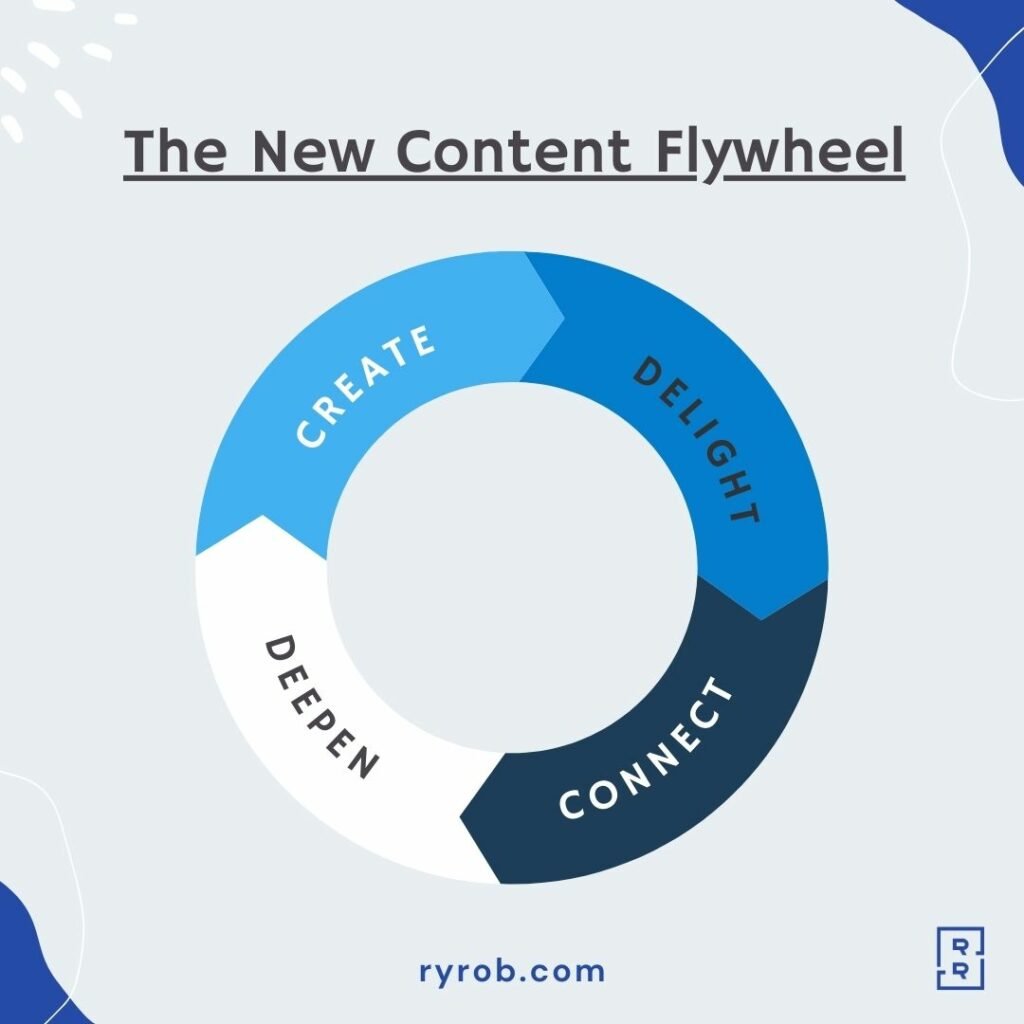
The new content flywheel is this continual loop:
- Create: Creating personal, value-centric content that genuinely solves real problems for your audience.
- Delight: Finding your balance of education & entertainment that puts a smile on people’s faces.
- Connect: Making your readers, listeners, viewers feel seen, heard, and understood builds connection.
- Deepen: Go deeper by listening to your audience and creating custom content for your people.
Like it or not, the truth is that content has become a commodity today. Our social feeds are flooded with creators trying to reach new audiences and capture attention—and the best way to stand out, is by embracing your weird. Lean into expressing your personality, be goofy if that’s who you are, share openly from your heart and you only stand you gain.
The new content flywheel starts with being unapologetically you. Share your stories, sprinkle in your quirks, and let yourself shine.
2. Using Generative AI Tools to Your Advantage
I’ll forever be an advocate keeping yourself front & center in your content creation process.
However, dismissing the incredible advantages of AI tools is a little like refusing to use your GPS when you’re lost in the woods, just because you’re nostalgic for paper maps. Nostalgia is great, but I’d rather get to where I’m going than spend hours lost in the wilderness.
AI can help you be more efficient, cutting down the time investment on tasks that don’t bring you as much joy—so you can focus on what matters most—injecting your insights, expertise, heart, and soul into the content you create.
Here are some of the best use cases for AI tools in our modern content creation process:
- Generating Ideas: Tools like my free blog post idea generator thrive at coming up with a never-ending stream of research-backed topics where real audiences are actively searching for answers, help, education, and entertainment.
- Keyword Research: My free keyword research tool is great for validating whether or not a topic has enough of an audience to justify spending hours of time creating content on the subject.
- Outlines & First Drafts: Generating blog post outlines and writing first drafts using tools like my free AI article writer are amazing use cases for speeding up your creation process, allowing you to create more great content, faster. Just be sure to invest time, effort, energy, and love into your editing process, to make sure your content connects with real people. Here’s more on my AI writing process.
- Repurposing Content: This is one of my favorite use cases for AI today. Tools like my video to blog post generator will take any video you’ve created, and within seconds, write an SEO-optimized blog post draft that you can publish and reach a wider audience that prefers to consume content in written format.
Inside RightBlogger, we’ve built tons of AI-powered tools for creators to better research, plan, create, and promote content. These are the tools I wished I had when I was first beginning to blog.
Use My 50+ Powerful Free Blogging Tools Today
When I first started blogging, I couldn’t afford fancy tools. That sucked. And that’s why I’ve built a stable of powerful free blogging tools ranging from keyword research to an AI article writer, blog idea generator and more. Forever free for all to use—no strings attached.
3. Nailing Your On-Page and Off-Page SEO Basics
All of this beautiful (true) sentiment aside, here’s where things gets real—the basics of SEO still matter.

The nitty-gritty stuff very much has a place in content creation. I have some extremely in-depth guides on an overview of SEO for bloggers, and a detailed breakdown of on-page SEO fundamentals worth checking out. These deets include things like:
- Doing keyword research to make sure you’re covering the right topics (keyword clustering is smart too).
- Using proper heading structures to help readers and search engines navigate your content.
- Weaving in your target keyword phrases (without keyword stuffing) to show search engines what your content should be ranked for.
- Nailing your meta details (titles, descriptions, permalinks) and making sure they’re working in your favor for high organic rankings.
- Remembering to use descriptive, SEO-friendly image alt text for any graphics you include in your content.
Then there’s also what’s called off-page SEO. This is where things like backlinks, guest blogging, social signals, and the power of networking with other creators who are game to share your content with their audiences, comes into play.
SEO isn’t a “set it and forget it” kinda thing. If you want sustained (free) traffic from search engines like Google, it requires nailing all of these fundamentals, constant monitoring for fluctuations, and the willingness to pivot your content when necessary.
Keep an eye on your analytics, watch how your content performs, and don’t be afraid to tweak things. Flexibility is the name of this game.
So, is SEO Dead in 2026? No, it’s Different (and Very Much Alive)
So, is SEO dead? Far from it. But the discipline has fractured into multiple specialties — traditional SEO, GEO (Generative Engine Optimization), and AI citation tracking — that all matter in 2026. Generic informational content has been hit hard by AI Overviews, while commercial-intent content has been mostly spared. The foundation of all of it craves genuine, heart-felt content first, with the right technical foundation underneath. The creators winning in 2026 are the ones who lean into what makes them human, while quietly doing the GEO work to get cited by AI engines.
And while the proliferation of AI tools will no doubt continue to change the ways we create content over time, don’t lose sight of the real reason we’re drawn to learn from other people (creators like you)… for the genuine human connection we feel along the way.
So, remember why you’re here—to connect, share, educate, entertain, and make your corner of the Internet uniquely yours.
Is SEO Dead? Frequently Asked Questions
Is SEO dead in 2026?
Is SEO dead in 2026?
No, but it has fundamentally changed. The data is clear: zero-click searches are now 64.82% of all Google traffic, AI Mode produces zero clicks 93% of the time, and AI Overviews appear on 48% of SERPs (cutting organic CTR by 61% where they appear). But SEO has evolved into GEO (Generative Engine Optimization) — the new discipline of getting cited by AI search engines like Google AI Overviews, ChatGPT, Perplexity, and Bing Copilot. Traditional ranking still matters, but it’s no longer the whole game.
Is AI killing SEO?
Is AI killing SEO?
AI is killing certain types of SEO — specifically the “how to do X” and “what is X” content that AI Overviews now answer directly. Generic informational content has been hit hard. But commercial-intent queries (“best X for Y,” “X vs. Y,” product reviews) are largely unaffected because users still want to read multiple sources before spending money. AI search has split SEO into winners and losers depending on what kind of content you create.
What is GEO (Generative Engine Optimization)?
What is GEO (Generative Engine Optimization)?
GEO is the practice of structuring and optimizing your content so AI search engines (Google AI Overviews, ChatGPT, Perplexity, Gemini, Bing Copilot) cite it as a source when answering user questions. Unlike SEO which targets ranking position, GEO targets citation. Key tactics: direct answers near the top of each section, factual specificity (numbers, dates, names), schema markup (boosts citation rates 61%), first-hand experience language, FAQ sections, and getting indexed in Bing (which powers ChatGPT search).
Should I stop doing SEO and focus only on AI optimization?
Should I stop doing SEO and focus only on AI optimization?
No — they’re complementary, not opposing strategies. Most of the same content fundamentals matter for both: clear structure, factual accuracy, first-hand expertise, and direct answers. The differences are at the margins: traditional SEO cares more about long-form depth and backlinks, while GEO cares more about scannable answers and schema markup. The best approach in 2026 is to optimize for both at the same time — most of the work overlaps.
How has Google search changed in 2026?
How has Google search changed in 2026?
The biggest changes: AI Overviews now appear on 48% of SERPs (formerly called SGE — Search Generative Experience). Google launched a standalone AI Mode where conversational AI replaces the traditional search results entirely (93% of AI Mode searches end without a click). The Helpful Content Update and core algorithm refinements have continued penalizing thin and AI-generated content. Schema markup, E-E-A-T signals, and first-hand experience have become more important than backlink count for many queries.
Which kinds of websites are most hurt by AI search?
Which kinds of websites are most hurt by AI search?
The hardest-hit category is informational content sites that monetize via display ads — sites built around “how to do X” and “what is X” content. AI Overviews answer those queries directly, so traffic has dropped 30-60% for many of them. Less affected: affiliate review sites (commercial queries still drive clicks), local service businesses (local SERPs largely unchanged), eCommerce stores (transactional queries unaffected), and creator brands with direct audience relationships (email, newsletter, YouTube) that don’t depend on search traffic alone.
How do I get cited by ChatGPT and Perplexity?
How do I get cited by ChatGPT and Perplexity?
ChatGPT’s web search uses Bing’s index, so first: submit your sitemap to Bing Webmaster Tools and make sure you’re properly indexed in Bing (most SEO advice focuses on Google, but for ChatGPT visibility, Bing matters more). For both ChatGPT and Perplexity, structure content with direct answers, factual specificity, schema markup, and clear E-E-A-T signals. Only 11% of domains are cited by both — so you may need slightly different tactics for each. Track your citations with tools like Otterly.ai, Profound, or Ahrefs Brand Radar.
What should I do if my SEO traffic is dropping in 2026?
What should I do if my SEO traffic is dropping in 2026?
First, identify which query types are dropping. If it’s informational queries (“how to X”), you’re seeing the AI Overviews effect — pivot to: (1) commercial content with affiliate or product monetization, (2) audience-building via email and YouTube to reduce search dependency, (3) GEO optimization to get cited in AI Overviews (which can recover some of the lost traffic via cited brand searches). If commercial queries are dropping, that’s usually a separate problem — algorithm updates, competition, or thin content. Diagnose before pivoting.

Ryan, thanks for writing this post. I have some blog posts from my travel blog that were ranking OK, not great (like 30s-40s) that were *purely* human written, but which have dropped to the 90s or even out of the top 100. I think the content is high quality and it’s all based on personal experience rather than what GPT thinks. Why do you think my rankings have dropped so much? You’ve been such an invaluable resource since starting my blogging journey and I’d appreciate any insight! <3
SEO isn’t dead in 2024; it’s evolving. With search algorithms becoming more sophisticated and user-centric, traditional SEO tactics are giving way to a more holistic approach focused on providing valuable content and enhancing user experience. Adaptation is key to staying ahead in this dynamic landscape
SEO (Search Engine Optimization) isn’t dead in 2024; it’s just evolved. As search engines continue to refine their algorithms and users’ search behaviors change, SEO strategies have adapted accordingly. While some traditional SEO tactics may have become less effective or outdated, the essence of SEO—optimizing your content to be found and favored by search engines—remains crucial for online visibility.
In 2024, SEO emphasizes user experience, quality content, and relevance more than ever. Search engines prioritize websites that provide valuable, authoritative, and user-friendly content. This means focusing on creating content that genuinely addresses users’ needs, optimizing for mobile devices, improving site speed, and enhancing overall user experience.
This article offers a clear and encouraging perspective on the evolving world of SEO. Thanks for breaking down these changes and providing actionable insights for navigating them!
I love how this blog breaks down the trends and offers practical tips for keeping SEO strategies fresh and effective
SEO is far from dead in 2025; it’s evolving, and staying ahead of the curve is key to success.
great post , thank you for sharing.
very good information sir and improve my knowledge thanks a lot
SEO is definitely evolving, not dying! Loved the insights on adapting to algorithm changes and focusing on quality content. With AI and voice search gaining traction, how do you see SEO strategies shifting in the next few years?
Very interesting, I like this!
Great article! SEO isn’t dead; it’s just evolving. Adapting to new trends is key to staying relevant. Thanks for the valuable insights!
Hi Ryan,
Fantastic article! I really appreciate the insights on how SEO is evolving in 2025.
Your breakdown of old SEO vs. new SEO is especially helpful.
I was wondering—how do you see AI-generated content impacting search rankings in the long run?
Will human-written content always have the upper hand?
Thanks for sharing such valuable knowledge!”