

Alright, so what actually makes for the best shared hosting plan for a new site? It’s a harder question than it seems on the surface, because so much of the advice online is years out of date, or just the same recycled list of names.
I’ve blogged and run my own websites for 15+ years, testing more than 11 different hosting companies along the way, and I’ve built a content business that reaches a large monthly audience. So this breakdown comes from real use, not a pricing page, and my goal is to help you find a reliable shared hosting provider, instead of wasting time on the ones that underdeliver.
The best shared hosting should help you launch fast, stay online, and avoid billing surprises later. Because many of these providers include a free domain, it’s easier than ever to minimize your initial costs when launching a small business website. Watch my full breakdown here:
Disclosure: Please note that some of the links below are affiliate links and at no additional cost to you, I’ll earn a commission. Know that I only recommend products and services I’ve personally used and stand behind. When you use one of my affiliate links, the company compensates me, which helps me run this blog and keep my in-depth content free of charge for readers (like you).
Key Takeaways for the Best Shared Hosting Plans in 2026
- Shared hosting remains the smartest starting point for most new blogs and small business sites because it’s affordable, user-friendly, and easy to upgrade as your audience grows.
- When selecting a shared hosting provider, the five checks that matter most are consistent uptime, excellent page load speed, reliable customer support, a WordPress-friendly setup, and transparent renewal pricing.
- These factors, combined with overall site performance, ensure your website visitors have a positive experience while keeping your initial budget intact.
- Bluehost is my top pick for beginners because the setup process is intuitive, the WordPress integration is robust, and the introductory pricing is competitive if you choose a longer term.
- SiteGround tends to lead on raw speed metrics (but gets tricky with renewal price jumps), while DreamHost earns high marks for its clear month-to-month flexibility.
- Remember that renewal pricing matters more than the initial flashy promo rate. A low first-year price can look like the best shared hosting deal, but it may end up costing far more over time than a plan with predictable long-term costs.
I’ve said it for the better part of a decade, and it still holds: If you’re starting out, Bluehost’s shared hosting is where I’d point you.👇
Get Reliable Shared Hosting with Bluehost
Everything a first site needs, none of the headaches. The Bluehost Starter plan gives you reliable uptime, one-click WordPress, and around-the-clock support, all at an intro price that’s honestly hard to beat.
What Shared Hosting Is and Why It Still Makes Sense
Shared hosting is the entry-level option for a reason. One physical server hosts many websites, and each site uses a slice of the same machine’s server resources, including CPU, memory, and storage.
A simple way to picture it is an apartment building. Your website rents one unit, while other websites rent the units around it. Everyone shares the building’s core systems, which is why shared hosting is the most affordable way to get online.
For most new WordPress sites, you only need about 10GB to 20GB of disk space and a standard amount of bandwidth to handle initial traffic levels with ease.
Shared vs. VPS vs. Dedicated Hosting
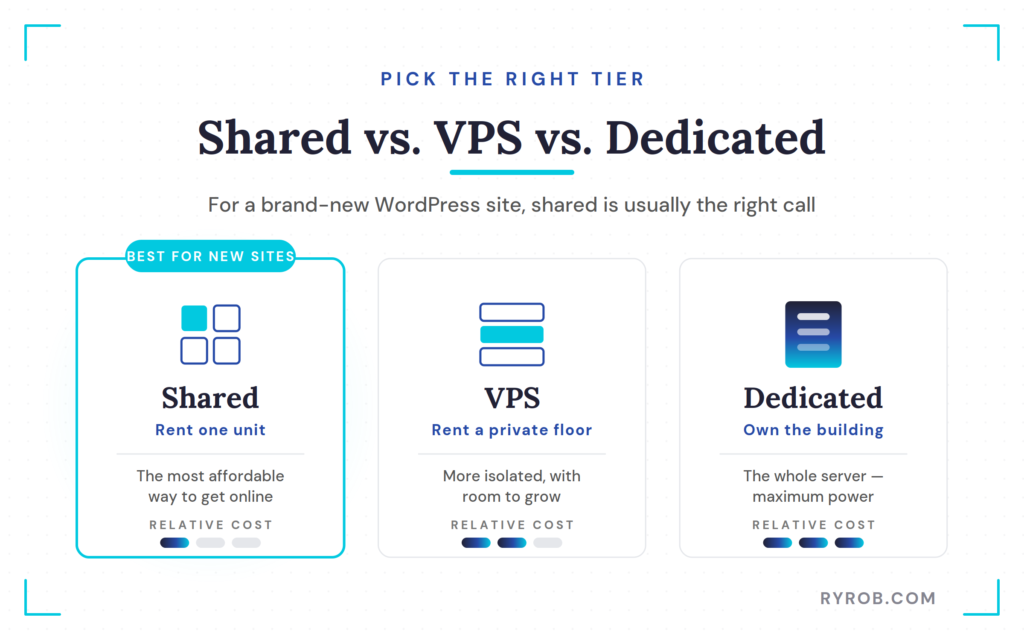
A VPS hosting plan provides your site with a more isolated environment. You still share the larger physical machine, but your resource allocation is more protected. That means better performance consistency and more room to grow, but it also comes with a higher price tag.
If you want a balance between ease of use and performance, you might also consider managed WordPress hosting, which handles technical updates and security for you. Dedicated hosting, on the other hand, is like owning the entire building. You get the entire server to yourself, providing maximum control and power, but that is far beyond what most first-time site owners need.
For a brand-new WordPress site, shared hosting is usually the right call because the goal is to get online without overspending. You do not need premium horsepower on day one if your site has low traffic and a standard setup.
This is important because many beginners are pushed toward bigger plans far too early. Marketing materials often make complex hosting sound like the only responsible choice, but that is usually more power than a first blog or small business site will use for quite a while.
If you are still at the stage of picking a domain, installing WordPress, and publishing your first posts, shared hosting keeps things simple. For help with that next step, this guide on setting up a WordPress blog pairs well with choosing a host.
How to Choose the Best Shared Hosting: 5 Checks That Matter
The hosting market is crowded, so comparing plans by headline price alone is a mistake. Cheap hosting can turn expensive fast if your site slows down, support disappears, or the renewal charge doubles or triples after the first term.
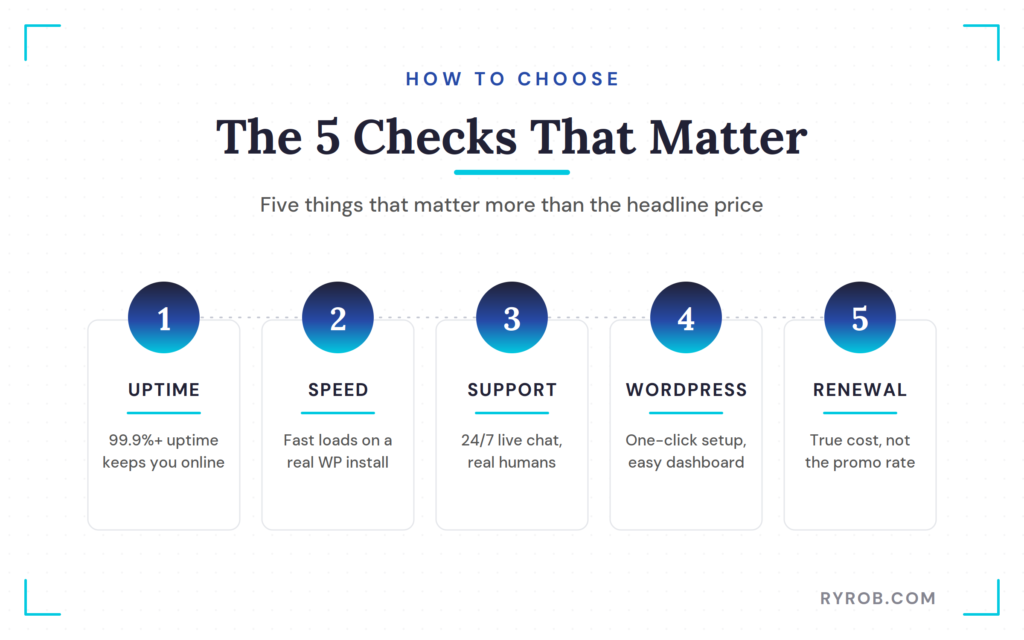
The better way to evaluate a host is to use a short checklist that reflects real life, not marketing copy. These are the five checks that matter most when you are choosing the best shared hosting for a first WordPress site.
1. Uptime That Keeps Your Site Online
Uptime is the most basic promise a host makes. When someone types in your URL, your site needs to load.
Look for a published uptime guarantee of 99.9% or better. If a host doesn’t clearly say what uptime level it aims to maintain, that is a bad sign. A company that won’t put a number on its uptime guarantee usually doesn’t want to be judged on it.
This matters more than people think. A site that randomly disappears loses visitors, sales, leads, and trust. For a blog, that means missed readers. For a business site, that can mean missed revenue.
Long-running review teams also treat reliability as a core benchmark. You can see that in PCMag’s hosting review criteria, where pricing, features, support, and reliability all factor into the evaluation.
2. Speed on a Real WordPress Site
A blank demo site can make almost any host look fast. That test doesn’t tell you much.
The real question is what happens after you install WordPress, add a theme, upload images, turn on a few plugins, and start publishing actual content. Good shared hosting should provide solid loading speed, a fast TTFB (Time to First Byte), and access to various data center locations so your server is physically closer to your target audience. You don’t need enterprise performance, but you do need a host that can handle a normal WordPress site without feeling sluggish.
Speed matters because visitors notice it right away. Search engines do too. A slower site can hurt engagement, and it can make your content harder to discover over time.
3. Support That Actually Responds
Support is easy to ignore until something breaks. Then it becomes the only feature you care about.
At some point, there will be a late-night issue you didn’t cause and don’t know how to fix. Maybe WordPress throws an error after an update. Your login stops working for no clear reason. Suddenly the site loads as a blank screen and you need help now, not tomorrow afternoon.
That is why 24/7 live chat with real people matters so much. High-quality customer support is vital for beginners, and email-only options can leave you stuck for too long. AI-only customer support can be fine for account questions, but it often falls apart when you are dealing with a WordPress-specific problem.
The best shared hosting providers do not leave you alone when your site goes sideways.
4. WordPress Integration That Saves You Time
Most new blogs and small business sites run on WordPress, so your host should make WordPress easy from the start.
That means one-click installation, automatic updates, and an intuitive dashboard. Whether your host uses a custom control panel or the industry-standard cPanel, the interface should not feel like you need a second tutorial just to launch your site. The right host reduces friction. The wrong one turns setup into a chore.
Bluehost does especially well here, and that is a major reason it ranks first in this comparison. WordPress has recommended Bluehost for years, and that long relationship shows in the setup flow.
If you want the bigger picture beyond this article, my roundup of best web hosting for bloggers compares more options across different budgets and growth stages.
5. The Renewal Price Problem Most Buyers Miss
This is where a lot of people get burned.
A host advertises a beautiful introductory price, maybe $1.99 or $2.95 per month. The checkout page looks cheap, so you assume you have found a long-term bargain. Then the first term ends, and the plan reverts to a much higher renewal price.
Always check the renewal rate before you buy, not after your first term ends.
Here is a simple example. If a host charges $1.99 per month for the first year and $11.99 per month for the next two years, your total over 36 months is $311.64. That works out to about $8.66 per month, not the promo rate you saw on the front page.
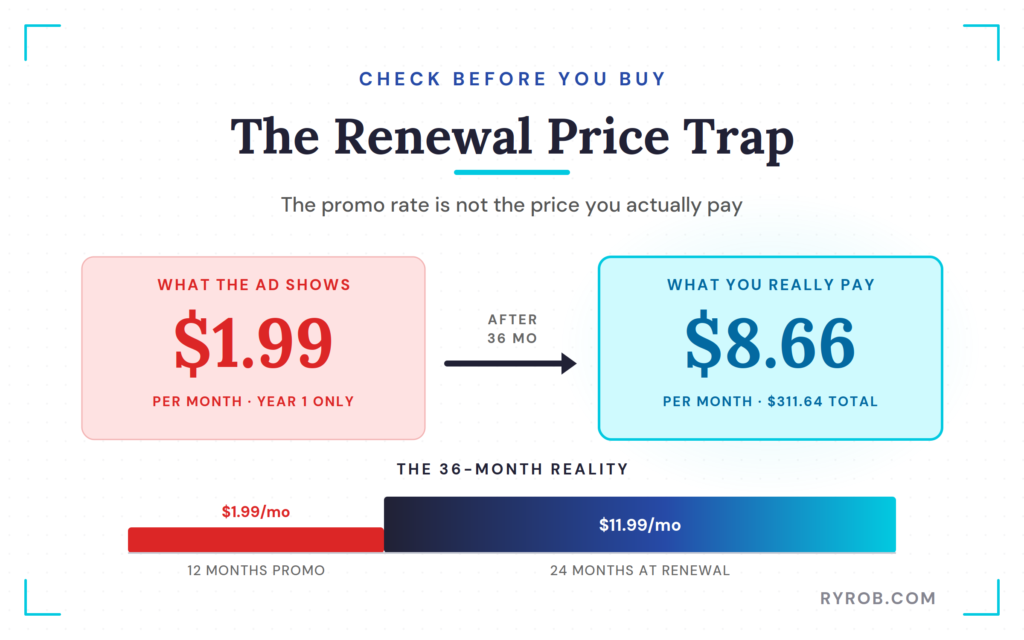
The practical move is to compare the full cost of ownership, not only the first term. If the host offers a longer intro period and the upfront payment fits your budget, locking in that lower rate for a longer stretch can save real money.
While you are on that checkout page, do two more quick checks. Confirm the plan includes free SSL certificates (essential for security and trust, and a must if you plan to run e-commerce stores), and look for a money-back guarantee, which is a helpful safety net if the host does not work out. If a store is on your roadmap, it is also worth glancing at what other security features the host bundles in.
The 5 Best Shared Hosting Providers Compared for 2026
Most shoppers researching the best shared hosting end up comparing the same names. Bluehost, DreamHost, SiteGround, Hostinger, and HostGator come up again and again. When you compare these services, it is helpful to look for extras like easy website migration tools to move your existing content without downtime.
This quick table keeps the comparison focused on practical buying decisions.
| Host | Best Fit | Main Strength | Main Limitation |
|---|---|---|---|
| Bluehost | First-time WordPress users, bloggers, and small business owners | Strong WordPress integration, easy setup, solid customer support, good intro value | Renewal pricing rises unless you lock in a longer term |
| DreamHost | Shoppers who want flexibility and good support | Clear month-to-month shared hosting option, strong support reputation | Doesn’t beat Bluehost here on beginner WordPress onboarding |
| SiteGround | Buyers who care most about speed and don’t mind paying more | Exceptional site performance and strong support in hands-on testing | Higher pricing, especially after renewal |
| Hostinger | Budget shoppers comparing low-cost options | Popular value-focused alternative in third-party testing | No clear WordPress beginner advantage over Bluehost in this comparison |
| HostGator | Buyers reviewing the usual shared hosting shortlist | Familiar name in shared hosting | No category win called out here over the top picks |
The table covers the field at a glance, but here is how the picks shake out in practice.
DreamHost earns its place for flexibility, with a clear month-to-month shared hosting option that helps if you do not want to commit to a long term right away. SiteGround often leads on raw site performance in hands-on testing, so if speed is your top priority and you are willing to pay more, it is a strong option.
Hostinger keeps showing up because price-conscious buyers keep comparing it, and third-party testing from CNET’s hosting roundup highlights the value pricing behind that reputation. HostGator is the familiar budget name of the group, dependable enough as an entry option, though it does not pull ahead on speed, support, or WordPress setup.
Each of these can be the right call depending on what you weigh most: speed, flexibility, price, or ease of setup.
Why Bluehost Is My Pick for Best Shared Hosting
Bluehost does not win in every single category. That’s not the point.
It wins the overall beginner package, which is what matters most for a first site. The setup is easy, the WordPress integration is strong, the customer support is reliable, and the entry price is attractive, especially since you often get a free domain included. Just make sure to go in with open eyes about renewal pricing.
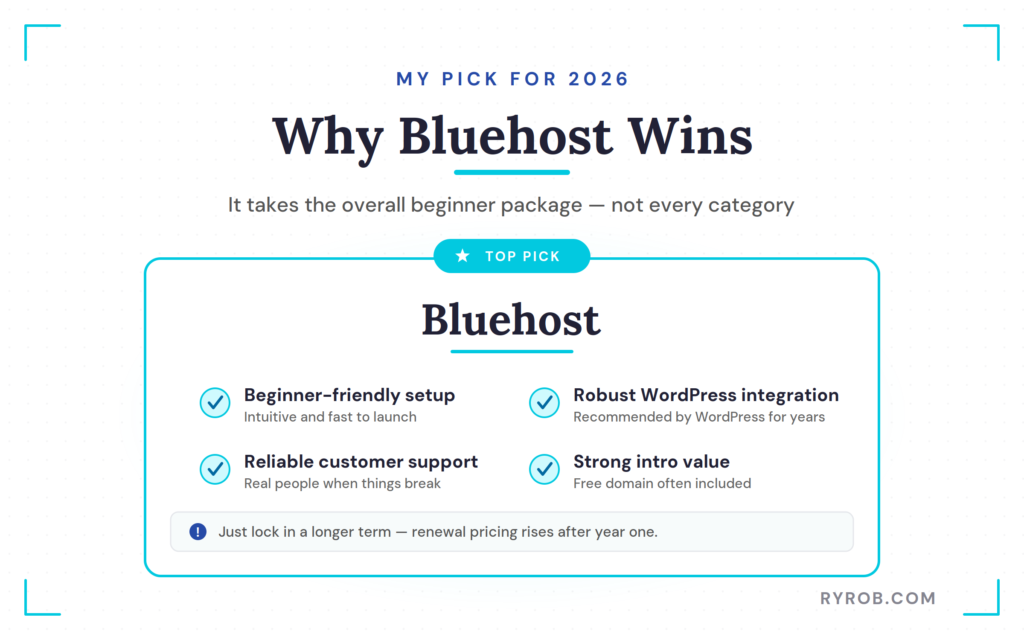
For a first WordPress blog, content site, or small business website, Bluehost is the budget-friendly shared hosting plan that makes the most sense for most people.
When to Move Beyond Shared Hosting
Shared hosting is a smart starting point, but it is not the forever plan for every site.
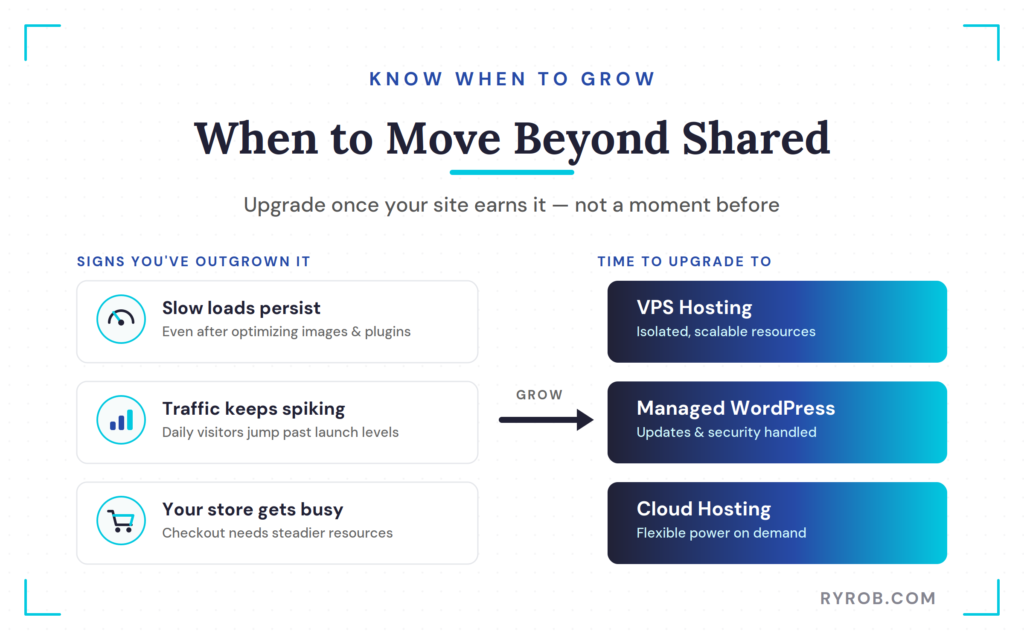
Once your traffic grows, your store gets busier, or your loading speed suffers even after you have cleaned up plugins and optimized images, you have likely outgrown the shared environment. In these cases, you are essentially asking a basic plan to handle more than it was built for, which is one of the most common WordPress hosting mistakes a growing blog can make. Frequent traffic spikes are often the primary signal that it is time to look at more robust options.
That is when a transition to VPS hosting, managed WordPress hosting, or cloud hosting starts to make sense. These solutions provide more predictable resources, better performance under heavy load, and fewer neighbor-related slowdowns.
The upgrade path matters because growth changes the math. Paying more for hosting is easy to justify when the site already brings in enough traffic, leads, or sales to support the investment. Ryan’s guide to managed WordPress hosting plans is a perfect next stop if your current plan feels cramped or limited.
For most new bloggers and small business owners, however, that step comes later. Starting with the best shared hosting providers and upgrading only when your site earns it remains the most practical move.
FAQs About Best Shared Hosting
Still have questions? Here are some common ones about choosing the best shared hosting.
Is Shared Hosting Good Enough for a New WordPress Site?
Yes, for most users it is. If you are launching your first blog, portfolio, or small business website, shared hosting provides the most cost-effective way to get online quickly.
Most providers include essential security features like free SSL certificates to keep your site safe, and you can easily upgrade to more powerful plans if your traffic grows or performance requirements change.
What Makes Bluehost the Best Shared Hosting Pick Here?
The primary reason is its balance of features. Bluehost offers a beginner-friendly setup, seamless WordPress integration, and highly reliable customer support.
While renewal rates increase over time, the provider excels at helping new site owners launch without unnecessary friction. The intuitive control panel makes managing your domain and files straightforward, even if you have no technical experience.
Should You Avoid Monthly Hosting Plans?
Not necessarily. Monthly hosting plans offer flexibility if you are testing an idea before making a long-term commitment. However, keep in mind that the lowest advertised prices are almost always tied to longer billing terms.
If you are committed to building your site, locking in a multi-year rate is the most effective way to save money on your hosting expenses.
What Extra Features Should I Look For in a Hosting Plan?
When comparing the best shared hosting options, look for value-added tools that simplify site management. Many hosts now include free automated backups to protect your data and prevent accidental loss.
Additionally, confirm whether the plan includes professional email hosting for your domain, which helps establish your brand identity. Many providers also offer a drag-and-drop website builder, which is perfect for beginners who want to design a professional site without needing to code.
When Should You Upgrade From Shared Hosting?
You should upgrade your plan when your site has clearly outgrown the shared environment. Common signs include consistent slow load times, a significant increase in daily visitors, or the need for resources to support a busy online store.
If your site continues to underperform even after you have implemented basic optimization, it is likely time to transition to a more robust solution, such as VPS or managed hosting.
Final Thoughts on Best Shared Hosting
The best shared hosting plan for a new site is not necessarily the one with the flashiest promo banner. Instead, it is the service that keeps your site online, handles a standard WordPress setup efficiently, provides responsive support, and remains transparent about costs.
Before you finalize your decision, always verify the renewal price so you are not caught off guard when your initial term ends. It is also wise to choose a provider that offers a reliable money-back guarantee, giving you peace of mind as you get started. If you are looking for an especially simple setup, opting for a host that includes an intuitive website builder can be a significant advantage for beginners.
For most first-time site owners in 2026, Bluehost remains a top choice because it covers these core essentials and streamlines the launch process. By keeping these factors in mind, you can select the best shared hosting solution to get your site live without wasting your budget.
Get Reliable Shared Hosting with Bluehost
Everything a first site needs, none of the headaches. The Bluehost Starter plan gives you reliable uptime, one-click WordPress, and around-the-clock support, all at an intro price that’s honestly hard to beat.
