

AI prompt tracking has exploded as one of the biggest trends in AI SEO. Put simply, AI prompt tracking is the systematic monitoring of how your brand, name, or company shows up across all the major generative AI platforms (like ChatGPT, Gemini, Perplexity, Claude, and in Google’s AI Overviews).
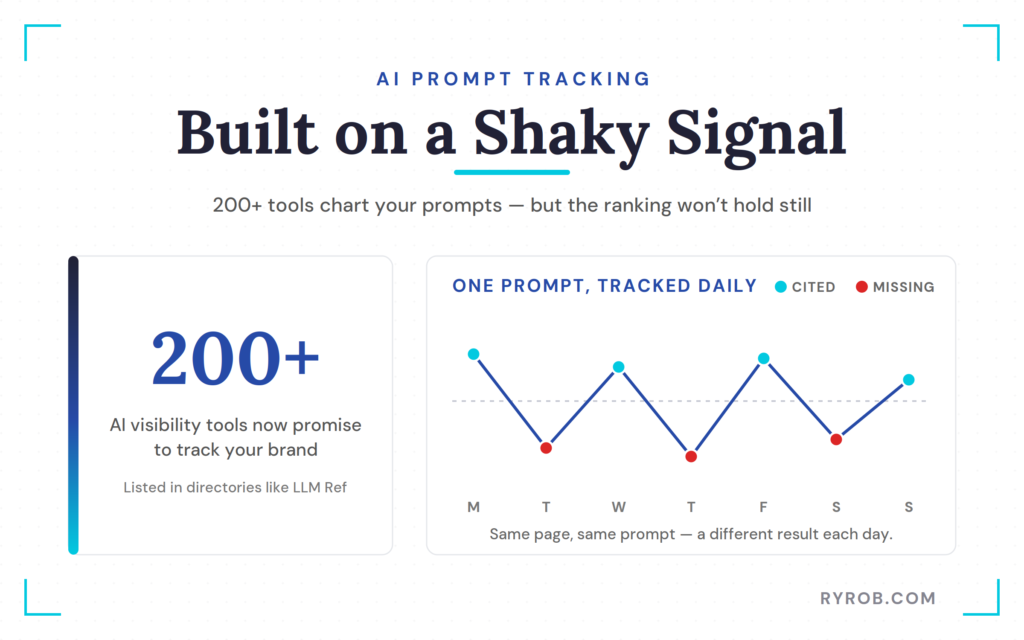
Now in 2026, more than 200+ AI visibility tools promise to help you track your brand’s visibility across all the top LLMs.
The idea of AI prompt tracking sounds simple: Monitor prompts, watch citations, and react faster than your competitors. On paper, it feels like an easy way to measure success in today’s leading AI search engines, but the data is often much harder to act on than it appears.
Prompt-level rankings are noisy, unstable, and rarely reflect the work that actually improves long-term AI visibility. Instead of making tracking your strategy, focus on creating content worth citing and use monitoring as an occasional check-in. Here’s my full guide to taking action on your AI prompt tracking, to turn these tool insights into an actionable GEO strategy:
Key Takeaways for AI Prompt Tracking (and Taking Action)
- Rankings for unbranded prompts are highly volatile, meaning they change too often to drive day-to-day decisions regarding your overall AI visibility.
- The best answer engine optimization work still starts with strong content that is clear, complete, and easy for AI systems to cite.
- Mentions on other trusted sites matter because AI models trust outside proof more than your own claims.
- Monitoring has value, but it should stay a small part of your budget and workflow.
Why AI Prompt Tracking Isn’t a Real GEO Strategy
The rise of Generative Engine Optimization (GEO), also called Answer Engine Optimization (AEO), has created a familiar pattern. A new traffic source appears, marketers want a dashboard, and software companies rush to build one.
That is exactly what happened with AI search. Over the last year and a half, directories like LLM Ref have listed more than 200 AI visibility tools. Most promise the same thing: track your brand mentions across models, see where you appear for important prompts, and watch your rank over time.
Why AI Prompt Tracking Tools Became So Popular
The appeal makes sense. SEO teams have spent years living inside Search Console, rank trackers, and reporting tools. When GEO started shaping how people discover information, the natural reaction was simple: “We need the AI version of rank tracking.”
So the smart market delivered it in the form of AI prompt tracking tools.
Now you can buy dashboards that watch performance across Google AI Overviews, ChatGPT, Gemini, Claude, and Perplexity. Some even try to show the search queries those systems appear to use under the hood. On the surface, that feels like progress because it turns a messy channel into neat charts.
The problem is that neat charts do not always reflect a stable system. Traditional search rankings have plenty of volatility, but they still behave more consistently than Large Language Model (LLM) outputs. That difference matters more than most sales pages admit.
What Makes LLM Results So Noisy
AI answers are non-deterministic. It means the same prompt can produce different answers across repeated runs.
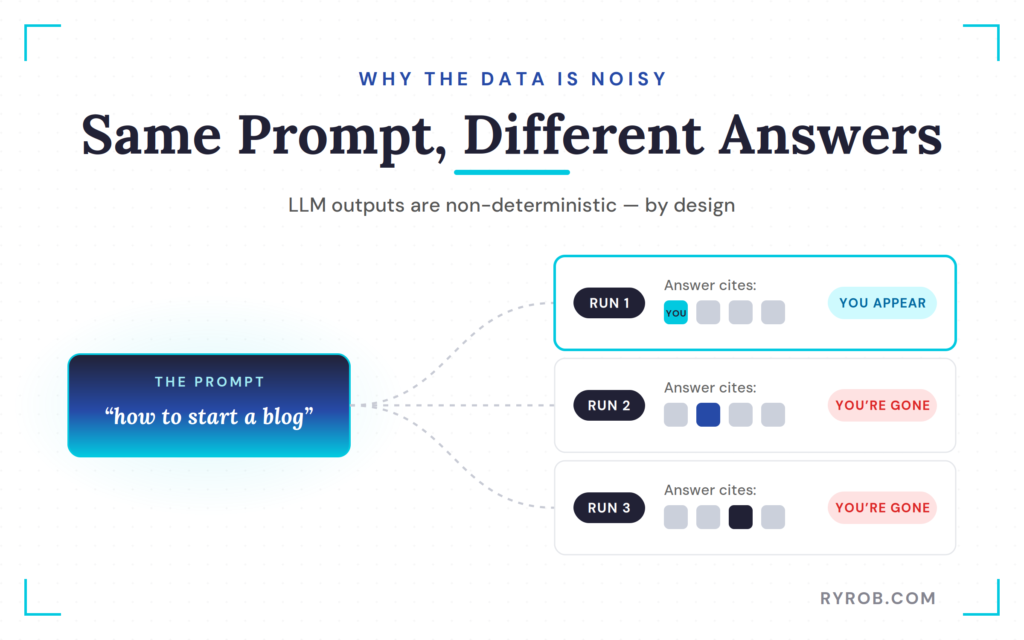
Ask one model “how to start a blog” twice, and you may get different brands, different cited pages, and different wording. The response can also change based on:
- Time of day
- Region
- Conversation history
- Model updates
That is not a minor quirk. It’s built into how these systems work.
If you want the technical version, Thinking Machines Lab has a useful technical guide to nondeterminism in LLM inference. The short version is enough for most marketers: many variables shape the answer, and you do not control most of them.
Because of that, daily AI prompt tracking charts can bounce around even when your site has not changed. One day you appear in an answer. The next day you do not. That swing does not always mean your content improved or got worse.
Why Tracking Signals Can Mislead Your Strategy
A prompt dashboard can tell you that you disappeared from an answer. It usually cannot tell you why.
Your page might have been too thin, or another source may have covered the topic better. The model could also choose a different set of citations because the surrounding context changed. Sometimes, nothing meaningful happened at all.
That is why AI prompt tracking often pulls teams toward symptoms instead of causes. It encourages teams to obsess over conversational queries rather than improving the foundational assets that deserve to be cited.
If a tool tells you where you disappeared but not why, it won’t help you decide what to fix next.
Tracking still has a place. A baseline snapshot is useful. A periodic check-in can confirm whether your work is moving in the right direction. Trouble starts when prompt tracking becomes the strategy instead of the scorecard.
The AEO Priorities Pyramid: A Better Way to Spend Your Time
A much better way to think about AI visibility is to rank your effort by what actually changes outcomes. If you want to improve your AI visibility, you need a framework that prioritizes substance over vanity metrics.
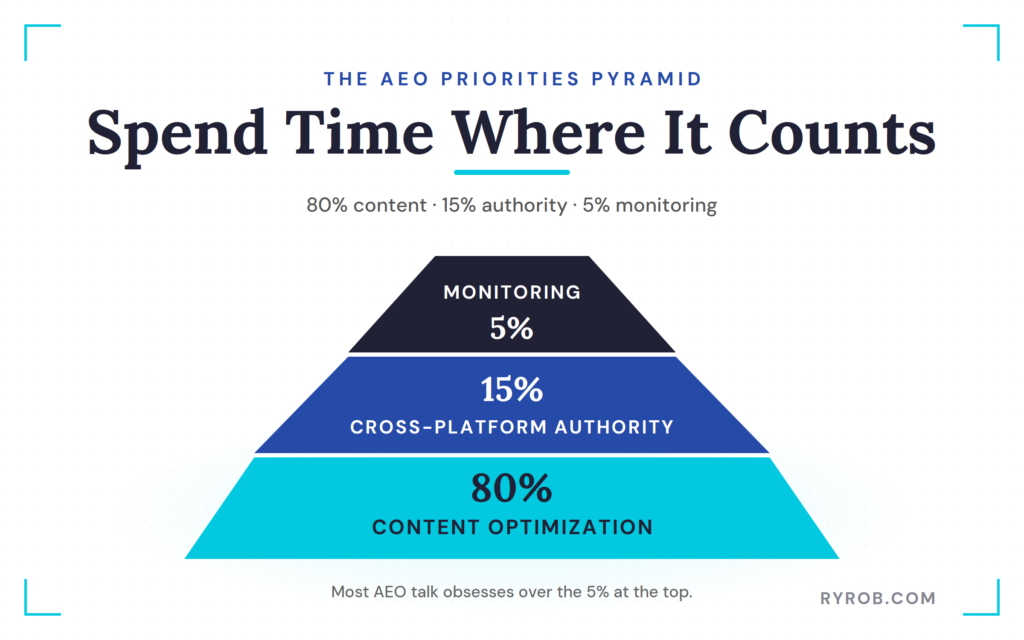
The simplest version looks like this: 80% content optimization, 15% cross-platform authority, and 5% monitoring. Most conversations about AEO focus on the tiny slice at the top, while the real work happens at the bottom.
The Foundation: Content Optimization (80%)
Most of your effort belongs here because AI systems cite content that is useful, structured well, and grounded in facts. These systems are looking for pages that answer a question clearly and cover the topic with enough depth to build trust.
This approach aligns with the core principles of search. Strong pages still win because they help the reader. To succeed, you should perform a manual audit to identify content gaps and organize your work into logical topic clusters.
By doing this, you ensure your site provides comprehensive answers. If your site wants to appear for beginner queries, one excellent page is more valuable than ten shallow ones. A solid step-by-step guide to starting a blog has a far better shot at being cited than a page that only brushes the surface.
The same goes for supporting pages that cover related questions, like how to start a blog for free.
This is where content optimization tools matter more than monitoring tools. A good optimizer helps you identify what is missing, fix muddy structures, or ensure your answer addresses the core question early. Additionally, using structured data helps foundation models parse your content more efficiently, making it easier for them to extract the specific answers they need.
The Middle Layer: Cross-Platform Authority (15%)
Once your content is worth citing, you need other places on the web to back it up.
AI models trust outside proof more than claims you make about yourself. If your site says you are an expert, that helps a little. If trusted citation sources quote you, compare you, review you, or mention your work, that carries more weight.
That can include:
- Guest appearances on podcasts
- Expert quotes in industry articles
- Mentions in editorial roundups
- Comparison pages
- Customer reviews
- Relevant industry profiles
Your business name, your role, and your topic area should match wherever people and machines find you.
This layer is smaller than content optimization because it works best after your pages are already strong. Still, it often becomes the multiplier that pushes a site into more AI answers. Good content buried on an island stays buried, while good content backed by credible mentions gets easier to trust.
Search has always moved in this direction. AI systems are pushing it further because they are built to synthesize signals across many sources, not just your website.
The Top Layer: Monitoring (5%)
Monitoring belongs at the top because it helps with feedback, not growth.
A baseline audit is smart. Checking your visibility after a round of content updates is smart. Watching whether your citation share on a few important prompts goes up or down over time can be useful, too.
The mistake is turning that into a daily ritual.
If you are staring at charts for 200 prompts across four models every morning, you are probably spending time on noise. The underlying responses move too often on their own. That makes it hard to separate a real win from ordinary variation.
A simpler routine works better:
- Start with a baseline.
- Improve weak pages and expand topical coverage.
- Build authority outside your website.
- Check whether visibility improves over time.
Do not expect perfect stability. Look for direction instead.
A monthly review can make sense for fast-moving teams. For most sites, quarterly is enough. The goal is to confirm that your content and authority work are paying off, not to react to every wobble in the chart.
What to Do Instead of Obsessing Over AI Prompt Tracking
The replacement for dashboard obsession is not less discipline. It is better focus.
Instead of asking, “Where did my citation move today?” ask, “What would make this page easier to trust and cite?” That question leads to work you can publish, test, and improve.
Monitoring Tools vs. Optimization Tools
The split between these tools matters because they do different jobs.
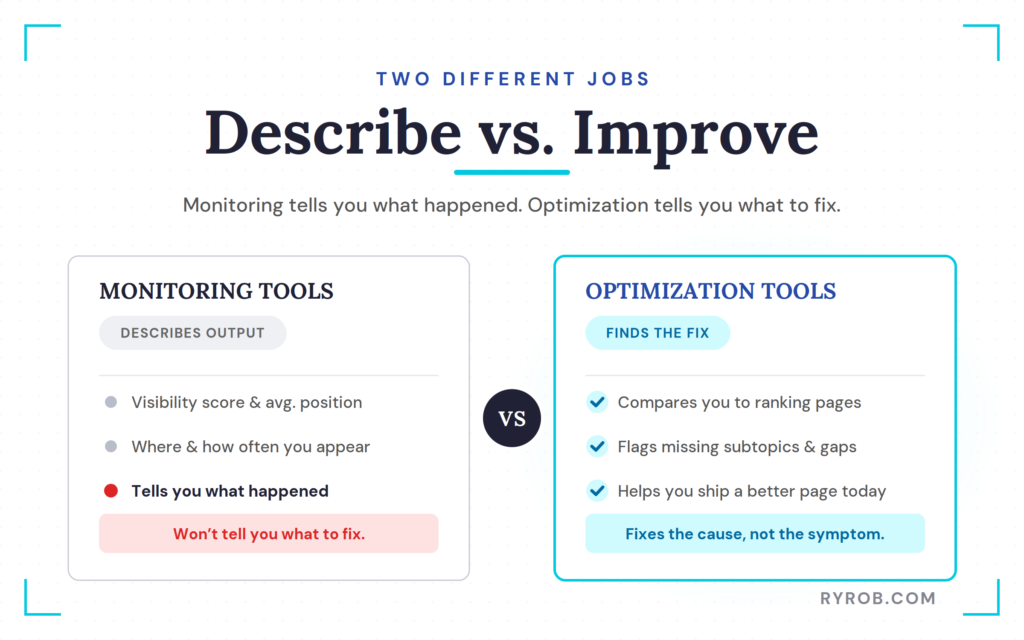
Monitoring tools describe the output. They track your visibility score and average position, showing you where you appear and how often your brand is cited. While this AI prompt tracking can be useful for occasional snapshots, it stops there. It tells you what is happening, but not how to fix it.
Optimization tools work closer to the cause. They compare your content with the pages already earning attention. They help you improve your competitor visibility by flagging missing subtopics, weak structure, or poor alignment with the user intent.
Whether you are targeting unbranded prompts to build awareness, informational prompts to educate, or comparative prompts to influence a final brand evaluation, optimization tools help you capture users at every stage of the buyer journey.
Both categories have a use. Only one category helps you ship a better page today.
Use Content Optimization Tools to Find the Real Gaps
When a page is not showing up in AI answers, start with the content itself.
Look at whether the page answers the main question early. Check whether it covers the supporting questions a reader would expect next. Make sure the headings are clear, the claims are factual, and the page is not forcing the user to dig through fluff before getting help.
This matters even more for topics with broad intent. If someone asks how to start a blog, the strongest pages do not stop at a definition. They explain platform choice, hosting, naming, setup, publishing, and early promotion because that is what a real beginner needs.
AI systems tend to reward that kind of completeness because it gives them better source material. When your content is thin, no amount of monitoring will solve the root problem.
Build Authority Outside Your Own Website
After your core pages are strong, widen the trail of proof.
That can include:
- Pitching expert quotes to publications
- Appearing on podcasts
- Earning mentions in comparison posts
- Getting featured in editorial roundups
- Asking happy customers for reviews
Also, clean up the basics. Keep your name, company details, expertise, and positioning consistent across profiles and mentions. Mixed signals make it harder for AI systems to connect the dots.
This work can feel slower than watching a dashboard. It is still more useful because it gives models stronger evidence to trust when they decide which sources to surface.
Treat Tracking as a Monthly or Quarterly Health Check
Tracking works best when it stays light.
Start with a baseline. Then spend time updating weak pages, expanding topical coverage, and building outside mentions. After that, come back and check whether visibility improved across a small set of prompts that matter.
Do not expect perfect stability. Look for direction instead.
A monthly review can make sense for fast-moving teams. For most sites, quarterly is enough. The goal is to confirm that your content and authority work are paying off, not to react to every wobble in the chart.
How I’d Spend $500 on AI Visibility Right Now
A budget forces clarity. If you only have a few hundred dollars a month, where that money goes matters.
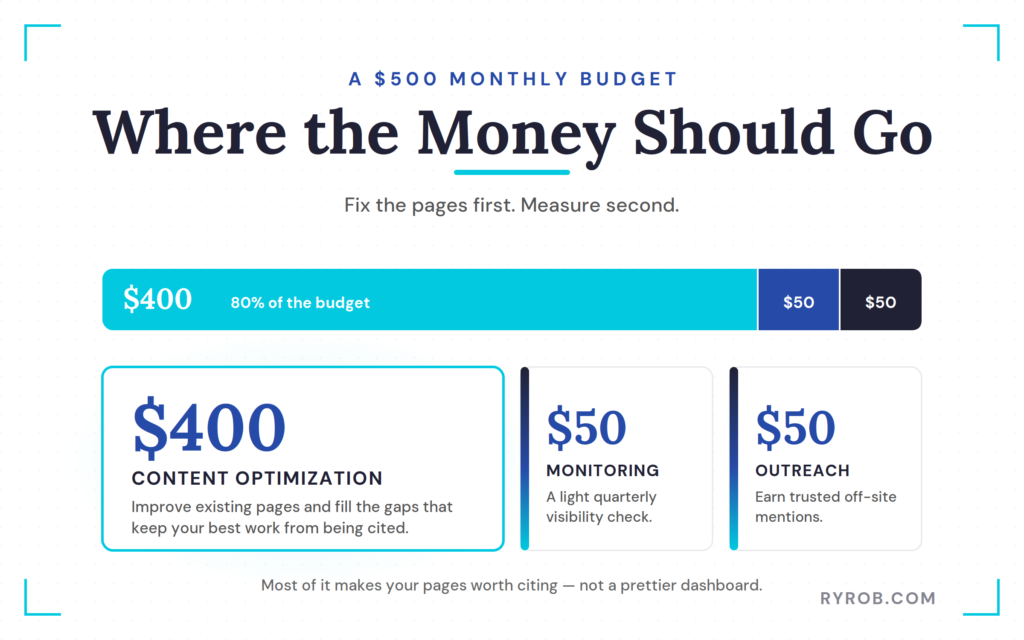
For most sites, the answer is straightforward:
- $400: Content optimization
- $50: AI visibility monitoring
- $50: Outreach and third-party mentions
Put Most of the Budget Into Content Improvements
I’d put $400 into a content optimization tool or workflow that helps improve existing pages and identify missing topics worth publishing.
That money should make your site more citable. It should help you spot thin pages, weak structure, shallow topical coverage, and content gaps that prevent your best pages from competing effectively.
Spending heavily on prompt dashboards before fixing your pages is backwards. If the page is not good enough to cite, a nicer chart will not change the outcome for your AI visibility.
Reserve a Small Slice for AI Visibility Monitoring
I would keep $50 for visibility checks.
That could be a simple automated report, a manual audit, or a lightweight tool that gives you a quarterly view of your performance on a small set of important prompts. The exact method matters less than the restraint.
Use it to measure progress after improvements go live, but do not use it as your main activity.
Use the Rest for Outreach and Mentions
The last $50 would go toward outreach overhead.
That might help with software for pitching expert quotes, finding podcast opportunities, organizing citation targets, or supporting customer review requests. The point is to create more trusted brand mentions outside your own site, which serve as signals for AI search engines to recognize your expertise.
A small budget can still go far here because you are not trying to buy attention. You are trying to create more places where your expertise shows up in a credible way.
FAQs About AI Prompt Tracking
Here are a few of the most frequently asked questions I get about AI prompt tracking.
Is AI Prompt Tracking Ever Useful?
Yes, AI prompt tracking is useful when used in moderation.
It is helpful for a baseline audit and periodic check-ins as part of your broader AI visibility strategy. AI prompt tracking becomes a problem only when you treat volatile data as the primary driver for your content decisions, so use it to spot trends rather than relying on it for daily tactical adjustments.
Why Do AI Answers Change So Much for the Same Prompt?
AI answers change because large language models are non-deterministic.
They do not behave like a static search engine results page. Instead, they vary based on model version, prior context, user location, and other factors.
A recent research paper detailing deterministic LLM settings found that even with specific configurations, repeat responses can vary significantly. That is why prompt level rank reports often produce noisy data that does not reflect how users actually interact with conversational queries.
How Often Should You Check AI Visibility?
Most websites only need to check AI visibility quarterly.
Checking your average position daily is often a trap that leads to overreacting to minor fluctuations. Teams using automated prompt templates to scale content might prefer monthly checks, but even then, the reports should remain lightweight to avoid analysis paralysis.
What Matters More Than AI Rank Reports?
High quality content, clear structural hierarchy, and topic depth matter more than AI rank reports.
Earning legitimate brand mentions and diversifying your citation sources are also essential for building authority. These are the primary inputs that give AI search engines a reason to reference your site.
Rank reports are merely lagging indicators. The information provided by AI search engines is ultimately governed by the quality of natural language patterns in your content.
Do Most Sites Need a Dedicated AEO Dashboard?
No, most sites do not need a dedicated AEO dashboard.
For the average content site, the biggest gains come from strengthening existing pages and increasing external digital proof. While a dedicated dashboard might help large enterprises with many stakeholders, most sites overspend on measurement before the foundational elements are in place.
Focus on the basics before investing in complex tracking tools.
Final Thoughts on AI Prompt Tracking
The rush into various tools has made measurement feel like progress. However, for most sites, real growth still comes from better content and stronger proof across the web. While many marketers get bogged down in AI prompt tracking, your focus should remain on building a foundation that these systems can actually trust.
When your pages answer complex questions with clarity, and other trusted sources validate your expertise, you provide the data that Google AI Overviews and other AI search engines need to cite you reliably.
The most effective strategy is to craft content using natural language that appeals to both human readers and machine algorithms. Once you prioritize this quality, a light audit every month or quarter is more than enough to determine if your AI visibility strategy is paying off.
Spend less time watching prompt charts move around. Spend more time publishing pages and mentions that deserve to show up.

Hi Ryan, I was so happy to hear that Bing now provides a lot of those in their Webmaster Tools. However, they do change quite often, so I’m glad I didn’t keep any of those expensive tools to track them.
I’m sure Google will be releasing something too after Bing has.
Thanks for sharing how you would use your budget for other things like outreach and 3rd party mentions, something I need to do more of.