

Whether you run a blog that’s B2B or B2C, write about healthcare or horse grooming, have a hundred readers or millions, and have been blogging for twenty years or two days, there’s one thing all successful content creators share in common… an SEO content strategy.
My SEO content strategy (which we’re breaking down here today) is responsible for bringing more than 859,960+ unique visitors to my blog in the last 30 days alone:

SEO may not be the lifeblood of your business if you have other acquisition channels, but it’s impossible to ignore that an estimated 5 trillion searches happen on Google every year — roughly 14 billion per day (Google’s last official figure dates to 2016, so current numbers are third-party estimates). SEO still represents an incredible traffic opportunity. People who come from search engines like Google (for the right queries) are still some of the best, most highly qualified leads for business owners today.
Despite what many think, SEO is not dead in the age of AI—but it has evolved. What remains true, is that deep down, we’re all just content marketers, standing in front of our audience, asking them to love us… errrrrr or at least trust us, and eventually buy from us.
But, how successful we are with our SEO content strategy, depends on much more than just great content.
A few technical improvements to your content (SEO) can significantly affect:
- Whether and how high up your content appears on Search Engine Result Pages (SERPs)
- Who sees it and how many of those people actually click through to read your content
Sounds like a pretty big deal to nail this SEO content strategy thing, doesn’t it? That’s exactly what we’re covering in this guide, but first…
What is a Search Engine Optimization (SEO) Content Strategy?
🔑 An SEO content strategy is a step-by-step system for creating content and getting it to rank high in organic Google search results, for your target audience’s key pain points. A successful SEO content strategy will have your content appearing on page 1 for many things your audience searches for online. This helps you drive targeted traffic back to your site, and fuels your related business growth.
Search engines like Google don’t just trust any ol’ website to recommend to their users, it’s a complex system that makes determinations behind the scenes.
They rely on a number of ever-changing ranking factors to determine worthiness, and if your website (or content) falls short, you’ll be as good as invisible. That makes getting this equation right, pretty important.
It’s crucial to optimize your content, so that it can (hopefully) make its way to the first page of search results, where it stands a fighting chance of being clicked on, read, and has the opportunity to build a long-term relationship with your new potential audience.
Create Automated SEO Blog Posts in Minutes with RightBlogger
Join 45,417+ bloggers, marketers, writers & business owners in using RightBlogger, my very own Autoblogging solution with a built-in automated Content Schedule, and a kit of 80+ powerful tools for blogging, SEO, and marketing. You’ll create AI SEO-optimized content faster & get more traffic from Google and ChatGPT today. Plus, you’ll access online courses, a community, and more.
Why You Need an AI-Enabled SEO Content Strategy in 2026
The bigger reason to modernize your strategy in 2026 is that search itself has changed. In SparkToro’s 2026 analysis of Similarweb clickstream data, 68.01% of U.S. Google searches ended without a click in the first four months of the year — up from 60.45% in 2024, the steepest two-year jump SparkToro has ever measured. A big driver is Google’s own AI Overviews, which now answer a meaningful share of queries right inside the results page. The takeaway: ranking still matters, but how you create and structure content has to account for AI search, not just the ten blue links. We’ll cover exactly how in Step 9.
You can do SEO without AI, but considering that AI tools can help every step of the way—from keyword research and topic mapping to content creation and editing—cutting them out of your SEO content strategy altogether goes beyond protectionist, and into archaic territory. Like insisting on using rocks & twigs to start a fire when you have a flamethrower in your pocket.
Nobody’s asking you to put AI in the driver’s seat for SEO and let it churn out piece after piece of uninspired, cookie-cutter content. Trust me, that ain’t it either. But I’ve been using AI to rank my content and drive significant SEO traffic for almost two years now…

What we’re talking about here is AI-enabled SEO research and content planning. Where you set the goals and design the deliverables, and AI just helps you deliver them with more ease and efficiency.
The other commonly cited rebuttal is that these tools can negatively impact your ranking, but to the powers that be (read: Google), the use of AI isn’t a dealbreaker, only its poor use is.
So if you want to get your content to rank higher, faster, here’s a guide explaining the steps to create an SEO content strategy—with AI.
My Step-by-Step Guide to Creating an SEO Content Strategy Using AI
Uncomplicate SEO by following these steps—you’ll walk away from this guide with an SEO content strategy that’s ready to be implemented.
1. Set Your SEO Goals
Before you lace up your boots and head out into the vast wilderness that is SEO these days, you’ll need to set some expectations for your SEO strategy. You can’t get to where you wanna go, if you don’t take the time to clearly define that destination.

Here are a few starter SEO goals I recommend considering (as they support your greater business goals):
- To increase organic traffic by 3x by the end of the quarter
- A conversion rate higher than last year
- To rank in the first 10 results for your 50 most important keyword phrases
From the get-go, be clear about what you expect to achieve. That way, you won’t get caught up in chasing vanity metrics.
Because an uptick in traffic, however massive, means little if it’s not from your target audience or it doesn’t convert well.
Create killer content that matches search intent to attract more of your ICPs (ideal customer profile) and drive real revenue from the people you bring to your site. That’s the point, right?
Depending on your goals, assess factors like your:
- Previous rankings
- Traffic patterns
- Conversion rates
Then, you can use SEO forecasting tools (like Exploding Topics) to set achievable targets for growing your most important metrics, moving forward.
For example, if you want to increase organic share of voice, use a tool that lets you analyze competitor performance (more on that later). Then use Google Search Console to track your overall website rank or for specific keywords. Or check your competitor’s and your domain authority on a platform like Moz.
This kind of knowledge empowers you to set realistic, time-bound targets to bridge the gap.
2. Do Smart Keyword Research
Keywords might not generate the frenzy they did once upon a time (remember reading random keywords jammed in the middle of sentences like fruit loops in baklava?), but they’re still widely considered important enough to be the first step of drafting any SEO content.
Let’s say we wanted to plan an article for the Hunter blog, as part of their SEO content strategy. One of their main offerings is an email finder, so we’ll input that as a short-tail keyword in the Keyword Tool and see what it generates.

We found a keyword phrase early on, but if you don’t, toggle the filters till you find one with decent search volume, low to medium competition, and a neat cost per click.

The next step in keyword research is to create a cluster of long-tail keywords centered around our short-tail keywords. We can use these in the same article to rank for multiple search queries, or use them as topic inspiration for new content, but topic clustering signals site authority to search engines.
Match every keyword to its search intent. Before you write a single word, tag each target keyword by the type of intent behind it, because that determines the format your content needs to take:
- Informational (“how to do keyword research”) — wants a guide, tutorial, or explainer.
- Commercial (“best email finder tools”) — wants a comparison, listicle, or review to evaluate options.
- Transactional (“Hunter pricing,” “buy X”) — wants a product, pricing, or signup page.
- Navigational (“Hunter login”) — wants a specific page or brand.
Build clusters around a pillar page (your in-depth “hub” on a core topic) with supporting “spoke” articles that each target a related long-tail keyword and link back to the pillar. This hub-and-spoke architecture is what signals topical authority to both Google and AI search engines — and it’s the structure nearly every top-ranking content strategy uses today.
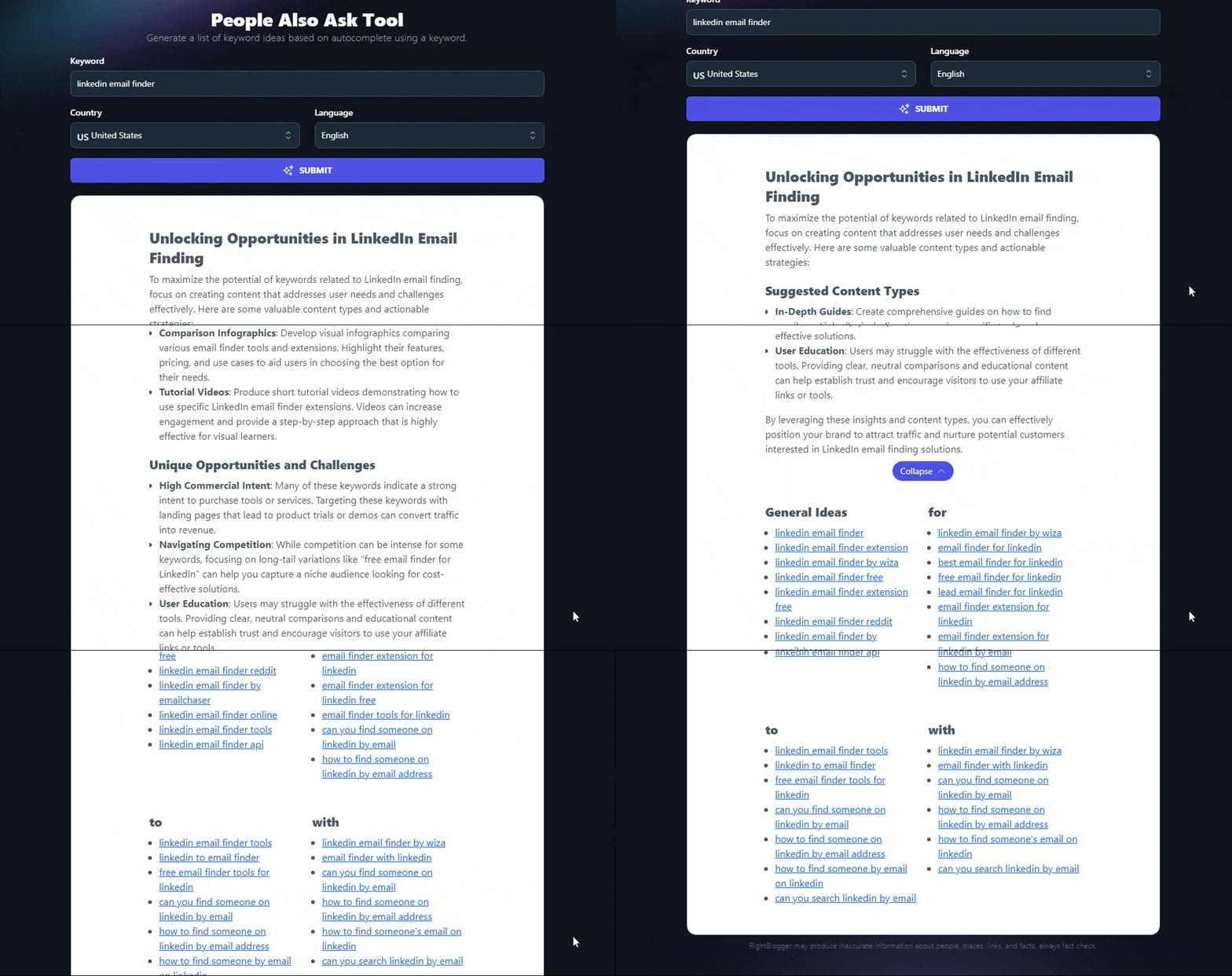
RightBlogger (the blog automation platform I co-founded) includes a full suite of SEO research and content tools. Beyond the writing and research features shown below, it also offers Site Agent for automated blog maintenance and white-label SEO reporting for agencies.
To capitalize on trends, browse through industry or trade journals, forums and social media groups.
Look up the topic’s rising popularity on Exploding Topics or Google Trends and filter by time or region to spot emerging trends.
3. Analyze Your Competition
SEO’s been cutthroat for a while now, but ever since AI snippets happened, competition has intensified for citations and the top three spots.
Apart from basic website ranking comparison (that we discussed above), backlink profiles can provide important glimpses into your competitors’ most traffic-generating blog posts.
You can use this free backlink checker or, to get a more comprehensive report on competitor backlinks, the paid version of the tool over on RightBlogger.
For competitive analysis, RightBlogger has another ace up its sleeve — the Content Gap tool.
Note: This is different from Ahref’s Content Gap Analysis tool which tells you which topics are covered by your competitor, but not you. Right blogger’s Content Gap tool provides an in-depth analysis of two versions of a specific piece of content — yours and the competition’s.
Manually, that takes hours, but we compared a Hunter blog article on email authentication with one of the top three results on Google in ten seconds.

One of the first changes suggested is the inclusion of a 2024 policy update from Google and Yahoo.

Hunter’s article was written in 2023, and this small revision could make it more competitive.
The other suggestions also come in the form of actionable advice, something most other tools wouldn’t offer.

4. Create High-Quality Content for Your Target Audience
SEO is commonly misunderstood to take away from the quality of content. But when done right, it refines, enriches, and highlights the best parts so that search engines spot it.
Even human reviewers at Google assess content quality using the E-E-A-T framework (Experience, Expertise, Authoritativeness, and Trustworthiness).
AI writing tools like RightBlogger, SEMRush, and Ahrefs can help you create SEO-optimized blog posts that meet these four parameters.
For this example, I gave my AI Article Writer inside RightBlogger a spin, and the level of customization really helps me dial in a stellar first draft SEO blog post:

Start by deciding these key features of your content piece:
- Topic
- Tone
- Article length
- Primary keyword
- Target audience
Once you’ve loaded those details into the tool, you’ll be presented with an SEO outline and then, a fully baked first draft article.
We’d still need to add our insights and opinions to the piece, along with a few structural edits here and there, but the advanced prep reduced the turnaround time for SEO content to just an hour or two. Check out my detailed AI blogging process and this tutorial on how to write a blog post with AI for more.
Other tools from the RightBlogger line-up that deserve an honorary mention:
- Content Filler: When writing each additional word feels like wading through molasses
- Make Text Punchier: To give your content an attitude makeover
- Improve Writing: For overall flow and clarity revisions
- *personal favorite – Explain Like I’m Five: A godsend for situations where you know little about the topic you’re writing on, and you’re yet to find a guide that doesn’t make your eyes glaze over. It can also be used to rewrite complicated concepts and enhance readability.
5. Use On-Page SEO to Scale Your Content Marketing
On-page SEO simply means the optimization techniques applied to the page your content is hosted on, to get it to rank better.
These are internal, controllable improvements and include things like:
- Eye-catching titles and headlines
- Keyword phrase placement
- The overall header structure
- Readability and skimmability
- Page URL
- Meta descriptions and meta tags
- Internal links
Search engines use these factors to determine if your content matches the search intent their users have.
Most of these modifications can be made or sped up using AI. For example, an AI-drafted or updated SEO outline, with headers containing most or many search terms, can help your content rank better.
Meta title and meta description writers (like my free tools) can create click-worthy content that appears on SERPs and increases site visits.
Internal link-finder tools can find relevant linking opportunities to distribute link equity and provide context to search engines as to what your article is about.
6. Build a Content Calendar
So far, we’ve focused on the content planning and creation aspects of the SEO journey. But where the rubber really hits the road is when your articles go live.
And once you’ve started generating traffic, you don’t want to lose the momentum you’ve got going.
A content calendar keeps your SEO strategy from going off the rails.
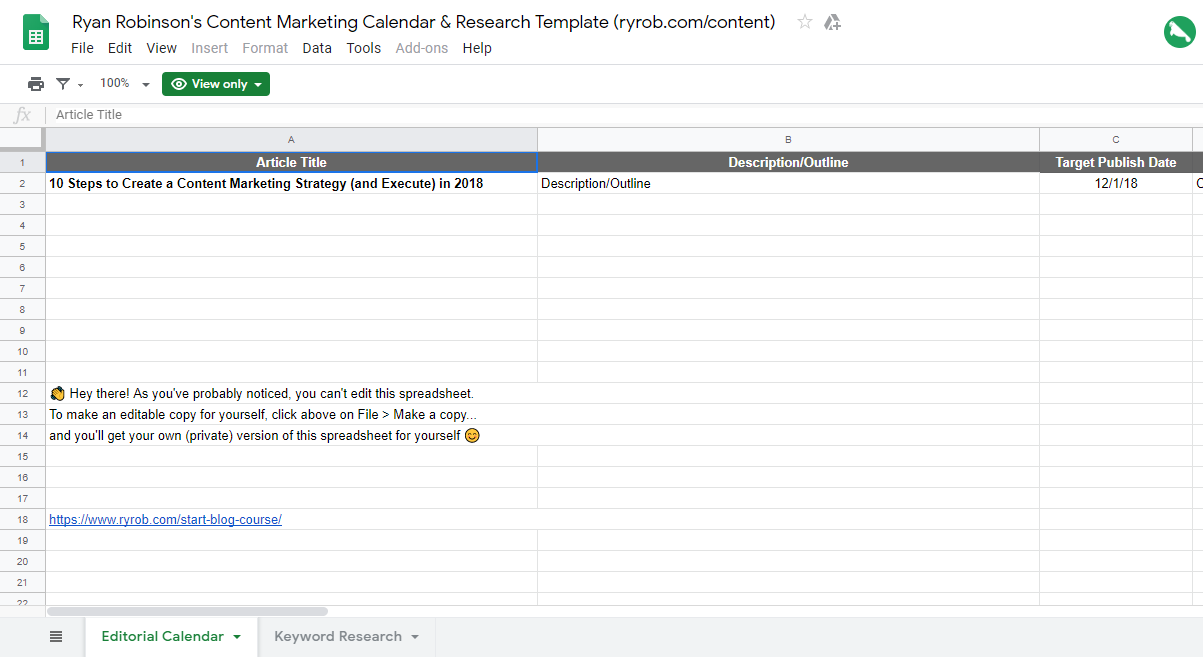
You can use it to plan keyword research sessions, create topic clusters, set deadlines for first drafts, edits, and publication, and identify gaps in your strategy.
Take advantage of a day when you’re in a creative mood and knock out the topics for the next couple of months.
If you’ve run out of ideas, my free blog post idea generator can come to your rescue:
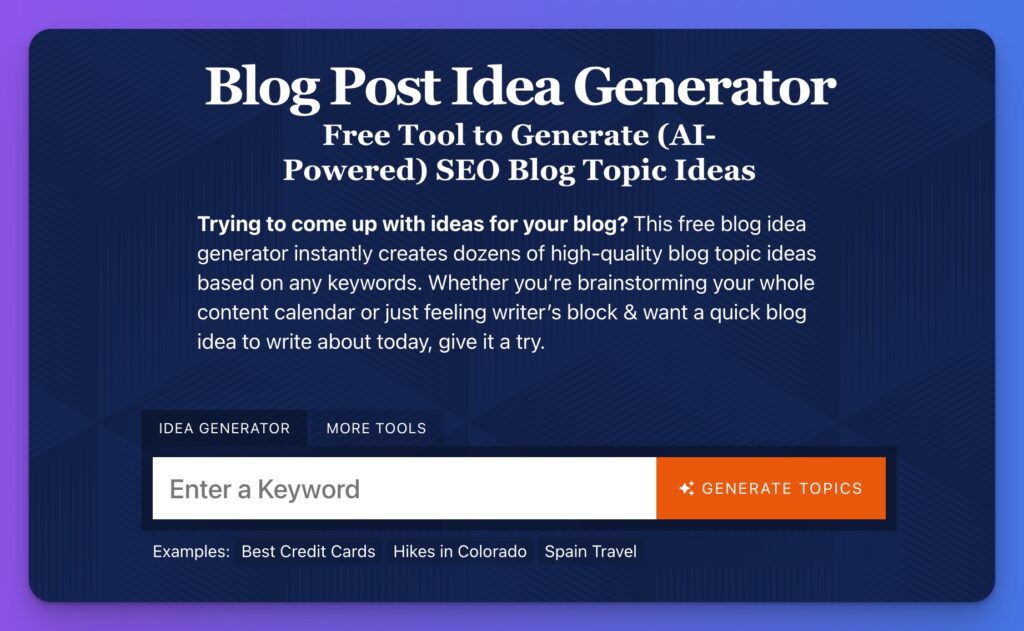
After deciding blog topics, schedule them to correspond with company announcements or generate interest in an upcoming event.
A content calendar also makes cross-channel posting and collaborations easier.
7. Amplify Results with Link Building
Off-page SEO is another key element of a strong content marketing strategy. It’s less controllable, but at least as much, if not more, rewarding.
And link building is one of the most surefire ways to get higher rankings.
Use tools to find competitor backlinks as described earlier. You can also track unlinked brand mentions with tools like Google Alerts and Ahrefs Content Explorer.
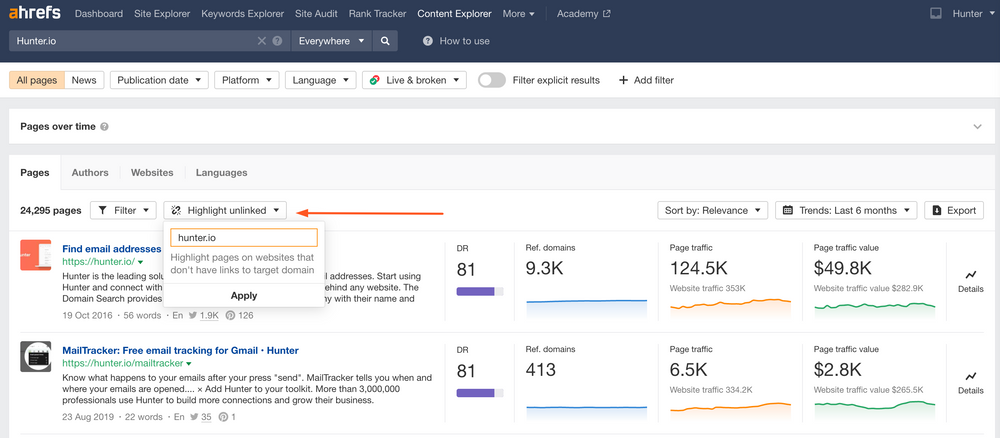
Hunter offers a directory of B2B businesses where you can apply filters to find companies in non-competing but complementary niches for partnerships.

The database includes contact information for key decision-makers, like content editors.
Compile a list of companies and their key contacts in a separate sheet for outreach. Then use Hunter’s Email Finder to get email addresses, and send personalized outreach emails to prospects.
Mention their blog, an article you liked, or potential collaboration ideas between {Company} and yours to make your message more authentic.
Of course, this process goes much faster if done through cold email automation software. Hunter Campaigns is designed for sending cold emails and allows you to create, track and manage your link building outreach.

Tip: Use the auto follow-up feature to set behavioral or time-bound triggers to maximize chances of landing a backlink.

8. Monitor Metrics to Improve Your Content Performance
To improve SEO content performance, continuously monitor these key metrics:
- Organic Traffic: How many people found your website via search engines? Traffic should ideally increase over time. Analyze the sources of traffic to improve content marketing performance.
- Reading Time: How relevant and useful did searchers find your content? Low dwell times or session duration, especially combined with high bounce rates, indicate unengaging content and a poor user experience. Improve readability with bulleted lists, visuals, infographics, or interactive elements.
- Clicks: How many users clicked on your content based on its title and meta description? Rewrite using the meta description writer to for a higher click-through rate.
- Traffic Quality: Are the people visiting your website potential customers? A low conversion rate calls for content edits to make it match search intent.
- Keyword Rankings: Are you ranking in the top results for your main keywords? If not, perform a Content Gap Analysis and, if needed, a site audit to address pain points.
- Website Ranking (Overall): Known as Domain Authority (Moz) or Domain Rating (Ahrefs), this reflects your site’s overall backlink strength — a third-party 0–100 score, not an official Google metric. Improve it with a consistent publishing schedule, quality backlinks, and a commitment to E-E-A-T content.
Other slightly less essential, yet still directionally helpful metrics to track include:
- Total monthly visitors
- Bounce rate
- Heat map
- Leads
- Conversions
- Sales
New for 2026 — track your AI search visibility, too. Rankings and clicks alone no longer tell the whole story, because a growing share of searches end inside an AI answer. Use a dedicated AI-visibility tracker to measure how often AI engines mention your brand and cite your pages across ChatGPT, Perplexity, Google AI Overviews, Gemini, and Copilot. Ahrefs Brand Radar, the Semrush AI Toolkit, and Otterly are all built for this. More on the strategy behind it in the next step.
And there you have it—developing an SEO content strategy, in a nutshell.
Don’t overcomplicate this process, just start taking action to the best of your ability today. You’ll learn, grow, improve, and see increasingly more results over the coming months (and years) in growing your SEO traffic.
9. Optimize for AI Search Engines (GEO)
Ranking on Google is no longer the finish line — it’s the entry fee. A growing share of searches now end inside an AI-generated answer instead of on your page. As covered above, SparkToro found 68.01% of U.S. Google searches ended without a click in early 2026. Google’s AI Overviews are a big driver: Semrush’s 10-million-keyword tracker found AI Overviews appeared on 6.49% of queries in January 2025, peaked at 24.61% in July 2025, and settled around 15.69% by November 2025 (other 2026 trackers put the figure anywhere from ~20% to ~48%, depending on the keyword set and method).
Here’s the part that matters for your strategy: when an AI Overview shows up, Ahrefs found it cuts clicks to the #1 organic result by 58% (as of December 2025, up sharply from a 34.5% reduction back in April 2025). Pew Research saw the same thing in real browsing: users clicked a traditional link on just 8% of pages with an AI summary versus 15% without — and only 1% clicked a source cited inside the summary.
So the game becomes getting cited inside the AI answer, not just ranking near it. And the payoff is real: Seer Interactive analyzed 53 brands across 5.47 million queries and found pages cited in an AI Overview earned a 2.07% organic click-through rate versus 0.94% for non-cited pages on the same results page — roughly 120% more clicks, about 2.2x (Seer notes this is correlation, not proven causation).
Generative Engine Optimization (GEO) is how you earn those citations. It’s a layer on top of strong SEO, not a replacement — AI Overviews still pull heavily from Google’s existing index, so everything in Steps 1–8 is the foundation. Here’s what actually moves the needle:
- Answer the question in the first 40–150 words. Real-time AI engines (Perplexity, ChatGPT search, AI Overviews) judge relevance mostly on your opening. Put a complete, self-contained, plain-language answer right after the heading instead of building up to it.
- Lead with facts, not keywords. The foundational academic GEO study (Aggarwal et al., KDD 2024) found its three most effective tactics — adding citations, expert quotations, and statistics — together lifted source visibility by roughly 30–40%. Keyword-stuffing did the opposite. Cite named, authoritative sources and quantify your claims.
- Write for extraction. Use conversational, question-style H2/H3 headings that mirror how people actually phrase queries (5–15 words), keep paragraphs to one claim each, and put comparison data in tables.
- Don’t forget Bing. ChatGPT search runs on Bing’s index (~73% overlap), not Google’s. If you’re not in Bing Webmaster Tools, you can’t appear in ChatGPT answers no matter how you rank on Google. Submit your sitemap to Bing and use IndexNow for near-instant indexing.
- Check that AI crawlers can reach you. Many sites silently block them — Cloudflare now blocks AI bots by default. In your robots.txt, allow
OAI-SearchBot(ChatGPT search),GPTBot,ChatGPT-User,PerplexityBot, andGoogle-Extended. - Lean into experience and original data. First-hand experience and proprietary data are the hardest signals for AI to fabricate — which makes them your most defensible path to a citation. This is exactly where the “Experience” in E-E-A-T pays off.
One honest caveat: schema markup is not the citation hack it’s often sold as. The largest controlled test (Ahrefs, 2026) found schema had a near-zero effect on AI citations. Implement Organization, Article, and Author schema as table-stakes for parsing and discovery — but don’t expect markup alone to win you answers. Content quality, factual density, and rankings are the real levers.
And here’s where the RightBlogger toolkit fits the GEO workflow: the People Also Ask tool surfaces the exact question phrasings to turn into H3s, the Content Gap tool finds the sub-topics an AI engine expects a complete answer to cover, and Site Agent keeps internal links, meta descriptions, and stale dates fresh on a recurring schedule — and freshness is a documented citation driver for ChatGPT and Perplexity.
SEO Content Strategy & AI Search: FAQ
What is GEO (Generative Engine Optimization)?
GEO is the practice of structuring content so AI search engines — Google AI Overviews, ChatGPT, Perplexity, Gemini — cite it inside their generated answers. It sits on top of traditional SEO rather than replacing it: AI Overviews still pull heavily from Google’s existing index, so strong rankings remain the foundation. The added work is making your content easy to extract, fact-dense, and clearly attributed.
Is SEO still worth it in 2026 with AI Overviews?
Yes — arguably more than ever, but the goal shifts. SparkToro found 68.01% of U.S. Google searches ended without a click in early 2026, so simply ranking earns fewer visits. The win now is getting cited inside the AI answer: Seer Interactive found cited pages earned a 2.07% click-through rate versus 0.94% for non-cited pages on the same results page.
How do I get my content cited by ChatGPT?
First, make sure you’re indexed in Bing — ChatGPT search runs on Bing’s index (~73% overlap), not Google’s. Then answer the query completely in your first 40–150 words, use question-style headings, cite authoritative sources, and add statistics. ChatGPT expands one prompt into several sub-queries, so align your title and headings with the specific questions people actually ask.
Do AI Overviews hurt my website traffic?
They reduce clicks to top organic results. Ahrefs found AI Overviews cut clicks to the #1 page by 58% as of December 2025 (up from 34.5% in April 2025), and Pew saw real users click a link on only 8% of pages with an AI summary versus 15% without. The defensive move is to be the source the AI cites, which recovers much of that lost click value.
Does schema markup help me get cited by AI?
Less than you’d hope. The largest controlled study (Ahrefs, 2026) found schema had a near-zero effect on AI citations across Google AI Mode, AI Overviews, and ChatGPT. Implement Organization, Article, and Author schema as table-stakes for parsing and discovery — but treat content quality, factual density, and rankings as the real citation levers, not markup.
How often should I update my content for AI search?
Freshness matters most for ChatGPT and Perplexity and least for Google AI Overviews. A practical cadence is a quarterly or biannual audit: refresh statistics and dates, expand thin sections, fix internal links, and prune or retire pages that have decayed. Treat your content as a living asset, not a one-and-done publish — that ongoing refresh loop is one of the most underrated parts of an SEO content strategy.
What’s the difference between SEO and GEO?
Traditional SEO optimizes to rank a page in a list of blue links. GEO optimizes to get that page cited inside an AI-generated answer. SEO rewards keyword relevance and links; GEO rewards a self-contained answer up top, named sources, statistics, clear structure, and crawler access (including Bing for ChatGPT). You need both — GEO is a layer on a solid SEO base.
Taking Action: Bringing Your SEO Content Strategy into the Real World (with AI) Today
For better or for worse, AI-generated content is impossible to escape across all the major search engines in 2026 (and beyond).
Google itself is actively continuing to implement more AI summaries at the top of their own search results, and you can expect this to pick up pace on topics and search terms that have easily answered queries.

But here’s the thing… you don’t have to beat AI at content creation. You only need to beat the other companies, content creators, and marketers that are using AI to create content for the same target keywords & topics you’re pursuing. You are still what matters most here.
And to win at this game, you need an SEO content strategy—and the SEO tools that can work with you to create genuinely great content.
The tools we’ve covered in this guide will help you produce better, more engaging, organized, and SEO-optimized content in minutes.
Give them a try, especially all the tools I’ve built inside RightBlogger. They’re a package deal with a ton of other powerful tools, education, and community, which is the exact combo you need in this fast paced environment.
Empower tools to become your assistant, and you’ll free up precious hours to work in your zone of genius—and create better content for your audience, today.
Create Automated SEO Blog Posts in Minutes with RightBlogger
Join 45,417+ bloggers, marketers, writers & business owners in using RightBlogger, my very own Autoblogging solution with a built-in automated Content Schedule, and a kit of 80+ powerful tools for blogging, SEO, and marketing. You’ll create AI SEO-optimized content faster & get more traffic from Google and ChatGPT today. Plus, you’ll access online courses, a community, and more.

27 replies to “How to Create an SEO Content Strategy (Using AI) in 2026”
This guide provides a step-by-step approach to creating an effective SEO content strategy using AI tools, aimed at boosting traffic and rankings. It emphasizes goal-setting, keyword research, and performance tracking for long-term success.
Creating a successful SEO content strategy is essential for boosting online visibility and driving traffic to your website.
I love the use of AI even though it makes work very easier for bloggers but it must be mixed with human reasoning and logic coupled with real-life examples to make the seo content look more natural and less robotic.
I love your step by step seo content strategies though my greatest challenge is building backlinks as it is now like passing via a needle eye.
Thanks for this article.
This blog is an absolute goldmine for anyone looking to improve their SEO strategy! I love how Ryan breaks down the process step by step, from setting clear SEO goals to leveraging AI in content creation. The actionable insights on keyword research, competition analysis, and on-page optimization are incredibly valuable and make it feel achievable, even for beginners. It’s refreshing to see such a practical and clear guide. If you’re serious about boosting your SEO game, this post is a must-read! We at Altorise also focus on using strategic SEO approaches to improve their visibility and grow online presence.
Your post makes creating an SEO content strategy so much easier. AI seems like the future of SEO
This is a fantastic guide to creating an SEO content strategy, especially with the use of AI! I love how you emphasize setting clear goals, doing smart keyword research, and leveraging AI tools like RightBlogger to improve efficiency. The step-by-step approach makes it easier to understand how to use AI to complement SEO work, without taking over completely. Building a content calendar is also a great tip to maintain momentum. Thanks for the helpful insights!
You’re welcome! 🙏