
I opened ChatGPT, Perplexity, Gemini, and Claude with the same pre-purchase question about my business, my first real look at AI brand insights in action. Some of the answers recommended competitors. One repeated a fact about me that was five years out of date.
That’s the uncomfortable part. When you do brand research using these generative AI tools, potential customers can form an opinion about you before ever landing on your site. And you probably have no idea it’s happening. I didn’t. Check out my full Yoast SEO AI+ review, where we use their AI Brand Insights feature to diagnose and fix my AI visibility issues.
In this walkthrough, I dig into how conversational search assistants weigh brand citations, surface the hidden gaps in your digital footprint, and decide which companies to recommend.
Key Takeaways for My Yoast AI Brand Insights Review
- AI answers often cite only a handful of sources. If your site isn’t among them, you’re missing the conversation for that question.
- An AI visibility report isn’t a report card. It’s a prioritized list of questions your audience asks where your business isn’t yet the obvious answer.
- Clear business details, useful pages, and accurate schema all help machines understand what you do, along with strong titles and descriptive internal links.
- Don’t react to one weird AI response. Look for repeated patterns across multiple tools and multiple customer questions.
- Closing visibility gaps takes work. Publish the pages that deserve to exist, connect them to your site, and keep your facts current as part of modern brand management and AI visibility strategies.
See How AI Describes Your Brand with Yoast SEO AI+
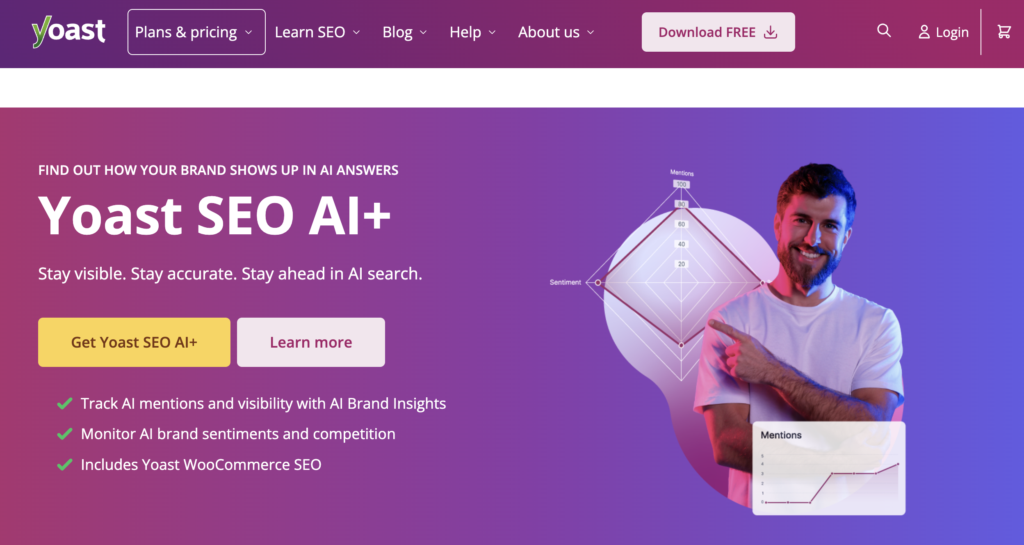
You’d be surprised how differently AI talks about your business than you would. That’s what this showed me the first time I ran it, the real story ChatGPT, Gemini, Claude, and Perplexity are telling people about my brand. Curious what yours says? Use code RYROB15 for 15% off when you sign up 👇
What Yoast AI Brand Insights Shows You About Your Business
AI brand insights are a practical way to see how your business appears across major AI assistants. The goal isn’t to force every chatbot to give you a glowing answer. That’d be a waste of time anyway.
What you want is a clear view of the patterns. Are you mentioned when someone asks for the kind of service, product, course, or expertise you offer?
Is the information correct? Which competitors show up instead? What sources do AI tools cite when answering questions in your space?
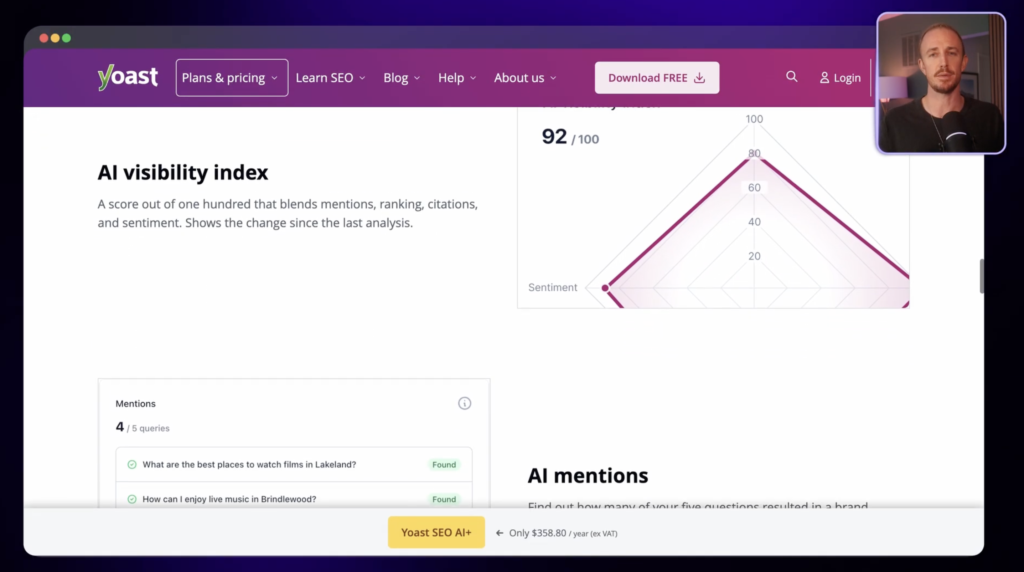
Yoast SEO AI+ includes an AI Brand Insights feature built for this kind of comprehensive brand analysis. It pulls visibility signals across ChatGPT, Gemini, Perplexity, and Claude into one scorecard, delivering sentiment analysis and real-time insights across various AI platforms.
In short, you can see an overall AI visibility index, sentiment, cited sources, competitor mentions, and the queries where you’re absent.
It runs in your browser, so you don’t need to install anything on your site just to see the data. You don’t need a WordPress site to use the visibility features, either. I also managed to lock in 15% off for my readers, so just drop in code RYROB15 when you sign up!
Why AI Visibility Matters Alongside Google Rankings
Traditional search gave people options. Someone typed in a question, Google showed a page of blue links, and even a result sitting in position six or seven could earn some clicks.
Conversational AI works differently. Someone asks, “What’s the best SEO consultant for a growing SaaS company?” or “Which blogging course should I take if I want to make money?” Then the tool returns one synthesized answer, often backed by three to five sources.
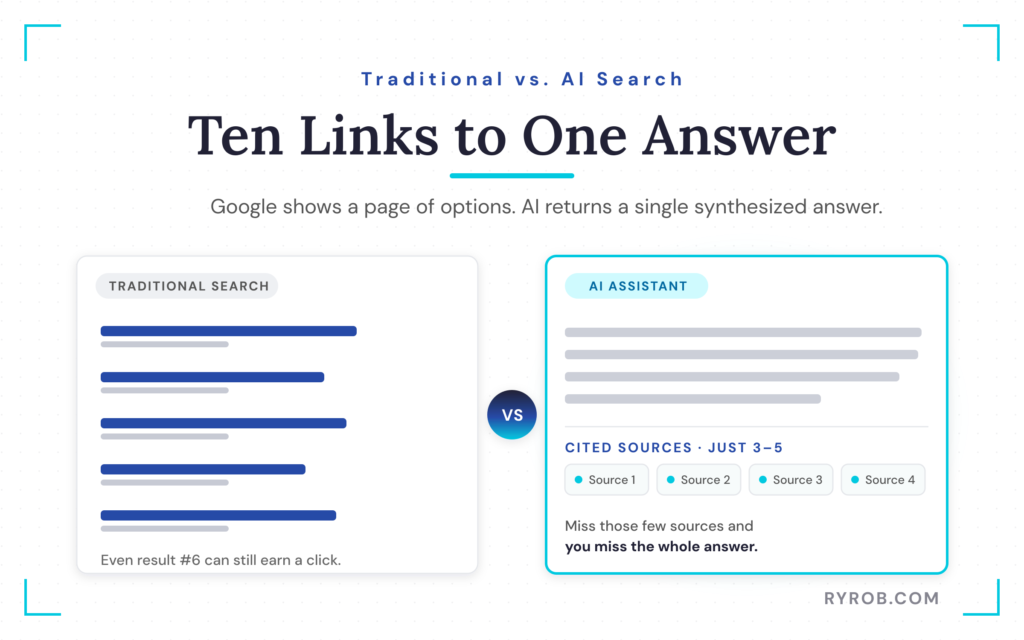
That doesn’t mean Google SEO is dead. Far from it, and optimizing for AI search is really just an extension of solid SEO. It means your business now needs to show up in two places where customers start their research.
Think of it like opening a second storefront. Your original storefront, Google, is still open.
But more people are also walking through the AI door. If your business isn’t listed there, competitors get the introduction while you’re still waiting outside.
For a deeper breakdown of the work that goes into earning those mentions, read my AI visibility guide.
The Signals That Matter in an AI Visibility Scorecard
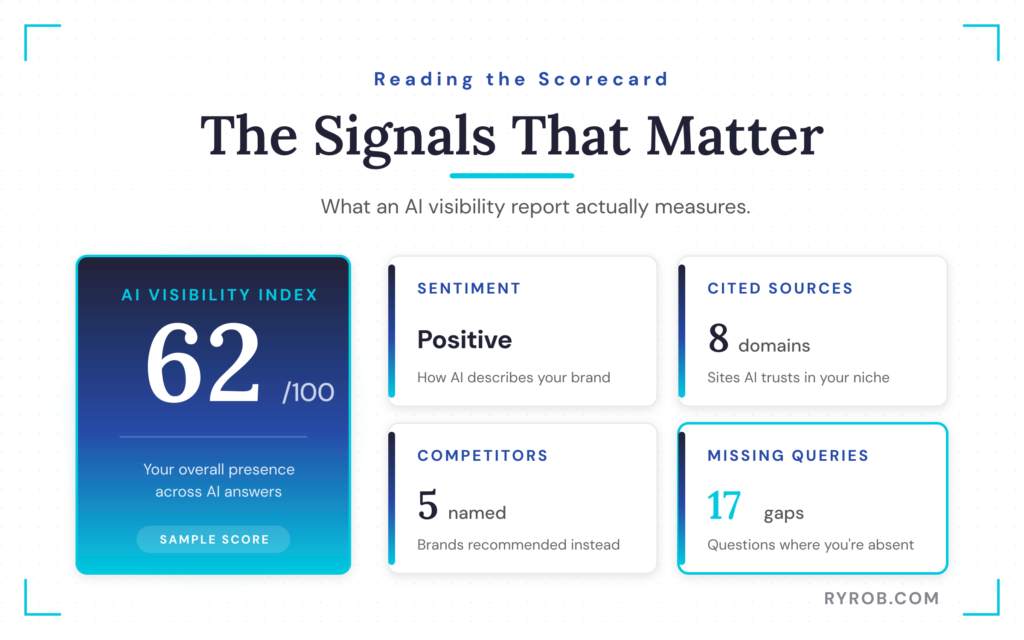
Start with whether your business is named at all. Then look at the context. A mention is less useful if it’s paired with old information, vague language, or an inaccurate description of what you offer.
Next, inspect the sources being cited. These are the sites and pages the AI tools appear to trust when answering questions in your niche.
Some may be competitors. Others may be publications, reviews, directories, or old articles that have done a better job explaining the topic than your site has.
Competitor recommendations can sting. I’ve been there. But they’re also useful because running a competitor gap analysis tells you which question needs better coverage, stronger proof, or clearer positioning on your own site.
Finally, review the queries where you’re missing. Each one is a potential citation gap. That gap could mean you need a new article, a stronger service page, cleaner information about your business, or all three.
How to Check Your AI Brand Visibility Without Guessing
You can run a basic audit yourself before committing to any tool. The trick is to ask questions a real potential customer would ask, not questions written to bait an AI into naming your brand.
Don’t ask, “Is my company the best?” That’s not useful. Ask the kinds of questions people type when they’re close to making a decision and don’t yet know who to trust.
Use the same questions across ChatGPT, Gemini, Claude, and Perplexity. Save the responses, the brands mentioned, the sources cited, and anything that looks outdated.
After a few rounds, you’ll start to see where the real issues are, helping you improve your brand tracking over time.
Ask the Questions Potential Customers Actually Use
Your prompts should map to your customer’s actual buying process. Start with questions around recommendations, comparisons, pricing, location, common pain points, and the results people want.
When designing these prompts, consider evolving customer preferences so your test questions accurately reflect current market behavior. You can also use this phase as a form of message testing, seeing how different value propositions land with large language models that parse unstructured data across the web.
Similarly, analyzing direct customer feedback can help you uncover real pain points to include in your prompts.
For example, a freelance writer could test questions like these.
- “Who are the best freelance B2B SaaS writers for early-stage startups?”
- “What should a SaaS company look for before hiring a content writer?”
- “Which content marketing consultant has experience with SEO and long-form blogging?”
- “How much does a freelance content strategist cost?”
A course creator might ask which course helps beginners start a blog, how long it takes to build traffic, or what tools a new blogger needs. A local service business could test service and location-based questions that customers use when they need help now.
Keep the phrasing neutral. You’re trying to find out what the tools say without pushing them toward your name.
Turn Missing Mentions Into Citation Gaps
A citation gap is a question your audience cares about where AI cites other sources but doesn’t cite you. That’s not a reason to panic. It’s a content and positioning opportunity staring you in the face.
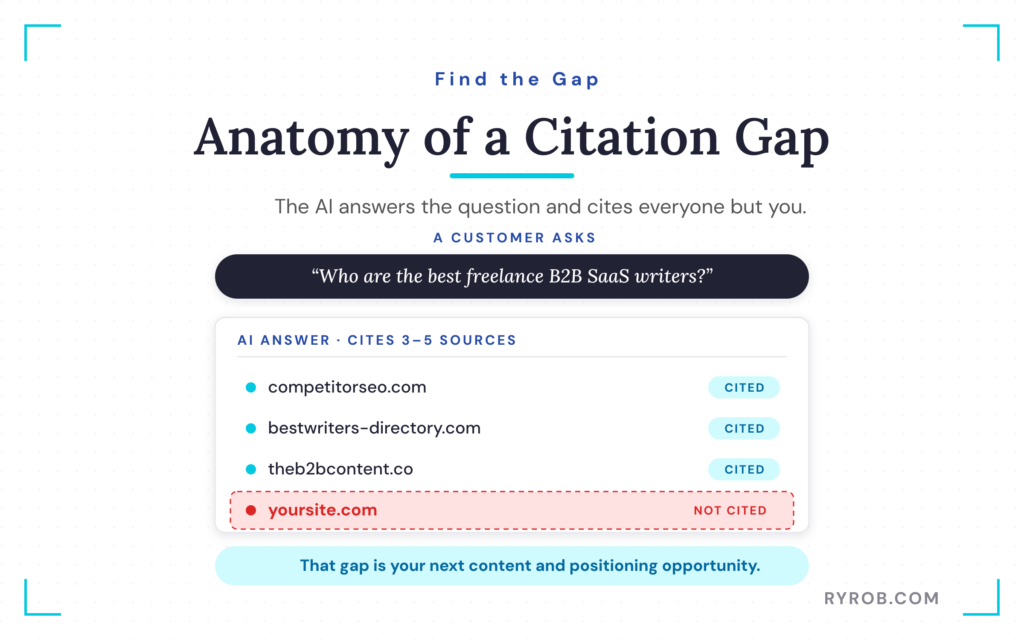
Sort your gaps by business value first. A missing mention for a question that leads directly to your highest-value service matters more than a broad informational question with no real path to revenue.
Then separate the issue into two buckets. Is the page missing because you don’t have content that answers the question? Or do you have the right content, but your brand details, page structure, and proof are too unclear for machines to connect the dots?
That distinction saves a lot of wasted effort. You don’t need to write ten new articles when the real problem is a confusing service page or an outdated author bio.
Make Your Website Easier for AI Systems to Understand
AI systems can’t cite what they can’t understand. If your pages don’t clearly show who runs the business, what you offer, who it’s for, and what each page answers, you’re making the job harder than it needs to be.
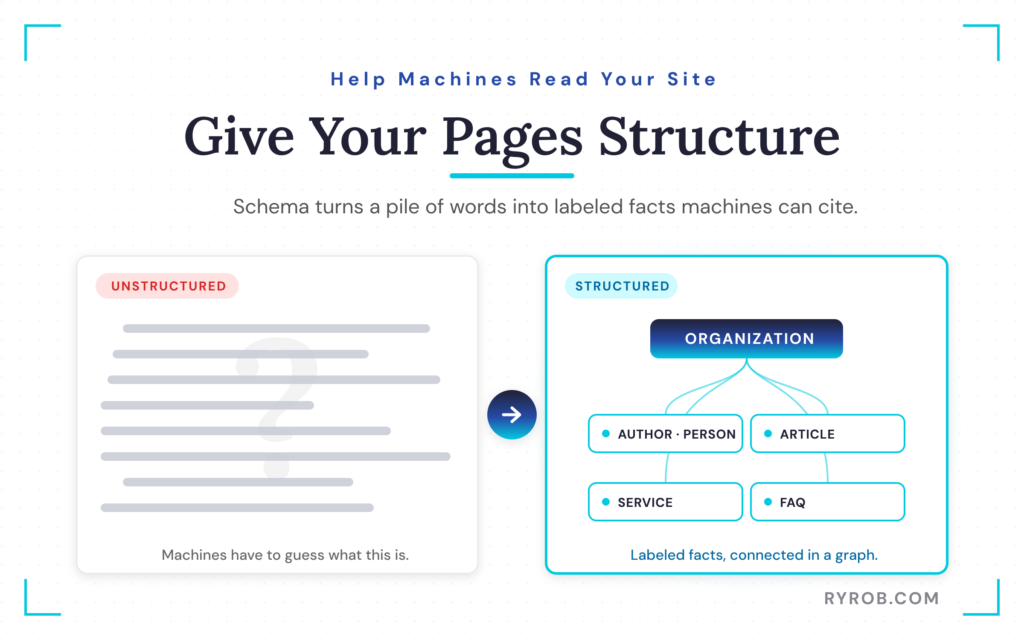
Without structure, a page is a pile of words. The system has to guess whether it’s looking at an article, a product, a service, a person, or an organization.
Schema gives machines labels. It can connect your organization, authors, articles, products, services, and other pages into a clearer picture. Yoast automatically builds schema and connects it into a graph, which helps search engines and AI systems understand how the pieces of your site fit together.
This isn’t an AI-only move. Clean structure has helped websites rank in Google for years. You’re improving both front doors with the same work.
Strengthen Schema, Titles, and Page Structure
Start with the information people can see. Your business name, service descriptions, author bios, contact information, and claims should be consistent across your site.
Maintaining brand consistency keeps your messaging clear and reliable for both users and crawlers. Don’t tell a different story on every page.
Use schema that matches what’s visibly on the page. An organization page can use Organization schema, and an author page can use Person schema.
Articles, products, services, and FAQs can use their relevant types when they accurately describe the content.
Don’t treat schema as a way to make unsupported claims. It won’t fix thin content, and it won’t turn a vague page into proof of expertise. It helps machines read the facts you already present clearly.
Your titles and headings matter, too. A page title should tell people what they’re getting before they click.
H2s and H3s should make the page easy to scan. A reader and a crawler should both be able to tell what the page is about without playing detective.
Clean Up Weak Titles and Meta Descriptions
The classic Yoast traffic light system still has a role here. Red, orange, and green checks can help spot weak SEO titles, missing meta descriptions, awkward keyword use, and readability issues before you publish.
Yoast Premium can also generate title and meta description options with AI tools. That’s useful for getting unstuck during content optimization, but don’t hand over the final call. Pick the version that makes a clear promise and accurately describes the page.
Put the main answer near the top of the page. Then expand with examples, tradeoffs, experience, and supporting details. Don’t bury the useful part beneath three paragraphs of throat-clearing.
Good content is easy to recognize. It has a direct answer, short paragraphs, useful subheadings, current facts, and a point of view earned through real work.
If you want another set of eyes on the foundations, run a free SEO analysis and work through the highest-impact issues first.
Turn Citation Gaps Into a Content Plan
Once you know where AI tools are ghosting you, you have the bones of a strong content plan. Every gap is a topic worth evaluating, not a demand to crank out another mediocre post. Your insights should directly inform your broader brand strategy so that every piece of content serves a purpose.
Yoast Premium’s AI content planner can turn a topic into a working brief with a suggested title, focus keyphrase, outline, and meta description. That’s a decent starting point. It’s not the finished article.
Use an AI draft to get past the blank page if you want. Then do the part that matters, bringing your own examples, experience, opinions, screenshots, sources, and fact-checking to the page.
Generic content doesn’t become useful just because it was published quickly.
A durable SEO content strategy using AI starts with questions that matter to your audience, then builds pages that answer them better than what’s already out there.
Create Content That Earns Citations, Not Just Traffic
A page worth citing does more than repeat a definition. It answers the question fast, explains the context, and handles the follow-up questions a reader will naturally have. By incorporating trend forecasting and predictive analytics into your research, you can anticipate what your audience will look for next.
Say you’re writing about hiring a freelance writer. Don’t stop at looking at a portfolio.
Explain what a strong portfolio proves, what it doesn’t prove, what sample questions to ask, and how to spot the difference between industry knowledge and empty marketing copy. You can even apply findings from market segmentation to tailor these insights to specific buyer personas, making your marketing campaigns more effective.
That’s the kind of detail that helps a human make a decision. It’s also the kind of structure that gives AI systems clearer material to summarize and cite.
Update facts when they change. Fix old pricing, outdated product details, dead links, and stale claims about your business. An AI answer based on a five-year-old fact is frustrating, but the best response is to make the current truth easy to find and verify.
Connect New Pages With Internal Links
Don’t publish a new citation-gap article and leave it sitting alone on an island. Link to it from relevant older posts, service pages, product pages, and category hubs.
Internal links help readers find the next useful thing. They also show search engines and AI systems how your content relates.
A guide about hiring a writer can point to your writing services. A beginner SEO post can link to a deeper guide on content planning.
Use descriptive anchor text. SEO content strategy using AI tells a reader what they’ll get. Click here tells them nothing.
Yoast’s internal linking suggestions can help surface relevant connection points after a new page goes live. The work is simple, but it compounds. More useful pages, better connected, give your site a clearer shape over time.
FAQs About AI Brand Insights and Search Visibility
A few questions come up almost every time someone starts digging into their AI visibility, so here are the quick answers.
Does AI Visibility Replace Google SEO?
No. Google still drives meaningful traffic and remains a core discovery channel. AI visibility is an additional channel where people may ask a question and receive an answer before they ever see a traditional search result.
Why Do ChatGPT, Gemini, Claude, and Perplexity Give Different Answers?
They use different systems, sources, retrieval methods, and ways of producing answers. That’s why you should look at patterns across various AI platforms instead of treating one answer as the final verdict.
How Often Should You Check AI Brand Visibility?
Review it regularly enough to catch changes in your brand information, content coverage, and competitor mentions. Integrating this step into your ongoing brand research, on a monthly or quarterly cadence, makes sense for many businesses, especially after publishing major content or changing important business details.
Does Schema Guarantee AI Citations?
No. Schema helps machines understand your content and business information. It doesn’t guarantee that an AI tool will cite your page, recommend your brand, or use your wording.
Can AI-Generated Content Help Close Citation Gaps?
It can help you create a first draft or a useful outline. But the finished page still needs human judgment, original experience, fact-checking, and information that gives readers a reason to trust it.
Final Thoughts About Yoast AI Brand Insights
You can’t improve an AI search presence you’ve never measured. Start with the questions your best potential customers ask before they buy, then find out who AI tools recommend and why.
Fix what machines can’t understand. Publish the answers your audience needs. Connect those pages to the rest of your site, then keep your facts current.
Building lasting AI visibility isn’t a one-time optimization project. It’s the result of doing the unglamorous work, over and over, as a core part of your brand strategy until your business becomes the clear answer.
See How AI Describes Your Brand with Yoast SEO AI+
You’d be surprised how differently AI talks about your business than you would. That’s what this showed me the first time I ran it, the real story ChatGPT, Gemini, Claude, and Perplexity are telling people about my brand. Curious what yours says? Use code RYROB15 for 15% off when you sign up 👇
