

Blogging is an excellent way to start making money, but it’s not without some costs—which brings us to today’s topic: how to get a free domain name. If you want to start a blog and avoid as many upfront costs as possible, you may wonder what you can get for free.
It makes sense to keep your expenses minimal in the beginning. You may not want to invest a lot of money until you find out if it’s something you enjoy or if you can make real money doing it.
The good news is that you can start a blog without a lot of upfront capital and add more expenses as your blogging starts to thrive.
Another option is to find ways to avoid costs, like getting a free domain name for your blog.
In this guide, I’ll show you six different ways to get a free domain name. I’m going to preface this article by saying that each option has pros and cons. You know the adage, “Nothing is really free,” and this is true with a domain name, too.
In this guide, I’ll share what I think is the best option for getting a free domain name and other options you may want to consider based on your blogging goals.
How to Get a Free Domain Name for Your Blog in 2026 (7 Real Ways)
- What is a Domain Name (and Why Do You Need One)?
- (Best Choice) Getting a Free Domain Name With Bluehost
- (Honorable Mention) Getting a Free Domain Name With Dreamhost
- (Not Recommended) Get a Free Domain Name With a Website Builder
- (Not Recommended) Get a Free Subdomain
- (Poor Option) Domain Registrar Ad Programs
- (Worst Option) Use a Free Domain Name Registrar (ccTLD Services)
Disclosure: Please note that some of the links below are affiliate links and at no additional cost to you, I may earn a commission. When you purchase website hosting using one of my affiliate links, the company compensates me, which helps keep all of my content (like my ultimate comparison of the best hosting plans) free of charge to you. Know that I only recommend tools I’ve personally used and stand behind.
Want to Start Your Blog (the Right Way)?
Check out my ultimate guide How to Start a Blog (on the Side).
What Changed About Free Domain Names in 2026
Before we get to the 7 ways, a few important shifts since I first wrote this guide that change which “free domain” options actually work in 2026:
- Freenom (the biggest free domain provider) shut down in 2026. For years, Freenom offered free .tk, .ga, .ml, .cf, and .gq country-code domains — and millions of people used them. After ongoing legal disputes and abuse problems, the service ended. If you find old guides recommending “free ccTLD domains from Freenom,” that path no longer exists. Don’t waste time looking for a replacement — the legitimate free domain options today are tied to hosting plans or website builders.
- ICANN raised .com prices. The wholesale price of a .com domain increased multiple times in 2024-2026 (currently around $11/year wholesale before registrar markup). That makes “free domain with hosting” deals more valuable than they used to be — you’re saving real money on something that’s gotten more expensive.
- AI website builders now bundle domains by default. Wix, Squarespace, GoDaddy Websites, and similar AI-powered site builders all include a free year of a domain when you sign up for a paid plan. For people who want a website without managing WordPress separately, this is a legitimate “free domain” path.
- Hostinger emerged as a serious budget option. Hostinger’s hosting plans now include a free domain for the first year alongside competitive hosting pricing (often $2-$4/month). Worth adding to the consideration set alongside Bluehost and Dreamhost.
The honest take: “completely free, no strings attached” domain names essentially don’t exist anymore. The legitimate free options below all involve trading off something else — usually a hosting plan you’d want anyway, or a subdomain you don’t own outright. With that in mind, here’s how to actually get one in 2026.
What is a Domain Name, and Why Do You Need One?
Before diving into how to get a free domain name for your blog, let’s first discuss what a domain name is and why it’s important to bloggers.
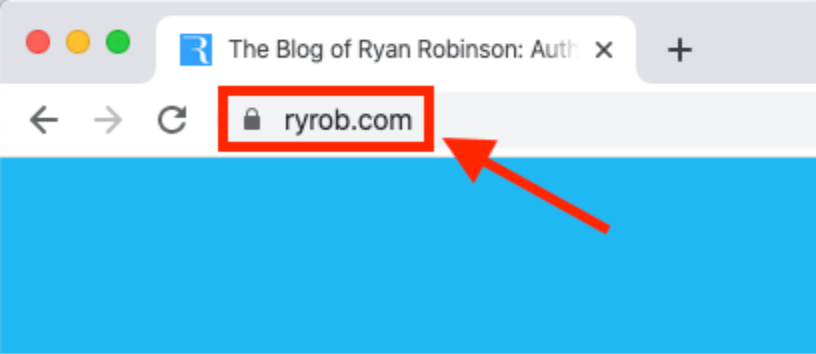
A domain name is the URL address visitors use to find your blog. For example, my domain name here is ryrob.com.
No one else can use that domain name because it’s registered to me through a domain name registrar.
There are a few ways to get a domain name for free, which we will discuss below. In most cases, you pay the domain name registrar an annual fee to continue having the rights to it.
If you let your payment lapse, the domain name becomes available for someone else to purchase. (which would give them the rights to the address).
Choosing a domain name can sometimes be tricky, considering many of the ones that come to mind easily might already be taken.
That’s why it’s helpful to use a domain name generator to help you develop a name. A friend and I created this tool for getting domain name suggestions when the one you prefer is already taken!
Use My Free Domain Name Generator
Try my free AI-Powered Domain Name Generator to get dozens of creative (available) domain name ideas today.
(Best Choice) Getting a Free Domain Name With Bluehost
My number one recommendation for getting a free domain name for your blog is getting it free through a hosting plan. Bluehost is my top choice for hosting plans.
Ideal for bloggers, Bluehost has affordable plans, free SSL security, 24/7 support, and a free domain name for the first year.
Bluehost is one of the few hosting plans that WordPress recommends. They offer a one-click WordPress installation, making it super easy to get started.
I want to make it abundantly clear here that you will be getting a free domain name for a year, but you do have to pay for the hosting plan to get the domain name. So, while it is free, there is still an expense.
Here’s how you can get your free domain name with Bluehost.
1. Sign Up for a Bluehost Hosting Plan
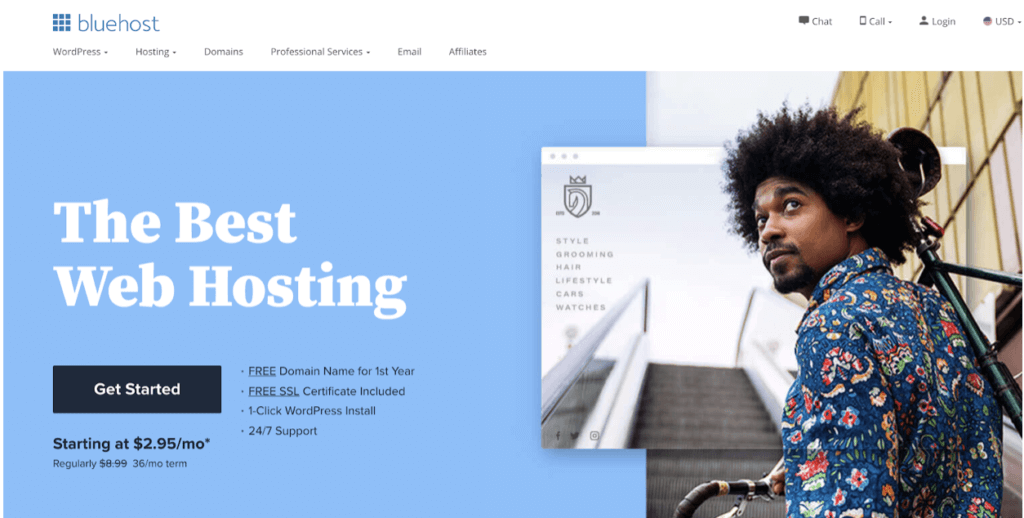
To get your hosting plan, go to Bluehost and select the “Get Started” button.
From there, select the hosting plan that works best for you. Bluehost offers four plans, each of which includes a free domain name for the first year.
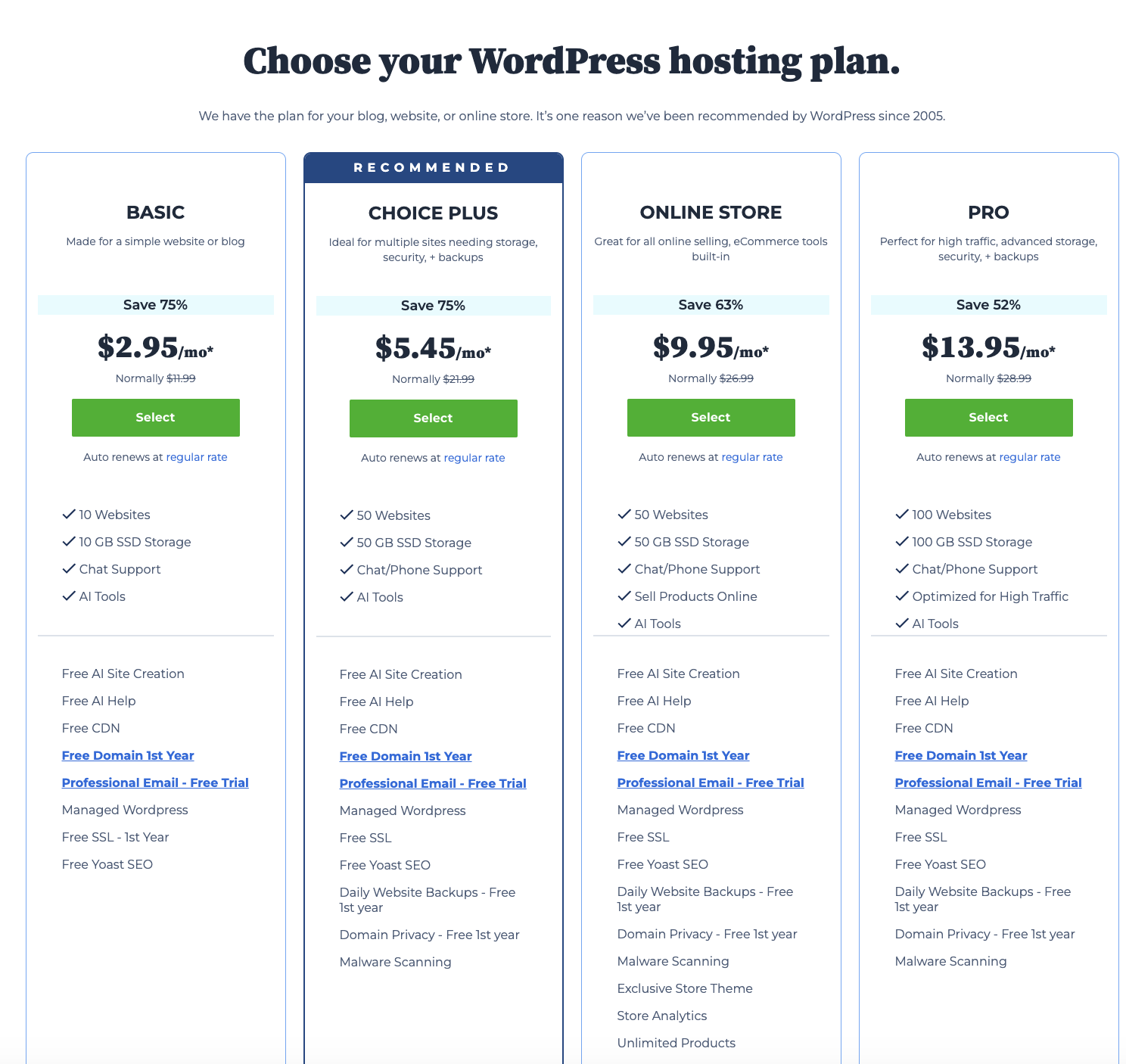
I recommend the Choice Plus plan because the price includes Domain Privacy, which protects private information like your name, address, and phone number from the public.
2. Input Your (Free) Domain Name
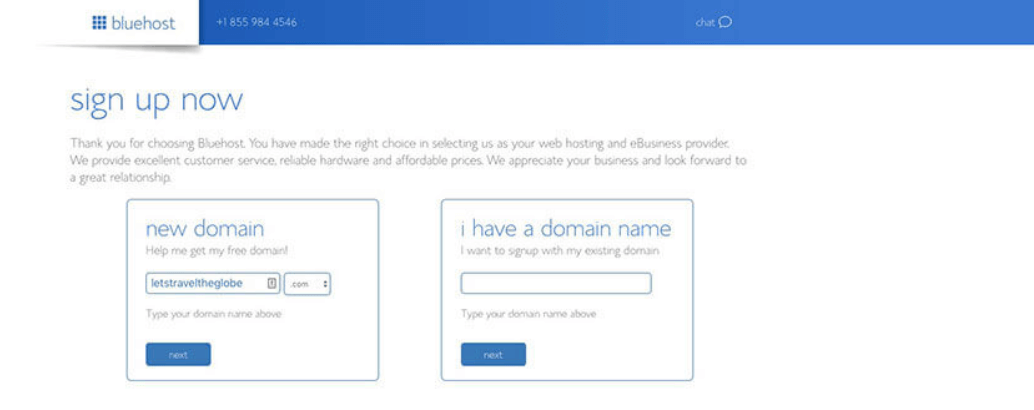
Once you’ve chosen your preferred plan, choose your domain name.
If you already have a name in mind, enter it now. If your preferred name has already been taken or you haven’t decided on your domain name, you can opt to enter it later.
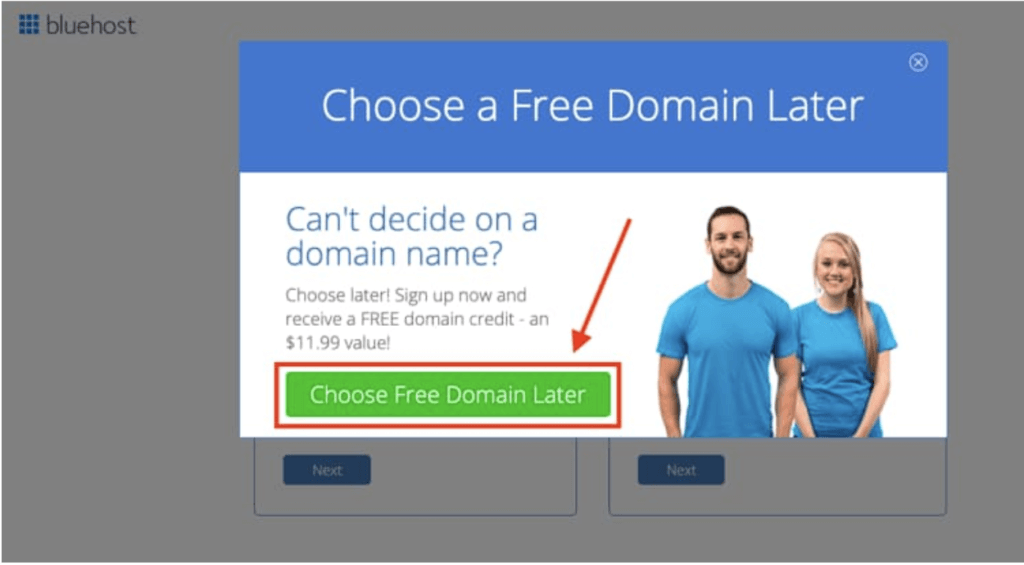
Or, if you want to find out if your domain name is available before you start the process with Bluehost, use their domain checker right here:
Check if your domain name is available:
This checker tool lets you know if your domain name (and extension) is available. If it’s not available, it’ll show you something like this:
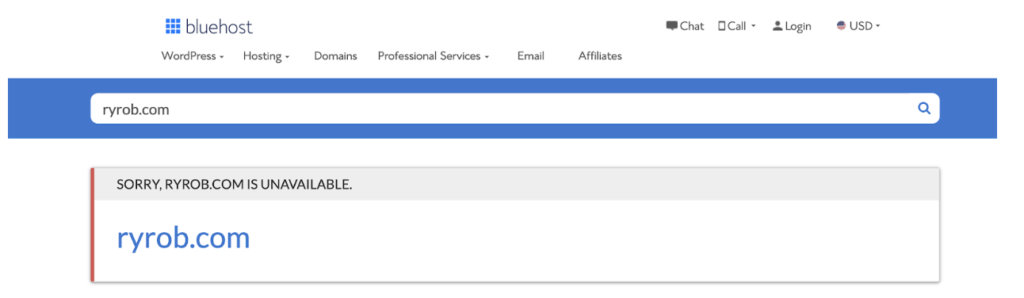
It will also give you a list of the same domain name with other possible extensions, but I suggest sticking with .com since it’s the most common and widely recognized.
3. Create Your Bluehost Account
The next step is to create your Bluehost account after choosing your domain name (or deciding later).
Bluehost will ask you for your email address, phone number, and address. It’s essential to put in an honest, current email address since this is the primary way they will communicate with you.
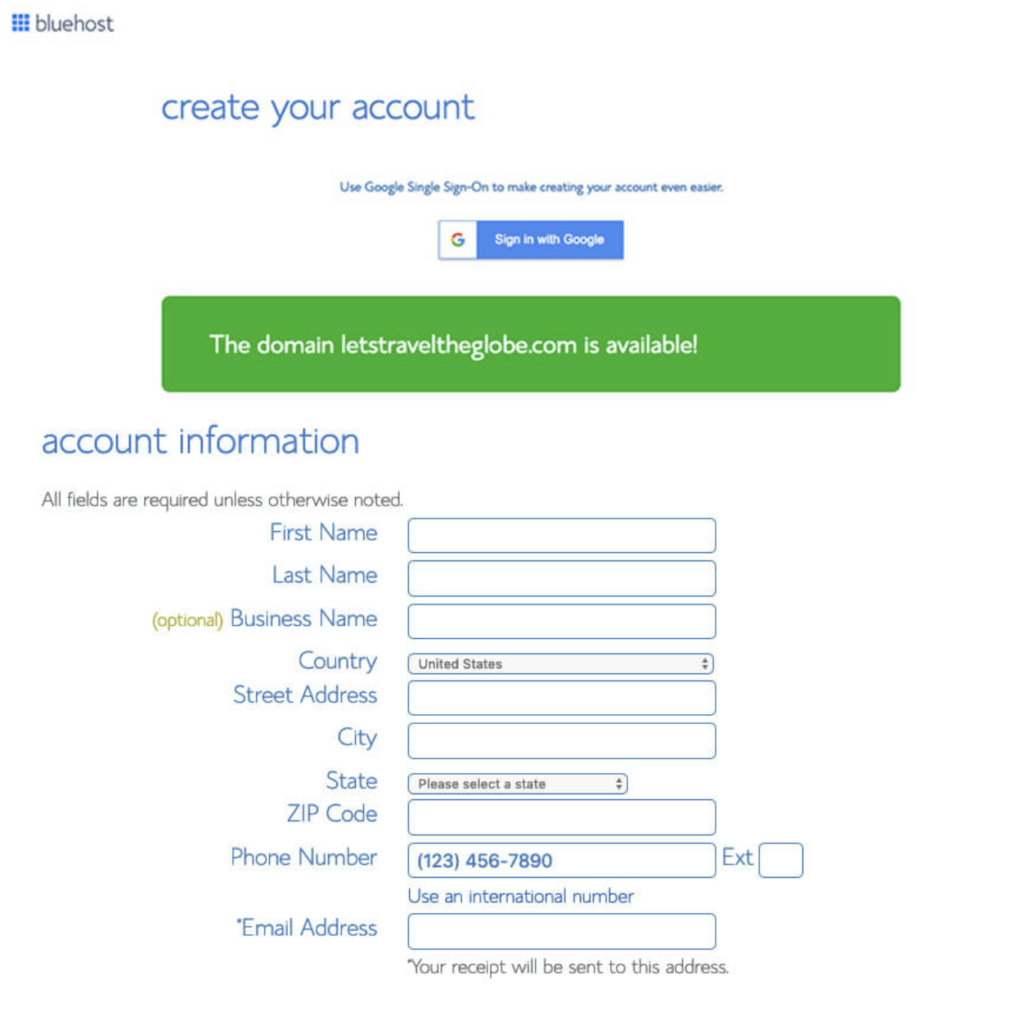
4. Select Your Hosting Package
Besides choosing a hosting plan, you’ll also have to agree to a term length. Currently, Bluehost offers a 1-month, 12-month, and 36-month contract. Each step up is a longer commitment but also a lower monthly price.
The most cost-effective option is the 36-month plan, which I recommend. Currently, the Bluehost 36-month plan is priced at $4.95 per month, while the 12-month plan is $2.95 per month. However, I still advise opting for the 36-month plan for better long-term savings.
5. Choose Your Package Extras
At this point, you’re almost finished! Your last step before billing is to select which package extras you want. Of those listed, I recommend choosing Domain Privacy Protection. The rest you can skip.
You’ll get this free with the Choice Plus plan. So if you’ve chosen that plan, you won’t have to select anything.
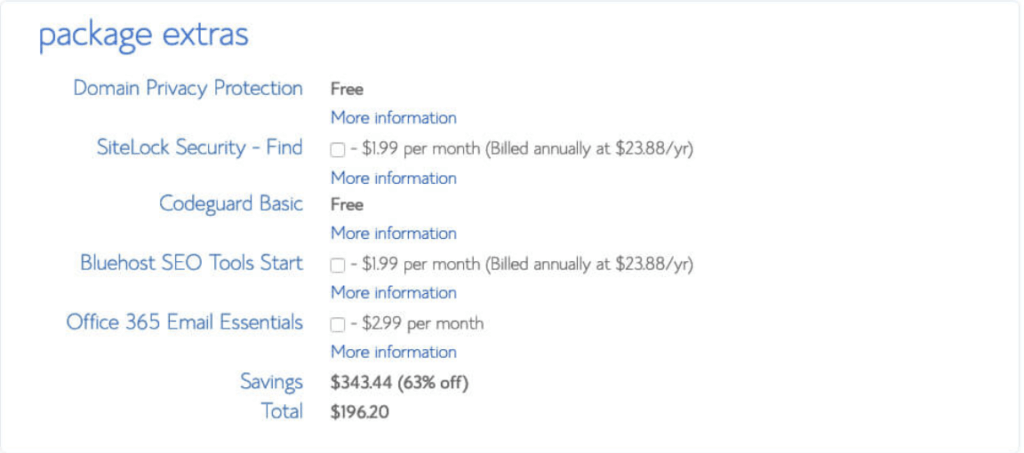
As for the other extras, there are a lot of free or inexpensive tools you can use to help with things like SEO optimization (including my own free keyword research tool & blog title generator tool).
I also have several guides, including an important primer on blog SEO tips and pointers about optimizing a blog post, that are both packed with information about making your blog more SEO-friendly after launching.
6. Enter Billing Information
Your final step is to enter your billing information. Once you’ve entered your payment information, don’t forget to agree to Bluehost’s terms of service.
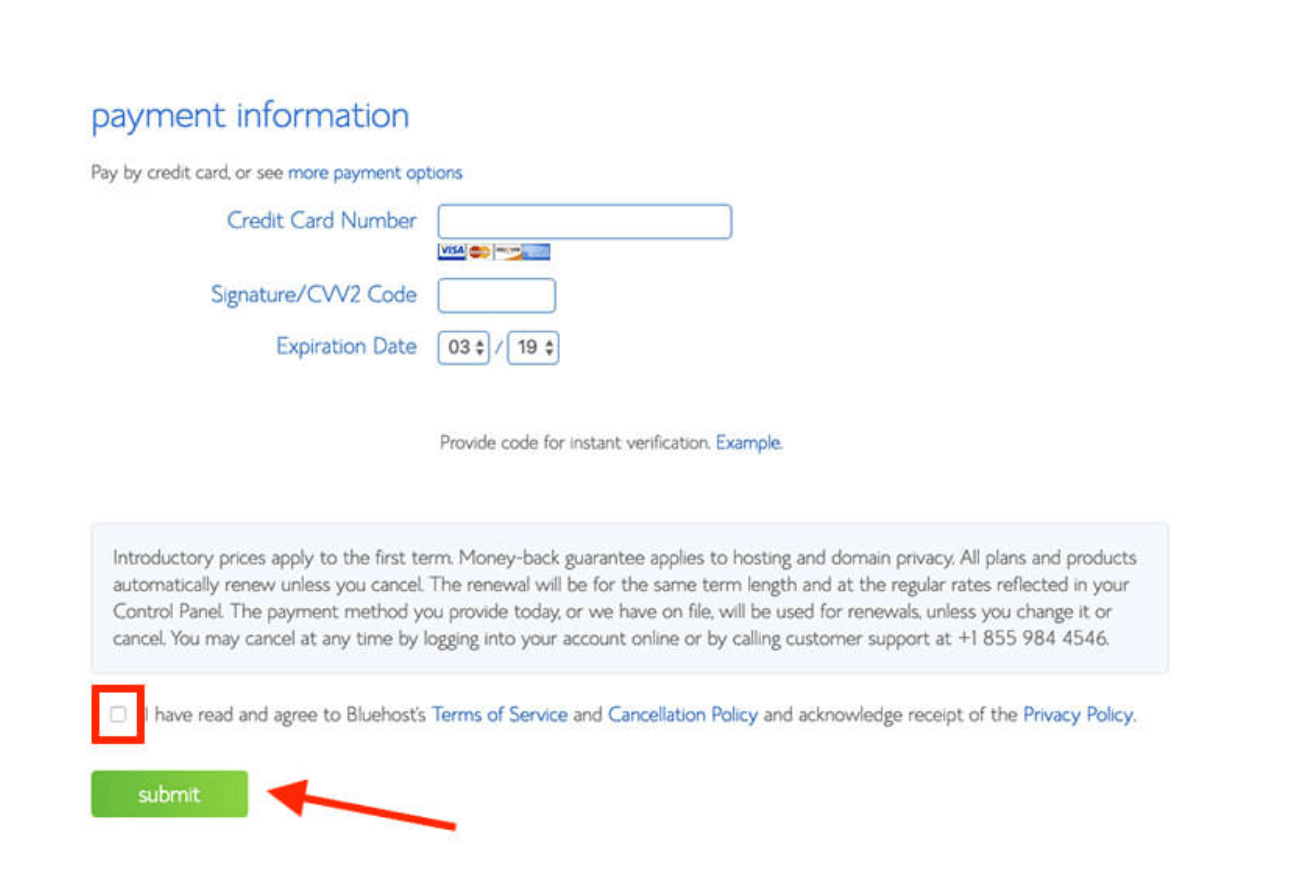
Now, you’re done! Congratulations! You’ve signed up for an awesome hosting plan. You’re ready to start your new blog, which you can set up since a free domain name came with your package.
(Honorable Mention) Getting a Free Domain Name With Dreamhost
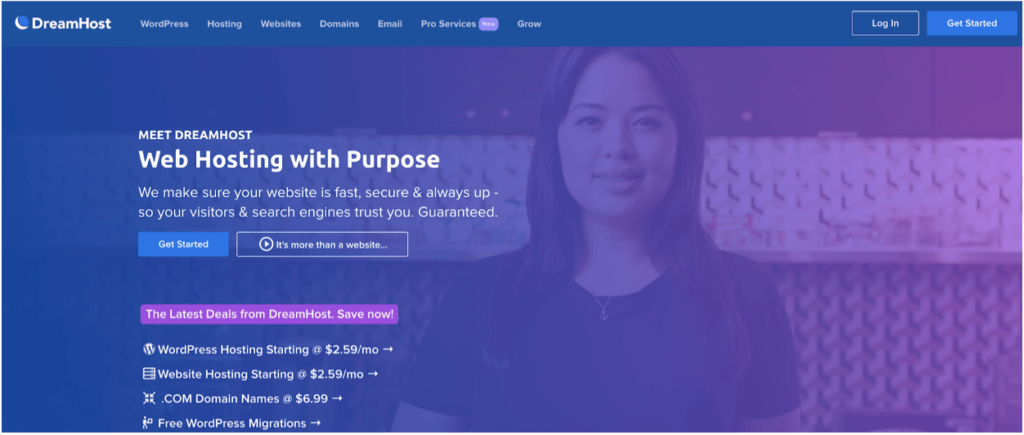
Dreamhost is another hosting plan I highly recommend. They offer inexpensive plans and fast, reliable, and great customer service. Let alone the fact that Dreamhost provides one of the industry’s only true monthly hosting plans that’ll allow you to pay for your hosting month-to-month as you go.
Another benefit of choosing Dreamhost is that it is carbon neutral, ranking it high on the list of green web hosting companies.
Like Bluehost, they’re also recommended by WordPress and are one of the longest-running hosting providers on the Internet.
When you choose Dreamhost, your domain name is free for the first year, making it one of the best options for getting a free domain name for your blog.
(Next Best Choice – Not Recommended) Get a Free Domain Name With a Website Builder
Another way to get a free domain name is to pay for a plan with a blogging site that offers a domain name as part of their package plan.
A few website builders that include a free domain name with the purchase of one of their premium plans include:
These website builders offer a free domain name, but you will still pay for a plan to reap the benefit.
While this is one way to get a free domain name for your blog, I would not recommend it for new or experienced bloggers.
Website builders certainly have their benefits—they’re easy to use, everything’s included, and no coding experience is needed. Many bloggers choose Wix or WordPress.com, so they don’t have to take care of any of the backend work.
The appeal of website builders is obvious, but I wouldn’t personally recommend them over WordPress.org. In case you aren’t familiar with it, there are two versions of WordPress.
WordPress.com is a hosting service that uses WordPress software to create a blog or website. WordPress.org is a free CMS that powers blogs and websites. You can learn more about it on my guide What is WordPress?.
Other website builders may be easier to start with than WordPress.org, but they lack the customization and freedom you get with WordPress.
WordPress is free to use, allowing you to do virtually anything you want with your blog.
With thousands of themes and plugins available, you can make your blog exactly what you want without being held back by a third-party application.
Although WordPress’s learning curve is steeper than Wix or Squarespace, it’s still very accessible to novice bloggers, and you won’t need to understand coding or complex technology to get started.
Also, there are many online resources to help you work through any questions you might have when working with WordPress.
(Not Recommended) Get a Free Subdomain
Some website builders offer a completely free version of their software.
These free versions are far more limited than their premium counterparts, but they do give you the option to start a blog without any upfront costs.
Some website builders that offer a free version include:
These free website builders also offer a free subdomain along with their plans. While getting a free website plan and free subdomain is a perk, these plans offer little compared to the premium plans.
You’ll also have to put up with their advertising on your site. In addition, a subdomain puts its branding alongside your name in the URL.
For example, in a typical domain name (not a subdomain), the address could be YourName.com, like it is here with mine:
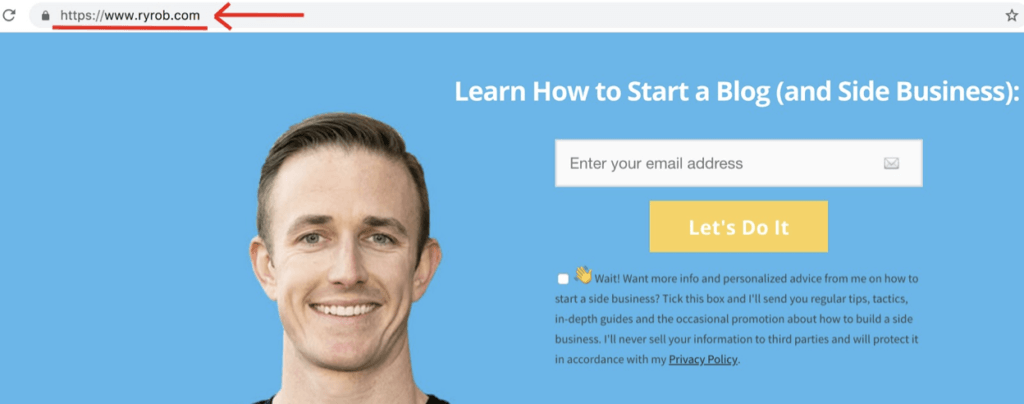
With a subdomain, it would instead look something like this:
www.ryrob.wordpress.com
It gives your URL a less professional appearance and makes it more difficult for people to remember your site address in the future.
(Poor Option) Domain Registrar Ad Programs
Another way to get a free domain name is through advertising programs. There are two main ways to do this.
The first is to pay for a domain name by displaying ads for a domain name registrar. You agree to run ads on your page in exchange for a free domain name.
Another is to display referral ads on your page. You can earn your free domain name by referring others to their site.
The main reason I consider this a bad option is the low return on these adverts. Yes, you’re saving a few dollars, but ad space on your blog is precious.
If you’re planning on using advertising, choosing an advertising network that pays more than the $12 a year you’d pay to get a domain name is far more profitable.
(Worst Option) Use a Free Domain Name Registrar (ccTLD Services)
Important 2026 update: The main free ccTLD provider — Freenom, which offered .tk, .ga, .ml, .cf, and .gq domains for free for over a decade — shut down in 2024 after years of legal disputes and abuse problems. As of 2026, there’s essentially no reputable provider giving away free country-code domains the way Freenom did. The information below is mostly historical context for why this option used to exist (and why even when it did exist, it wasn’t worth using for serious blogs).
Historically, you could get a free domain name through a ccTLD (Country Code Top Level Domain), depending on where you live. When people sign up for a domain name, they must do it through a registrar.
A top-level domain (TLD) refers to the extension at the end of your website. Mine is .com, but many other extensions are available, such as .org, .edu, or .net.
There are also country code (cc) extensions. You may have seen this when you visited an official government website. For example, this is England’s government website:
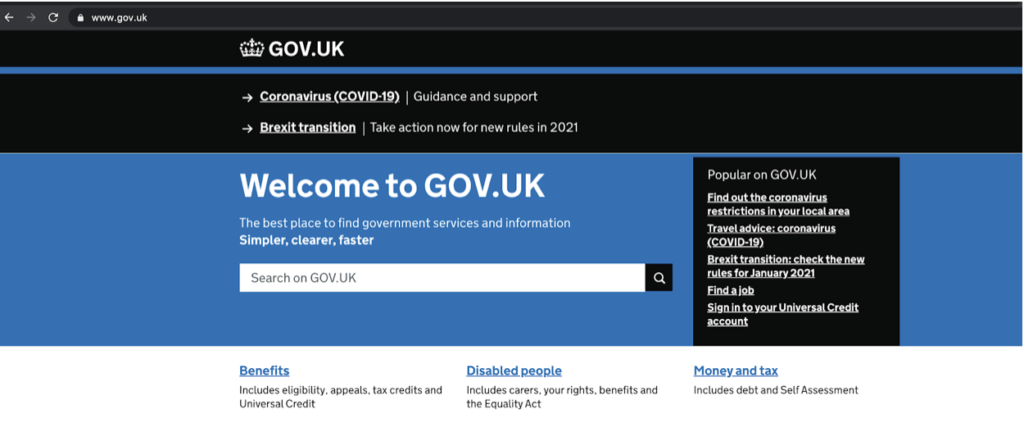
You can see that the extension at the end is “.uk,” not “.com.”
Some country-code extensions are available for free. Included on this list are the extensions:
- .tk – Tokelau
- .ga – Gabon
- .ml – Mali
- .cf – Central African Republic
- .gq – Equatorial Guinea
The purpose of country extensions is to show the geographical location of certain websites.
However, because these extensions are offered for free, quite a few websites use them that are not related to these countries in any way.
According to the hosting service Ionos by 1&1:
“The .tk domain ending is a special case for country domains. Over 30 million websites use this ccTLD, even though the island state of Tokelau, which officially presides over this domain extension, has less than 2 million inhabitants. The mass registration of .tk websites can be attributed to the fact that, in the past, it was completely free of charge to secure an internet address with this ccTLD. Even now, website owners with a .tk TLD can run their sites without paying a dime for the first 12 months after registering.”
This is why I consider this the worst option on the list. You do get a domain name for free, but you’ll have an extension most people won’t recognize, one that makes your website look very untrustworthy.
Another reason not to use this free domain name is that people who have used the free extension report their domain name being spontaneously removed.
It also risks ranking lower on a Google search since the extension is less recognizable.
This is not a reputable way to get a domain name and is simply not a worthwhile way to save money on one.
Free Domain Name FAQ
Can I actually get a completely free domain name with no strings attached in 2026?
Realistically, no — at least not for a real domain (.com, .net, .org, etc.). The era of “completely free, no strings attached” domains essentially ended when Freenom shut down in 2026. What you can get for free: a domain bundled with a hosting plan (Bluehost, Hostinger, and Dreamhost all include a free year), a domain bundled with a website builder plan (Wix, Squarespace, GoDaddy), or a free subdomain (yourname.wordpress.com, yourname.medium.com — but you don’t really own these). Anything advertising a “totally free domain” today is almost always one of these tradeoffs in disguise.
What’s the best way to get a free domain for a new blog?
Bundle it with hosting. Bluehost is still my top pick for new bloggers because the free domain comes with solid managed WordPress hosting at around $3-$5/month, plus a one-click WordPress install, free SSL, and 24/7 support. Hostinger and Dreamhost are also legitimate options. Avoid free subdomains for any blog you’re serious about — you don’t own the URL, you can’t customize it freely, and migrating later is painful.
How long is the domain actually free?
For most hosting bundles (Bluehost, Hostinger, Dreamhost), the domain is free for the first year. After that, you’ll renew it at the standard rate (currently around $15-$20/year for a .com). The hosting plan renews separately, usually at a higher rate than the initial promotional pricing. Read the fine print on renewal pricing before signing up — that’s where the “free domain” savings can quickly get eaten by hosting renewal increases if you’re not paying attention.
Should I use a free subdomain (like myname.wordpress.com)?
Only for testing or hobby projects. The downsides are significant: you don’t own the URL, the platform can change rules or shut you down, you can’t easily monetize the site, and you’ll lose all your traffic and SEO authority if you ever migrate to a real domain later. For anything serious — a blog you want to grow, a business site, anything you’d be sad to lose — get a real domain. The $15/year for a .com is essentially the cheapest digital business expense you’ll ever pay.
What happened to Freenom and free .tk domains?
Freenom — which gave away free .tk, .ga, .ml, .cf, and .gq country-code domains for over a decade — shut down in 2026 after years of legal disputes and widespread abuse of the free domains by spammers and scam operations. As of 2026, those ccTLDs are no longer available through any reputable free registrar. If you find old guides recommending Freenom or free ccTLDs, the information is outdated.
Are free domains from website builders any good?
The domains themselves are fine — they’re real domains, you just access them through the builder’s interface. The tradeoff is the website builder itself: if you ever want to leave Wix or Squarespace for WordPress, you can usually transfer the domain (after a year), but the website content doesn’t migrate cleanly. For most serious bloggers I still recommend going straight to WordPress hosting with the free domain (Bluehost, Hostinger, Dreamhost) rather than a website builder. But if a builder fits your needs and you’re not planning to migrate, the bundled domain is legitimate.
Is it worth paying for a domain instead of getting one free?
If you have any specific domain you really want (your name, a great brand name, a niche-specific .com), pay the $15/year and register it directly through a registrar like Namecheap, Porkbun, or Cloudflare. You’ll own it outright, you can host it anywhere, and you’re not locked into any hosting provider. The “free domain with hosting” path is fantastic when you’re starting a new blog from scratch — but if you’ve already picked your ideal domain, just buy it.
Final Thoughts: The Honest Take on Free Domains in 2026
If you’re starting a new blog and want a free domain: sign up for hosting through Bluehost (or Hostinger or Dreamhost), pick your domain during signup, get it free for the first year. That’s the path I’d recommend in 99% of cases.
If you’re not ready to commit to hosting and just want to test the waters: use a free subdomain on WordPress.com or Medium temporarily — but treat it as a placeholder, not a long-term home. The first time your test site starts working, migrate to a real domain.
And if you find an old guide recommending Freenom or free ccTLD domains: that path closed in 2026. Skip it.
For the full setup walkthrough, my complete guide on how to start a blog covers the entire process (hosting, free domain, WordPress install, theme, first post) step by step. For the broader hosting picture, my best web hosting plans guide covers all the options. And for the deeper “what is a domain” question, my how to choose a domain name guide walks through naming strategy.
What Free Domain Name Option Works Best For You?
After reading through this guide, which option do you think is best for your blogging strategy?
Would you like to try to get a free domain name through a hosting company, or would you prefer to run ads on your blog in exchange for a free domain name?
You might want to pay the regular price for a domain name and find other ways to save money on your blog.
My top choice for domain name registrar (if you’re not getting your domain name free through Bluehost) is Namecheap. They’re inexpensive, reliable, and straightforward to work with.
What about you? Do you know of other ways to get a free domain name that isn’t on my list?
Do you have other ways to save money as a blogger?
I’m looking forward to hearing your ideas in the comment section below.
Use My Free Domain Name Generator
Try my free AI-Powered Domain Name Generator to get dozens of creative (available) domain name ideas today.

Hey, Ryan!
All your posts are written well-detailed. I loved reading them, especially your income report that you always share.
Thanks for sharing this amazing post on how to get a free domain, it would really be helpful for beginners at the time when they start their blog.
Thanks,
Ravi Dixit
You’re welcome, Ravi! Good luck with your blog 🙏
Hey Ryan,
I love your reading material, well written
I always read and share your content this post is amazing and thanks for sharing.
Regards,
Shabana
Glad to hear that, Shabana! Good luck 🙂
We have no money to start blogging and you ask to buy hosting and than we will get free domain . Please Give me article about how to get free domain without buying any hosting because I wat to crest website with the help of blooger