

ChatGPT often cites pages that don’t even show up in the top 100 results on Google. Unconventional, I know. At the same time, visitors who click through from AI recommendation engines often convert at 5 times the rate of a typical Google visitor. This is already changing how website owners think about search.
As a result, a new traffic channel is opening up, and it does not follow the old rules of traditional SEO alone. Generative Engine Optimization (GEO) is the process of improving a website’s visibility within AI-driven response systems. It focuses on how your content shows up in AI search tools.
If you want your site to get recommended inside tools like ChatGPT, Claude, Perplexity, Gemini, and Google’s AI Overviews you need to look (a little) beyond traditional SEO. What matters in this next chapter of search, is how your content shows up in AI search results.
Key Takeaways for Generative Engine Optimization (GEO)
- Traditional SEO still matters, because AI tools must find and understand your pages before they can cite them.
- Generative Engine Optimization adds a new layer on top of standard search strategies, with a bigger focus on being quoted, summarized, and recommended inside AI answers.
- The framework is simple: technical foundation, entity clarity, citation worthiness, and cross-platform authority.
- AI tools are more likely to pull from pages that are fresh, well-structured, readable, data-backed, and easy to quote. Clear structure also improves how models parse your information.
- Your website is only part of the picture. YouTube, LinkedIn, forums, guest posts, and third-party brand mentions all shape how AI sees your business and its reputation.
Why ChatGPT Is Picking Different Pages Than Google
Google and ChatGPT are not surfacing content the same way, and it comes down to the job they are trying to do.
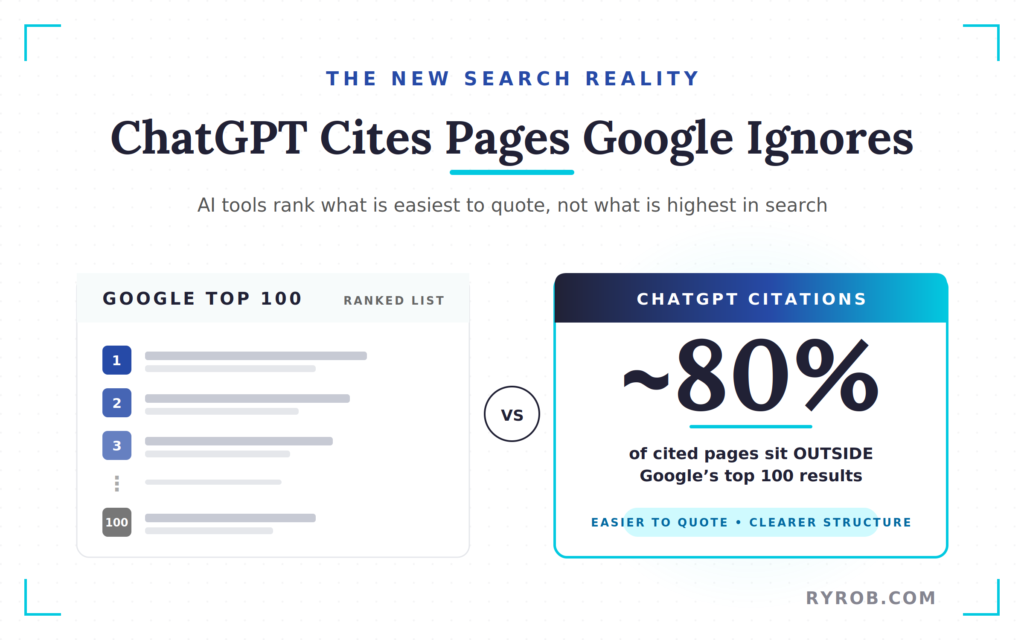
Google is ranking a list of results. ChatGPT and other large language models are trying to produce a single, synthesized answer. That difference alone changes what gets pulled into view, which is why a page can underperform in traditional rankings and still get cited in an AI response.
When I mentioned that roughly 80% of pages cited by ChatGPT are not in Google’s top 100, that was not meant to be a surprising stat. It was meant to highlight what is already happening. AI systems are often choosing content that is easier to extract from, easier to understand, and easier to trust in the moment someone asks a question.
A big part of that comes from retrieval augmented generation. This underlying tech explains why citations and references are pulled from sources that demonstrate strong authority and clarity. Clear structure, strong signals, and content that is easy to reference tend to win.
That;s why Generative Engine Optimization (GEO) matters. If you are only watching your Google rankings, you are only seeing part of what is driving visibility.
SEO, AEO, and GEO Explained
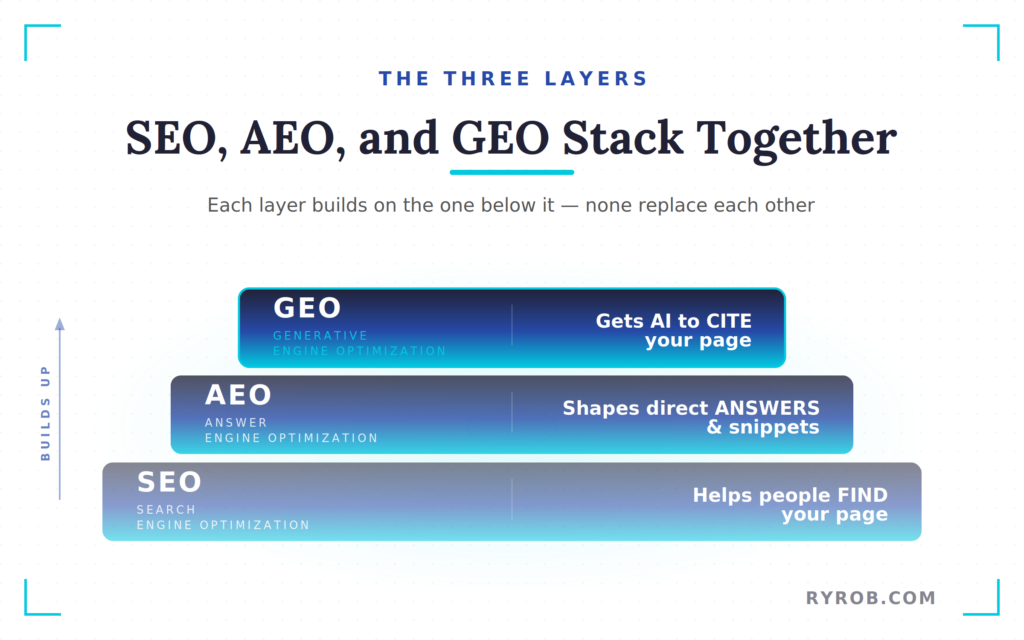
There is a lot of noise around these terms right now, so let’s simplify it.
SEO (Search Engine Optimization)
SEO is still the base layer. It is about getting your pages to rank in search engines, and Google still handles the majority of search behavior. That foundation is not going anywhere, and the core SEO practices still matter.
If you need a refresher on the basics, these best blog SEO strategies still matter a lot.
AEO (Answer Engine Optimization)
AEO is a more focused version of that. It is about shaping your content so search engines can pull direct answers from it, whether that is a featured snippet, a voice response, or an FAQ-style result.
GEO (Generative Engine Optimization)
GEO builds on top of both. It is about getting your content cited inside AI-generated answers. The simplest way to think about it is this: SEO helps people find your page, while GEO helps AI choose your page as part of the answer.
There is a lot of overlap across all three. Most of what works in SEO still applies, and even Google has made that clear in how it talks about AI search. The difference is in the last 20%, and that is where visibility inside AI responses is either won or lost.
Why AI Recommendations Can Convert Better
Not all traffic is equal.
Someone who clicks a blue link in Google might still be browsing, comparing, or killing time. A person who interacts with AI search engines through conversational queries is often further along. They have already asked a full question, looked at a synthesized answer, and picked a cited source to go deeper.
That changes user intent.
When your page gets recommended inside an AI response, it carries some of that built-in trust. You are not just another result on a list. You are part of the answer itself, which puts you in a much stronger position, especially if you are selling something or trying to drive action.
So yes, AI search traffic may be smaller today for many sites. But the quality can be much higher.
Getting cited by AI is not only about traffic volume. It is about showing up at the exact moment someone wants a trusted answer.
The AI Visibility Stack You Need
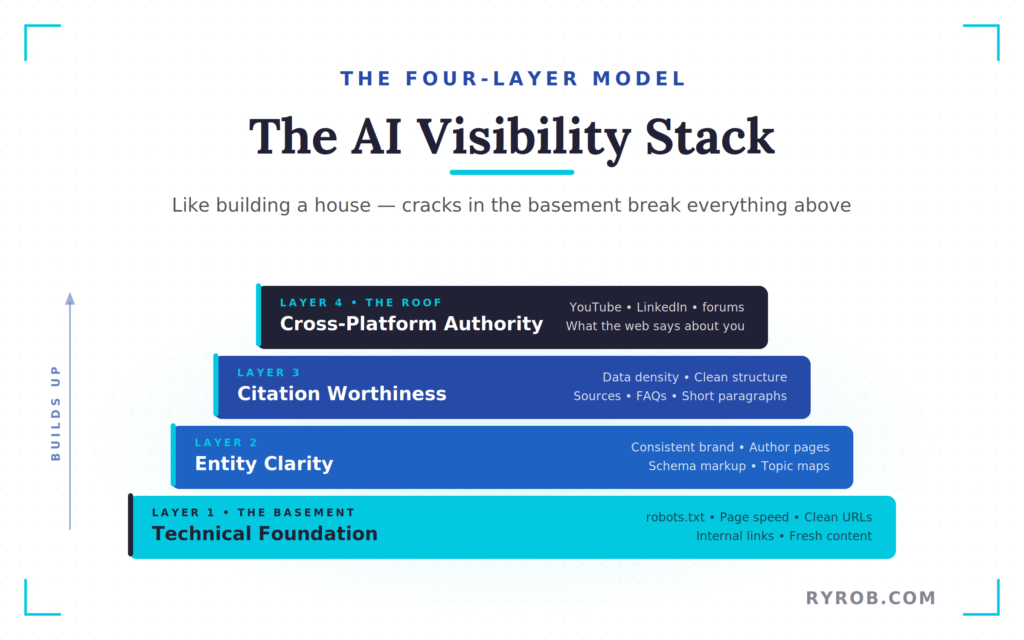
The easiest way to think about generative engine optimization is as a four-layer stack. I like to think of it like building a house. If the basement is cracked, it does not matter how strong the top looks.
Layer 1: Technical Foundation
This is the basement.
If AI crawlers cannot access your site, or your pages are slow, messy, and stale, you are making the job harder before it even starts. Much of this involves classic technical optimization, which is why GEO is not replacing traditional SEO.
Start with your robots.txt file. Some sites accidentally block GPTBot, ClaudeBot, or other AI crawlers. If that happens, your pages can become invisible to the very systems you are hoping will cite you.
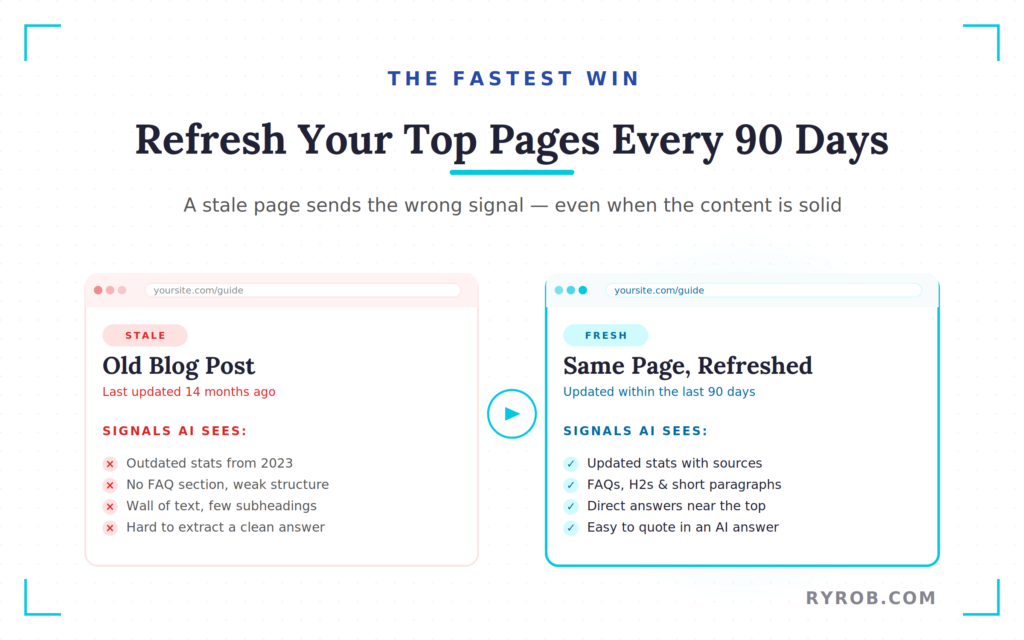
Next, look at freshness. Pages updated within the last 90 days are much more likely to get cited than stale pages. Once a page sits untouched for months, its odds of showing up in AI answers can drop fast.
Then there is structure. Clean URLs, smart internal links, logical topic clusters, and fast-loading pages all help AI connect the dots. If your site architecture is confusing, machines will struggle with it too.
Layer 2: Entity Clarity
This is where a lot of people fall behind.
AI systems do not think in keywords the same way search marketers used to. They think in entities, which means clearly defined things like a brand, a person, a product, or a topic. To achieve entity clarity, your brand name needs to stay consistent across all platforms.
Build author pages that explain who you are and what you know. Use organization schema, person schema, and article schema to strengthen your E-E-A-T signals and provide better machine readable data. Finally, map your topics so your content is connected and easy to understand.
Do not publish random one-off articles. Cover your core subject area in a complete way so the AI sees you as a reliable source.
Layer 3: Citation Worthiness
This is the layer where AI decides whether your content is worth quoting. Your content needs to be easy to find, but it also needs to be easy to extract from.
What makes a page citation-worthy?
- Data density plays a big role. AI tools favor clear numbers and specific insights.
- Strong structure improves readability and content extractability.
- Clear citations and references increase trust and authority.
Focusing on reference rates, especially when you include original data or expert-backed insights, makes your content more likely to be used in AI-generated answers.
Structure also matters. Clear H2s and H3s, short paragraphs, and FAQ sections make your content easier to parse. Research shows these elements can increase citation rates by roughly 73% to 89%.
Layer 4: Cross-Platform Authority
This is the roof, and it is the piece almost everyone ignores.
AI tools do not only look at your website. They look at your multi-platform presence to understand what the rest of the internet says about you. Roughly 84% of AI search citations come from user-generated and community-based sources.
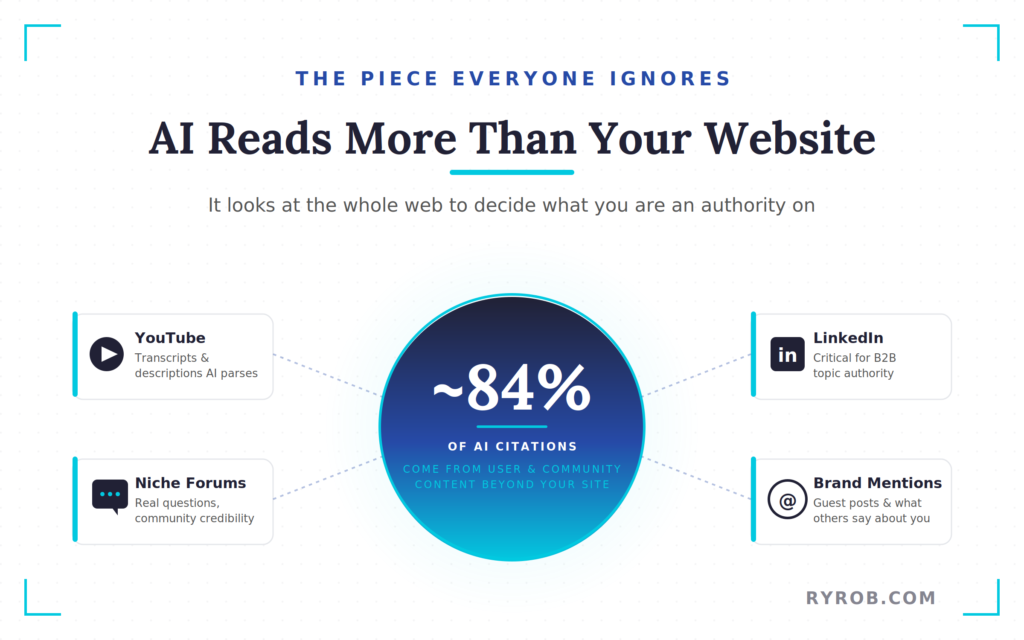
YouTube plays a big role here because it provides multimodal content that AI can interpret through transcripts and descriptions. LinkedIn is especially important for B2B topics, while niche forums help build credibility.
The core idea is simple. AI does not judge you only by what you say about yourself. It looks at the authority you build across the entire web.
My Step-by-Step Generative Engine Optimization Strategy
Knowing the framework is useful. Turning it into publishable content is where the real gains happen.
You don’t need a full site rebuild to get started, though it’s important to make sure you aren’t making any of these common website mistakes. In most cases, the better move is to improve the pages that already matter most.
Step 1: Audit Your Current Content
Start with your top pages, not your entire archive.
Check whether AI crawlers can reach them. Review your brand name across your site, social profiles, and third-party mentions. Look for topic gaps and ask yourself if you have one article on a subject or a full body of work.
This is also a good time to review accuracy. If your most important pages no longer reflect what you know today, that becomes your first update.
Step 2: Improve Your Existing Pages
This is usually the fastest win.
Take your top five pages and make them easier to cite. Add a short FAQ, tighten your subheadings, and include relevant statistics with sources. If a comparison helps, include it, and if a concept needs clarity, define it in simple terms.
As you update these pages, reinforce your brand visibility and authority. Make sure your content aligns with how people actually search by using relevant long-tail keywords that match real queries in AI search tools.
Then refresh the page. Update examples, screenshots, captions, and any outdated details. A page that worked a year ago can still be useful, but AI systems tend to favor fresher, clearer versions.
Step 3: Expand Beyond Your Website
If your website is the only place your expertise lives, you are limiting your reach.
Create a supporting YouTube video around a core topic. Share a clear point of view on LinkedIn if your audience is professional. Spend time answering real questions in communities where your audience already spends time.
Do not focus on dropping links. Focus on being useful. These trust signals influence how AI systems decide what gets mentioned, cited, and surfaced again.
The AI Visibility Toolkit
At this point, you might be wondering what tools actually help with this.
You don’t need a specialized Generative Engine Optimization platform to get started. Most of what you need already exists, and it comes down to how you use it.
A simple way to think about it:
- Use large language models to review your content for clarity, structure, and factual depth
- Track brand mentions manually or with social listening tools to understand how your authority shows up across the web
- Monitor traditional SEO platforms that are starting to include AI citation tracking
These give you a clearer view of how often your content is being surfaced in AI-generated answers.
A Simple 30-Day Plan to Improve AI Visibility (GEO Plan)
You do not need a massive quarterly plan to see results. A focused 30-day window is enough to build momentum in generative search if you stay consistent.
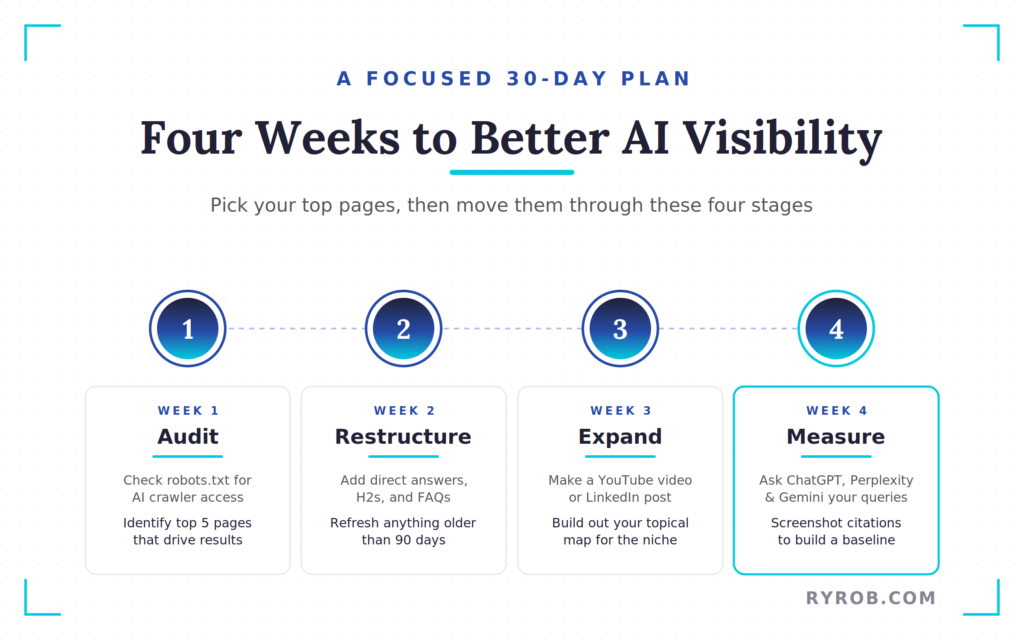
The goal is to improve structure, clarity, and content extractability so both readers and AI systems can easily understand your pages.
Week 1: Audit
Start by reviewing your robots.txt file to confirm that AI crawlers are not blocked. This is a critical first step, especially if you want your content to be eligible for citations and references. Then check your brand naming across your website, social profiles, and past content to ensure consistency.
Next, identify the five pages that generate the most traffic, leads, or sales. These are your priority pages. Focus on whether they are clear, up to date, and easy for AI systems to interpret.
Week 2: Restructure
Now shift your focus to improving your priority pages. Add direct, concise answers near the top and organize your content using clear H2 headings and short sections. This makes your content easier to scan and improves content extractability.
Incorporate FAQs, include verified statistics, and refine your writing so it is simple and direct. If a page has not been updated in over 90 days, refresh it fully. Adding structured data here can also help search systems better understand your content.
Week 3: Expand
To build authority, you need a multi-platform presence. Pick your most important topic and support it with external content. Create a YouTube video with clean chapters and a transcript, or publish a LinkedIn post that highlights your expertise.
Additionally, start building out your topical map to ensure you are covering all aspects of your niche, which helps AI models associate your site with that subject matter.
Week 4: Measure
Now it is time to test your results. Ask ChatGPT, Perplexity, and Gemini the specific questions your customers are asking. Track whether your site is cited in their responses and take screenshots to establish a baseline for your brand visibility. Repeat this process every month to monitor progress.
You should also check Bing Webmaster Tools for AI performance reporting, as this provides a helpful signal beyond your manual testing.
FAQs About Generative Engine Optimization
Here are additional questions that may help you.
Is Generative Engine Optimization Replacing SEO?
No. Generative engine optimization acts as an added layer on top of traditional SEO.
If your pages are not crawlable, useful, and structurally sound, you probably will not show up in AI answers either. GEO builds on the same foundation as your current strategy, but it places more weight on clarity, extractability, and brand authority across the web.
Can a Small Website Show Up in ChatGPT Answers?
Yes, a small website can show up in ChatGPT answers. The fact that ChatGPT often cites pages outside of the traditional top 100 search results is proof that conventional rankings are no longer the only gatekeeper.
A smaller site can still earn citations and references if the page is clear, current, trustworthy, and easier for the AI to parse than bigger competitors.
How Often Should I Update Pages for AI Visibility?
You should update your most important pages every 90 days. If a page drives traffic, conversions, or authority for your business, do not let it sit untouched for half a year.
Freshness matters more in AI search than many site owners realize, especially as AI systems utilize sentiment analysis to evaluate your brand mentions across the internet.
Keeping your content updated ensures your brand narrative remains positive and accurate.
Does Schema Markup Matter for GEO?
Yes, schema markup matters for GEO because it helps machines interpret the semantic relevance of your content.
By using structured data, you assist natural language processing models in understanding the context and relationships within your text. At a minimum, it helps to use organization schema, person schema, article schema, and FAQ schema where they make sense.
Schema will not save weak content, but it can make strong content easier for machines to understand.
What Should I Fix First if I Want More AI Citations?
You should start by improving the pages that already matter most to your business.
Update old content, tighten the structure, add sources, improve direct answers, and make your brand identity consistent across platforms. That is usually a much better move than publishing 20 new posts and hoping one sticks.
Final Thoughts on Generative Engine Optimization
The big shift here is simple: generative engine optimization isn’t a replacement for traditional SEO. Instead, it serves as an essential layer on top of your existing strategy.
If your site is technically sound, clear about its expertise, and easy for AI to interpret, you have a strong chance of being featured in AI answers. By focusing on building quality co-citations across YouTube, LinkedIn, and the wider web, you can increase your share of voice and appear alongside industry leaders.
Do not try to rebuild everything at once. Start with your top-performing pages, clean up what is already working, and give AI tools a better reason to cite your content instead of someone else.

Hi, you have lost me.
Im hoping RB is adding a new image making tool the same as ChatGPT
Please confirm
I use RB for prompting ChatGPT and finishing off the final image.And ChatGPT in between
Are you saying you now have an equivalent on RB
Hey John! Have you not used RightBlogger’s AI Image Generator tool? Take it for a spin over here: https://rightblogger.com/tool/ai-image
Well Ryan, I have just finished reading your article, “What is Generative Engine Optimization (GEO)?”, and your AI Visibility Guide. You have blown me away.
Back on the 1st of June, I became a university student for the first time in my 77 years. I have struggled to cope with the library of articles and academic texts that I have been obliged to wade through, and I’ve had so much difficulty doing so. The articles I have read have actually made me angry because they are so unreadable and seemingly inwardly looking. It is hard to describe the frustration I have felt.
In fact, I wrote to my primary lecturer yesterday and told him that I felt like I was not achieving what I set out to achieve in my course, which is called Web Communications. Having just read your article, I feel like, “Wow, this is the sort of information I have been looking for!”
I have a head full of ideas. I have never had a website, but I want to build one.
First and foremost, I am a writer. I write a series called “Snooping Around”. The way it works is quite simple:
• I take friends for a drive and take lots of photos with my Samsung S23 phone.
• I go back to my home in country Queensland, Australia, and write short stories about our trip.
• I build in some history, some geography, a map of where we went, the friendly people we met along the way, and some of the local businesses we patronised or observed.
They are very readable, enjoyable stories. Currently, I print as many copies as I can, give them away for free, and people really seem to enjoy reading them.
Now, I want to make them available online for $1 a copy. My thinking is that there is a world full of people out there, and if I were able to appeal to just 1% of them, I would have a tax problem! It is pretty simple thinking. I don’t need to do this for huge amounts of money; I just want to make people feel good, give them a sense of where they can go, and create useful travelogues that help them have enjoyable times.
I feel that if I study what you have put together in this one article—just one part of what I believe you do—then I can make myself happy and provide something truly useful for the world.
There you go, I’ve said it. I really appreciate what you have done here. As an Age Pensioner, my resources are meagre, but I’d like to build a truly useful site as a legacy. I had my own business in Hi-Fi and Custom Electronic Systems for 47 years, employing many good people whom I’m still in regular contact with. I have a wonderful circle of friends and work at ‘putting out for them’, and find that they put out for me in return.
I love life, and I love what you have created too! Many thanks Ryan. Cheers… Chris 😊 😊 😊