

What’s the best length for blog posts? How long should a blog post be in 2026?
Here’s the short answer: most blog posts perform best between 1,500 – 2,000 words. But the longer (and more accurate) answer in 2026 depends on whether you’re targeting Google rankings, AI Overview citations, backlinks, or social shares — and the data for each is meaningfully different. We’ll cover all of it below.
These are the kinds of questions many bloggers, particularly new ones, grapple with. After all, if you don’t know whether you’re aiming for 500 or 5,000 words, it’s very hard to write a blog post.
The good news is, blog post length doesn’t need to be a great mystery.
I’ve written several hundreds of blog posts (of widely varying lengths) over the years. There are some tried-and-true principles I’ve learned along the way, I’ll be explaining them in this article.
We’re going to look at why post length matters, tackle a pervasive myth about post length, share what the latest 2026 data says about AI search citations, and lay out the ideal blog length for different content types and goals.
How Long Should a Blog Post Be for SEO? 1,500 – 2,000 Words (Ideal Word Count) in 2026
- Why Does Post Length Matter Anyway?
- And the Ideal Blog Post Length Is…
- Post Length for SEO (2026 Data)
- Post Length for AI Search & AI Overview Citations
- Post Length Based on Content Type
- How to Write Longer Posts…Without the Fluff
- Quality Content Wins, Every Time
- FAQ
Disclosure: Please note that some of the links below are affiliate links and at no additional cost to you, I’ll earn a commission. Know that I only recommend products and services I’ve personally used and stand behind. When you use one of my affiliate links, the company compensates me, which helps me run this blog and keep my in-depth content free of charge for readers (like you).
Create Automated SEO Blog Posts in Minutes with RightBlogger
Join 45,417+ bloggers, marketers, writers & business owners in using RightBlogger, my very own Autoblogging solution with a built-in automated Content Schedule, and a kit of 80+ powerful tools for blogging, SEO, and marketing. You’ll create AI SEO-optimized content faster & get more traffic from Google and ChatGPT today. Plus, you’ll access online courses, a community, and more.
Why Does Post Length Matter Anyway?
Some bloggers think posts should be any length you like. And let’s face it, your blogging platform probably doesn’t restrict you here. You could publish a post that’s 50 words long—or a post that’s 20,000 words long.
Realistically, though, readers have certain expectations about online articles. They’re definitely looking for something longer than a tweet or two…but they’re not planning on reading the equivalent of a short novel.
Your blog readers want your post to cover your topic quickly—but they want you to go into enough detail to make it worth reading.
For most topics, that means roughly 1,200 – 2,000 words. For an in-depth guide like my guide to starting a blog, you could be looking at well over 5,000 words. The 2026 industry average for blog posts is around 1,427 words (up from 1,236 in 2023, per the latest blogging stats roundups), so that’s a reasonable baseline if you have no other constraints.
Search engines aim to give readers the content they want — and historically that meant longer posts tended to do better in search. The 2026 picture is more nuanced (especially once AI Overviews enter the mix), and we’ll dig into that in detail in a moment.
And the Ideal Blog Post Length is…
One huge myth is that short attention spans require short pieces of content.
You definitely don’t need to make all your posts 500 words or less to cater to busy online readers.
Instead, what matters is making your posts scannable.
That way, readers can easily find the information they’re looking for. This means using short paragraphs, bold text to emphasize key points, and subheadings to “signpost” the reader to different sections of your post.
Longer posts perform better in search results, which means longer posts are what readers want.
The ideal blog post length for most posts is 1,500 – 2,000 words. That range hits the sweet spot for SEO ranking, reader engagement, and social shares — without bloating into “padding territory” that hurts you. Some posts will need to go shorter (simple FAQ-style answers) or much longer (pillar guides). The right length depends on your goal — covered in detail below.
How many words is too few? For traditional SEO-focused blog posts, I’d still recommend you try to avoid going under 1,000 words — most ranking content lives in the 1,200+ range. But interestingly, the rules are different if you’re optimizing for AI Overview citations (where shorter content often wins). We’ll break that down in a separate section below.
Want to Start Your Blog (the Right Way)?
Check out my ultimate guide How to Start a Blog (on the Side).
Post Length for SEO

Readers like detailed content — and historically, Google has rewarded it. The 2026 data still backs that up, though the picture is more nuanced than it was a few years ago.
Back in the early days of money-making blogging, lots of bloggers aimed for 500 – 800 word posts because they were quick to write and they could publish something daily.
As blogging developed during the 2010s, long-form content became more and more popular, both with readers and with search engines.
The latest 2026 SEO data on blog post length:
- Backlinko’s analysis of top-ranking blog posts pegs the average at 1,447 words — meaning that’s the typical length of content actually winning the SERP today.
- Semrush data shows top-performing content averages around 1,152 words, while low-performing content averages just 668 words.
- A Backlinko + BuzzSumo study of 912 million blog posts found that content over 3,000 words gets 77.2% more backlinks on average than content under 1,000 words.
- Posts in the 1,000 – 2,000 word range tend to generate the most social media shares.
The takeaway: For competitive keywords, expect the top 10 Google results to live in the 1,500 – 2,500 words range — and you’ll want to be in that ballpark to compete. For backlink magnetism specifically (which lifts everything else), aim for 3,000+.
Writing longer pieces means you can add more keywords (without making your piece sound unnatural). It allows you to give readers even more value, increasing the chance they’ll share and link to your post.
Plus, influential bloggers are more likely to link to in-depth resources than to short posts that only skim the surface. All of this can help with your SEO.
Post Length for AI Search & AI Overview Citations (2026)
This is the section that didn’t exist when most “ideal blog post length” guides were written. With Google AI Overviews, ChatGPT search, Perplexity, and Bing Copilot now answering many queries directly inside their interfaces, getting cited by AI search engines is increasingly important — sometimes more important than ranking #1 in classic blue links.
And here’s the kicker: the optimal length for AI Overview citations is different than the optimal length for traditional SEO ranking.
What the data actually shows about AI Overviews and word count
Ahrefs conducted the most comprehensive study to date — analyzing 560,346 AI Overviews and 174,048 cited pages with valid word count data. Here’s what they found:
- The average word count of content cited in AI Overviews is just 1,282 words — only slightly longer than the average ranking content (1,188 words).
- 53.4% of pages cited by AI Overviews are under 1,000 words. Yes, you read that right — more than half of AI citations go to shorter content.
- The Spearman correlation between word count and being cited in AI Overviews is 0.04. That’s functionally zero — there is no meaningful relationship between length and citation rate.
Translation: Padding a blog post to hit 2,500+ words won’t help you get cited by AI Overviews. What matters is whether your content clearly answers the specific question being asked.
So how long should a blog post be for AI search?
The 2026 reality is that you need to think about three different optimization targets, not one:
- For traditional SEO ranking: Aim for 1,500 – 2,500 words. Long enough to demonstrate depth and earn the click; not so long it feels padded.
- For AI Overview citations: Length is largely irrelevant. What wins citations is content that directly and clearly answers a specific question, with clear factual statements that AI can lift as a quotable snippet. Many sub-1,000-word posts get cited because they’re tightly focused.
- For earning backlinks: Long-form (3,000+ words) still wins — those posts get 77.2% more backlinks on average. Comprehensive guides, original research, and “ultimate guide” pieces benefit from going long.
The practical takeaway: write to the search intent, not to a word count target. If your readers want a quick, definitive answer, give them 500-800 well-structured words. If they need a comprehensive walkthrough, go to 3,000+ words. The “1,500-2,000 word default” is just a starting point when you have no other signals.
How to structure posts for AI citation, regardless of length
Since word count alone isn’t the lever for AI citation, what is? Based on what AI search engines actually pull from:
- Clear, scannable headings (H2 and H3) that mirror the questions readers actually ask.
- Direct answer paragraphs right at the top of each section — typically 2-3 sentences that summarize the answer before the deeper explanation.
- Factual specificity — numbers, dates, specific names. AI models prefer content with verifiable details over vague generalizations.
- First-hand experience signals — phrases like “in my testing,” “when I tried,” or original case studies. These help AI distinguish genuine expertise from AI-generated rewrites of other AI content.
- FAQ sections with clear Q&A pairs — these are easy for AI to lift as direct answers.
Adopt this structure and your content will be competitive for AI citations whether it’s 800 words or 8,000.
Post Length Based on Content Type
Of course, there’s no “perfect” post length. The right length depends on your niche and the type of content you create.
“The Ultimate Guide to Losing Weight” isn’t going to deliver on its promise if it’s only 500 words long. Equally, “Five Quick Tips to Cut Calories This Week” is going to have readers yawning halfway through if you spin it out for 5,000 words.
To work out how long your post should be, search for your primary keyword on Google and take a look at the top 5 posts.
How long is a typical blog post, when it comes to your topic? Figure out the average blog post word count, and aim to make your post a similar length.
In general, evergreen content will usually be longer than news-focused content—but this isn’t a fixed rule.
How-To Articles
How-to articles vary depending on their topic.
If you’re writing a guide about something pretty basic (like “how to change your admin email address in WordPress”) then that’s going to be quite a lot shorter than a guide with much more scope (like “how to start a freelancing business”).
How many words? Aim for 1,000 – 4,000 words, depending on the scope of the topic.
Listicles
Listicles (also called list posts) are hugely popular with both bloggers and readers. They’re easy to write and read.
On sites like Buzzfeed, listicles may consist of lots of images or gifs and not too many words—but most bloggers will be producing list posts that are more in-depth. Super long lists can be overwhelming for readers, though.
How many words? Aim for roughly 100-200 words per list item, plus a 300-500 word intro and conclusion. A 10-item listicle will land around 1,500-2,500 words; a 25-item listicle will be 3,000-5,000+.
Articles for Lead Generation
Detailed, well-researched posts help position you as an expert. They give readers true value, and that encourages people to sign up to hear more from you.
For lead-generation content specifically, depth pays off. HubSpot found that the posts generating their most leads averaged just over 2,500 words — higher than their most-read posts (which averaged 2,100-2,400 words). This pattern still holds in 2026: posts that demonstrate enough expertise to convert a reader to a lead generally need 2,000+ words of substantive depth.
How many words? Aim for around 2,500 words.
Pillar Posts (or Ultimate Guides)
Pillar posts (often in the form of “ultimate guides”) are a particular type of evergreen post. They aim to be an in-depth guide to a big subject area, such as a whole category on your blog, within your niche.
Usually, they’ll link to a number of your other posts on that topic, acting as a hub on your blog. These are the types of posts that get linked to and shared a lot.
How many words? Aim for around 4,000 words.
Remember, you don’t have to hit these length recommendations every time. Think of them as an average blog post word count. Some of your posts will be a few hundred words longer, some will be a few hundred words shorter.
How to Write Longer Posts… Without the Fluff

What if your blog posts are normally 800 – 1,000 words? You want to make them longer, so you can provide more value to readers and improve your SEO, but how exactly should you go about it?
Some bloggers talk about “fluff” (or “padding”) to mean wordy content that doesn’t add value. Saying the same thing over and over again, or using loads of words to convey a simple concept, is fluff.
It’s annoying for readers, meaning they might head straight back to their search results to choose a different post, which could see your page being ranked less favorably by Google.
Instead, when you’re trying to lengthen a draft or rewrite an existing post to make it longer, you can:
Add More Items to Your List Post
A really easy way to make a list post longer is to simply add more items to your list. “Ten Ways to…” could become “Twenty Ways to…” —doubling the length.
Of course, you don’t want to pad out your list with weak examples. Make sure that the new items you add are just as good as the ones already on the list. If you’re struggling, try one of these other techniques to add to your list instead.
Include More Examples
One easy way to add value and length to a post that gives advice is to include more examples. Depending on your topic, these could be:
- Examples from your personal experience.
- Quotes from other bloggers, books, news articles, or other resources.
- Screenshots or photos, and a written explanation of them.
- Case studies from clients you’ve worked with—a great way of marketing your services.
- Links to products or services—this can be a good opportunity to include affiliate links.
For instance, if you have a post on “how to pick a blog niche” you could add examples of well-known blogs succeeding in different niches.
Add More Detailed Advice
Sometimes, you might give a brief overview of how to do something in your post. To make your post longer (and more valuable), you could go into greater detail. That might mean:
- Giving step by step instructions instead of a one-paragraph summary.
- Suggesting different ways in which readers could use your tips.
- Giving warnings about common mistakes or misconceptions.
- Sharing lessons learned from your own experience.
- Explaining when your advice doesn’t apply or who shouldn’t use it.
Give Tips for Going Further
If your post is aimed at beginners, you could add extra advice for readers who want to go further. This could be an extra “tip” for different parts of the post, or a suggestion on “Going further” or “Next steps.”
Another approach to this is to give a “recommended resource” for each part of your post, and explain why you’re suggesting that particular resource.
This can be a great way to link to your other blog posts—or to promote your products or services. You could also link to other bloggers or to resources you’re an affiliate for.
Answer Frequently Asked Questions (FAQs)
To find some great questions to answer, search for your keyword on Google and look for the “People always ask” section. For instance, here’s what comes up for “make money blogging”:
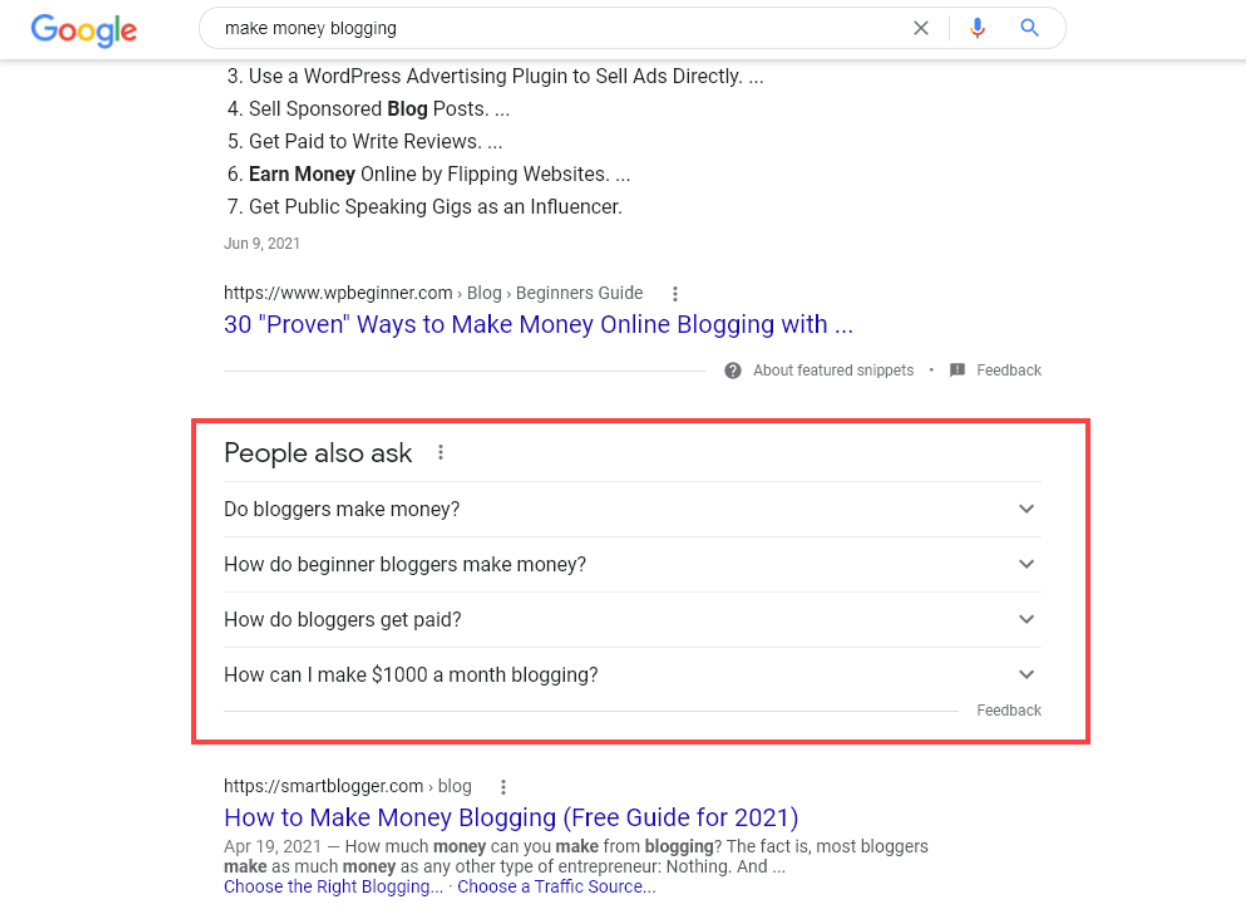
Answering these questions may help your post get more search engine traffic.
Snippets from different posts appear when a user clicks on one of those questions to see an answer, and your post might end up becoming one of the ones featured here.
It often makes sense to put your FAQs section near the end of your post, so readers can easily skip it if the questions aren’t relevant to them.
Quality Content Wins, Every Time
Ultimately, what really matters isn’t your word count. It’s the quality of your content.
Thoughtful, detailed, well-researched content will always win out over slap-dash content that simply repeats a few basic tips.
Aim to make your posts roughly 1,500 – 2,000 words — that’s the best default for blog posts in 2026 when you don’t have a specific reason to go shorter or longer.
If it’s a straightforward topic — or you’re specifically optimizing for AI Overview citations — 600-1,000 words can be exactly right. Tighter is often better when the question has a clear, direct answer.
If it’s a big topic, feel free to make your post as long as you like—just make sure your post is well-structured so readers can easily engage.
Whatever your blog post length, you need to be creating the best content you can. Start with a strong blog post outline—and it should all fall into place from there.
How Long Should a Blog Post Be: FAQ
What’s the ideal blog post length for SEO in 2026?
What’s the ideal blog post length for SEO in 2026?
For most blog posts targeting Google rankings, 1,500-2,000 words is the sweet spot. Backlinko’s analysis of top-ranking pages puts the average at 1,447 words, and Semrush data shows top-performing content averages around 1,152 words. Content over 3,000 words wins on backlinks (77.2% more on average) but isn’t necessary just to rank — especially for less competitive keywords.
Does longer content really rank better?
Does longer content really rank better?
Word count itself is not a Google ranking factor — comprehensiveness and search intent matching are. Longer content tends to rank better because it usually covers a topic more thoroughly, earns more backlinks, and demonstrates more depth. But a sharp, well-targeted 1,200-word post often beats a padded 3,000-word post on the same topic. Quality always wins over length.
How long should a blog post be to get cited in Google AI Overviews?
How long should a blog post be to get cited in Google AI Overviews?
Length doesn’t meaningfully matter for AI Overview citations. Ahrefs analyzed 174,000+ AI-cited pages and found the average length was 1,282 words — but 53.4% of cited pages were under 1,000 words, and the correlation between word count and citation rate was just 0.04 (essentially zero). What matters is direct, scannable answers to specific questions — not padding to hit a word count.
Is 500 words too short for a blog post?
Is 500 words too short for a blog post?
500 words is usually too short for traditional SEO-focused posts — Google’s top-ranking content typically runs 1,200+ words. But there are exceptions: brief news updates, FAQ-style answers, and content specifically targeting AI Overview citations can work at 500-800 words. The deciding factor is whether you’ve fully answered the search intent, not whether you’ve hit a magic number.
How long is the average blog post in 2026?
How long is the average blog post in 2026?
The current 2026 industry average is approximately 1,427 words, up from 1,236 words in 2023. Top-ranking content averages slightly higher (1,447 words per Backlinko’s data). The trend has been upward for years, but it appears to be plateauing as AI search shifts the optimal length downward for many query types.
How long should a pillar post or ultimate guide be?
How long should a pillar post or ultimate guide be?
Pillar posts and ultimate guides typically run 3,000-5,000+ words, and that’s appropriate for their purpose. These posts are designed to comprehensively cover a topic, serve as the hub for a content cluster, and attract backlinks (where the 3,000+ word backlink advantage really matters). Aim for 4,000 words as a target for most pillar pieces — but don’t pad to hit it. Cover the topic completely; the word count will follow.
How long should a listicle blog post be?
How long should a listicle blog post be?
Listicle length scales with item count. A good rule of thumb: 100-200 words per list item, plus a 300-500 word intro and conclusion. A 10-item listicle lands around 1,500-2,500 words; a 25-item listicle will run 3,000-5,000+. The longer ones tend to attract more backlinks; the shorter ones convert better for casual readers.
Should I make every blog post the same length?
Should I make every blog post the same length?
No. The right length varies by content type, search intent, and competitive landscape. A blog with a mix of 600-word FAQ posts, 1,500-word how-to articles, and 4,000-word pillar guides is often healthier than one where every post hits the same word count. Match length to purpose — readers (and search engines) reward the right length, not a consistent one.
Want to Start Your Blog (the Right Way)?
Check out my ultimate guide How to Start a Blog (on the Side).

40 replies to “How Long Should a Blog Post Be for SEO? The Ideal Word Count in 2026”
Thank you for sharing this profound article!
Hope will try to implement the same in our work too!
you’re welcome! I’m rooting for ya
thoughtful and detailed
I appreciate you!
Thank you for this article. It’s effortless to learn something new about it. This was an informative post for us. I would like to keep sharing these articles with others.