
After nearly a decade of paying for Ahrefs, I did something I didn’t see coming… I switched to Semrush. This honest Semrush review is everything I learned in the process, and my straight answer on whether it’s the SEO tool worth your money in 2026.
The switch wasn’t impulsive. With AI answers like ChatGPT and Claude now shaping how people find everything online, the tool you build your traffic on matters more than it ever has.
Here’s my full video walking you through how I use Semrush day to day:
Key Takeaways for Choosing Semrush
- It’s a true all-in-one platform. Semrush covers keyword research, competitor analysis, site audit, domain overview reports, rank tracking, and search intent analysis in one login.
- The Keyword Magic Tool is still the industry standard. This keyword research tool finds low-competition terms, filters them by keyword difficulty score, and uses search intent data to guide your ranking decisions.
- Position tracking now covers AI visibility. You get AI visibility tracking for ChatGPT, Perplexity, Gemini, and Google AI Overviews right beside your classic rankings.
- Pricing is premium. Plans start around $140 a month, and the platform has a learning curve for beginners.
Get the All-in-One SEO Tool I Actually Pay For: Semrush
I’ve paid for Semrush with my own money for years because it replaces a whole stack of separate tools with one login. Keyword research, competitor spying, site audits, rank tracking, and AI visibility all live in the same place. Test the full toolkit free for 7 days and see why it earned a permanent spot in my workflow.
My Honest Semrush Review After Years of Paying for It
Put simply, Semrush is massive digital marketing software for getting found online. It crawls a huge chunk of the internet, so its underlying data supports quick backlink analysis.
The clean user interface organizes the dashboard, while Domain Overview provides immediate data after you enter a URL.
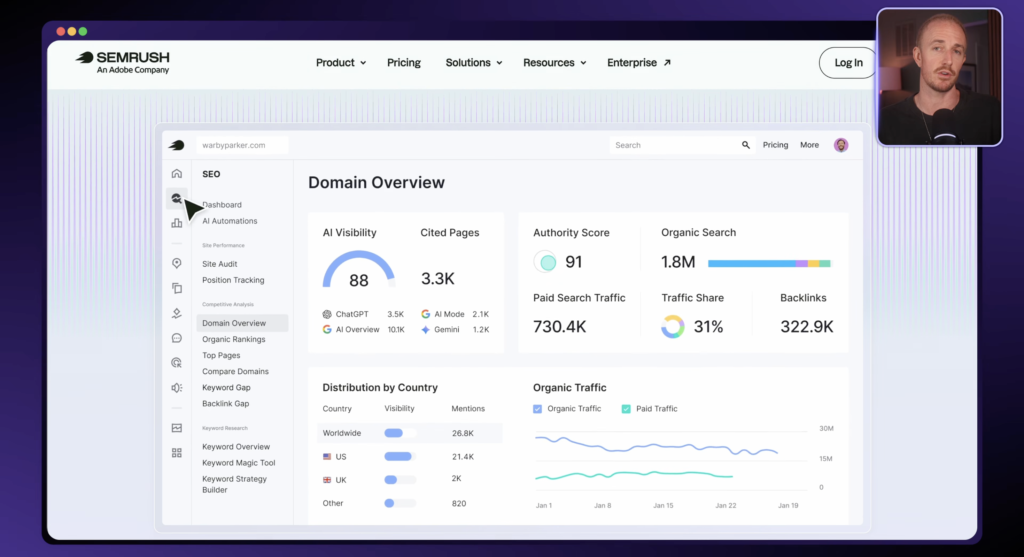
It’s easy to get overwhelmed at first because Semrush is an all-in-one SEO toolkit. It covers:
- SEO features
- Local SEO
- A content marketing toolkit
- A link building tool
- Ads and social reports
- AI visibility tracking
Before choosing a keyword, check its keyword difficulty score and search intent. If you’re a marketer, SEO professional, or entrepreneur, the platform is aimed right at you.
Take your time and learn the features as you go. You can also explore free keyword research tools if you aren’t ready for a paid subscription yet.
If you want a complete system, dependable traffic estimates can help turn organic traffic into revenue while aligning landing pages with visitor search intent.
The Semrush Features I Use Every Week
Every single week, I log in to use a handful of core features that drive my content strategy. Let’s look at the tools that actually matter for your daily workflow.
Keyword Research With the Keyword Magic Tool
Keyword research is the feature I use the most. The Keyword Magic Tool remains a leading keyword research tool and the industry standard.
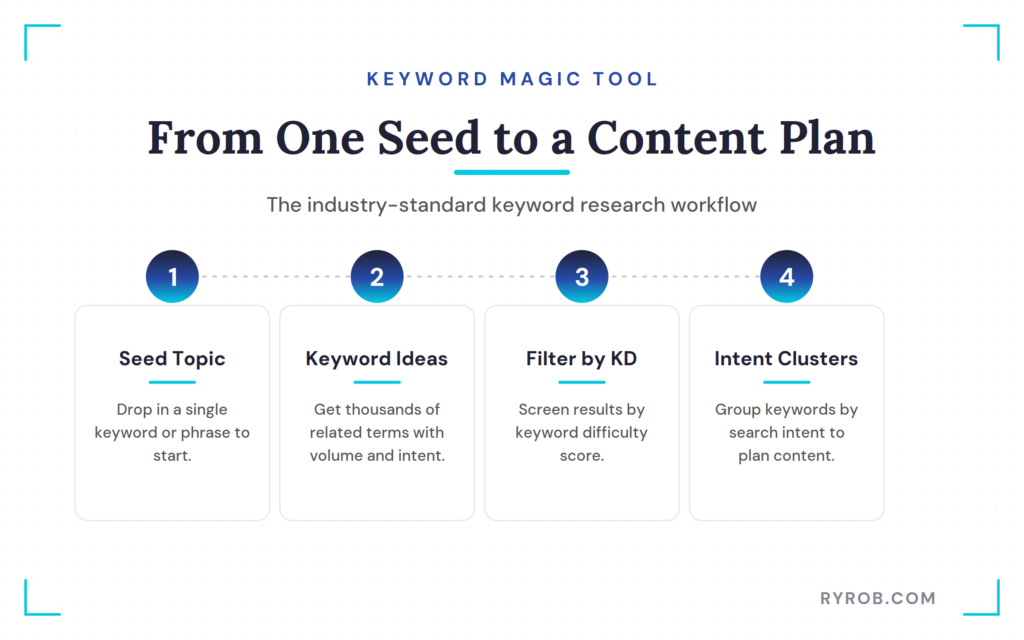
Let’s say I want to rank for a keyword like “how to grow a YouTube channel”. I can connect Semrush to my existing projects for a refined search that matches my specific web property.
The tool gives me estimates for keyword difficulty. I can drop in one seed topic and get thousands of related keywords with search volume and intent data. I filter results using the keyword difficulty score, then compare each keyword difficulty score against my site’s authority and goals.
Over on the left side, topic buckets let me filter by specific search intent, including commercial and informational terms. I can also group keywords that match identical search intent, which makes content planning much easier.
That helps me separate topics into different clusters. Rather than just targeting the top ranking term, I can drill down to what my audience cares about most.
For a step-by-step approach on this, you can read my guide on how to do keyword research.
Competitor Research That Reveals Their Playbook
Competitor analysis is another standout feature. I start with the domain overview, entering my site and rival URLs to compare their performance.
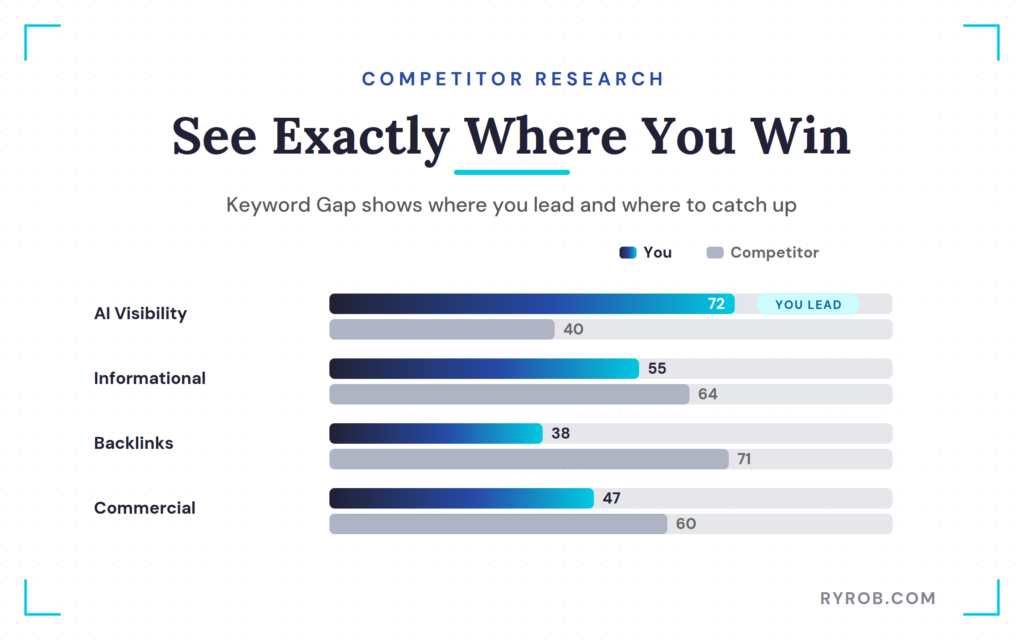
Then I use the Keyword Gap tool to uncover content opportunities competitors rank for that I don’t.
Semrush’s domain overview shows their best-performing pages, traffic estimates, and backlinks. Its organic research reports also support deeper backlink analysis and keyword comparisons. The keyword gap tool helps me identify competitor terms that satisfy valuable search intent.
When I run an example for RightBlogger, my blog automation SaaS tool, and compare it against major competitors, I can see where we’re winning and where we’re falling behind. We might be higher on AI visibility for certain queries, but our rivals are doing better on other topics.
I take these insights and figure out where my competitors are outranking me. Then I create content that matches that need better. It basically gives me the entire competitor playbook on one screen.
Position Tracking for Google and AI Rankings
Position tracking gives you daily rankings for your target keywords. The smart update for 2026 is that position tracking now includes AI visibility tracking. You’ll know whether you’re landing in Google’s AI Overviews, ChatGPT, and other AI platforms.
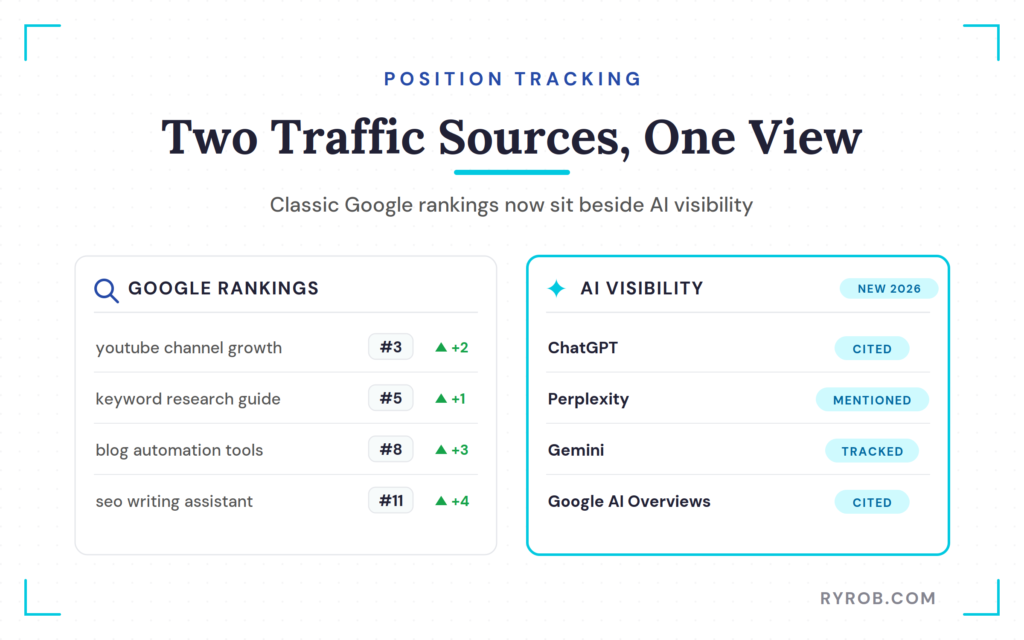
This is great because you can watch both key traffic sources in one single place. It’s also one of the big features that sets Semrush apart from competitors like Ahrefs, which charges an additional fee for similar AI visibility tracking features.
Site Audits That Flag Your Biggest Fixes
Site audit crawls your whole site and hands you a prioritized fix list. It flags whether AI crawlers can read your pages and whether indexed content fulfills search intent. I can prioritize those fixes alongside keyword difficulty targets, then see an overall grade for my site health.
When you click in, the site audit highlights issues and provides an explainer on how to fix them. If you work with a team, you can send these reports to other people.
I also use the SEO Writing Assistant for content optimization and Semrush’s link building tool for outreach and link acquisition.
Semrush’s New AI Visibility Tools for 2026
The coolest thing Semrush has built in recent years is their AI visibility toolkit. It tracks how often your brand shows up when people ask ChatGPT, Perplexity, Gemini, or Google’s AI a question.
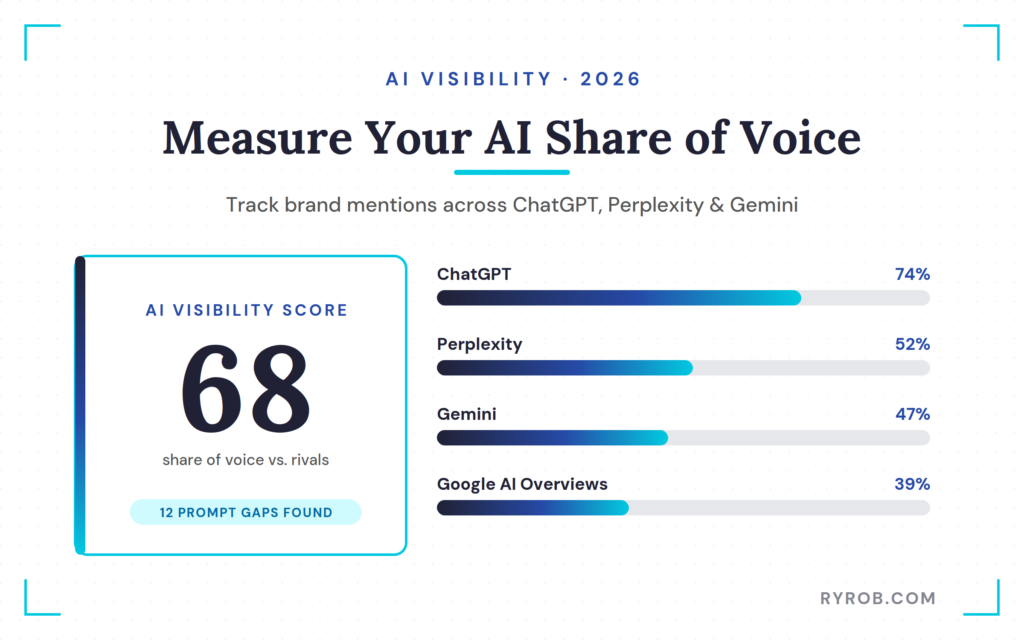
This kind of automated AI visibility tracking gives you a clear view of where you stand in generative search results.
You get an AI visibility score, your share of voice against competitors, and a list of the exact prompts where your rivals get mentioned and you don’t.
Tracking Your Brand Across ChatGPT, Perplexity, and Gemini
Measuring how your brand appears across conversational search engines is no longer optional. The toolkit provides a clear chart showing your citations, mentions, and which pages are actually being cited by which platform.
It is AI visibility tracking built for the era where answers replace links.
You’ll quickly see where you’re performing well and where you’re invisible. For instance, you might find that you do best in cited pages on ChatGPT, while your overall mentions are evenly distributed across other platforms.
This data goes beyond what a standard domain overview report shows, because it captures answers instead of just rankings.
Finding the Prompts Where Competitors Get Cited
The missing list of prompts where your competitors get mentioned and you don’t is a content to-do list handed straight to you. This turns prompt gap analysis into something as actionable as organic research.
You get recommendations on how to improve your AI citations by uncovering topic opportunities and checking your domain’s AI health.
As someone watching AI change how people find everything online, being able to measure this kind of stuff and take action on it is a massive advantage.
Unlike position tracking for classic search results, this shows you who wins when AI delivers the answer. There’s a real early mover advantage on optimizing for AI engines right now.
The MCP Connector for Claude and ChatGPT
Integrating Semrush data directly into AI assistants changes how you run analyses. You can run topic research, compare competitors, and set up regular competitor reporting directly through your preferred AI chat interface.
When you ask an AI model to analyze data for your site using Semrush insights, the model runs strategic decisions based on real-world search metrics. This matters because conversational search intent often differs from typed queries.
You need to understand how people phrase questions, how that shapes AI answers, and how to craft content that satisfies conversational search intent. The connector bridges the gap between raw AI generation and data-backed marketing decisions.
Semrush Pricing and Whether It’s Worth It
The platform isn’t perfect, and it comes with a premium price tag. Plans start at around $140 a month and climb from there. I use the Semrush One plan, which runs $199 a month, and content tools or advanced toolkits are available as add-ons.
There’s a learning curve the first time you log in, so give yourself some grace and experiment with the features. If you’re brand new to SEO, you might want to test free tools and trials first.
As a reminder, Adobe completed its acquisition of Semrush, cementing its place as an enterprise-grade marketing platform. If you’re serious about traffic growth and want one place that covers both classic SEO and the new AI search world, Semrush is the most complete tool for the price point.
FAQs About Using Semrush
Here are quick answers to the questions I get asked most about Semrush:
Can You Use Semrush for Free?
Yes, you can. Semrush has a limited free account that lets you run a small number of keyword lookups, domain overview checks, and site audits each day, which is enough to get a feel for the platform.
If you want the full toolkit without paying yet, the 7-day free trial opens everything up so you can test it properly before you commit.
Is Semrush Worth It for Beginners and Small Businesses?
It can be, but it depends on how serious you are about traffic. If you’re actively publishing content and treating SEO as a real growth channel, the keyword research and competitor analysis alone can pay for the subscription.
If you’re only dabbling, start with the free tools and trials first, since the platform is premium-priced and has a learning curve.
Is Semrush Hard to Learn?
There’s a real learning curve the first time you log in, since the platform packs in a lot. My advice is to give yourself some grace and explore the features as you go, rather than trying to master everything at once. Within a week or two of regular use, the tools you rely on most start to feel like second nature.
What Is Semrush Used For?
Semrush is an all-in-one platform for getting found online. People use it for keyword research, competitor analysis, rank tracking, site audits, and now AI visibility tracking across ChatGPT, Perplexity, Gemini, and Google AI Overviews.
It’s built for marketers, SEO professionals, and entrepreneurs who want one place to plan content and grow organic traffic.
Final Thoughts on Using Semrush
To wrap up this Semrush review, if you’re serious about growing your organic traffic, it is an indispensable SEO toolkit and the most dependable SEO tool available today. Create content that fully satisfies your audience’s search intent, then use Semrush to build consistent traffic over the long haul.
AI visibility tracking is its key differentiator. Adopting these features early gives you an edge over competitors who still ignore conversational search. Start with a free trial and see how Semrush can transform your workflow.
Get the All-in-One SEO Tool I Actually Pay For: Semrush
I’ve paid for Semrush with my own money for years because it replaces a whole stack of separate tools with one login. Keyword research, competitor spying, site audits, rank tracking, and AI visibility all live in the same place. Test the full toolkit free for 7 days and see why it earned a permanent spot in my workflow.

Great review! I especially liked the focus on Semrush’s AI visibility tracking, competitor research, and keyword tools. The shift from traditional SEO to AI search makes tools like this increasingly useful for marketers.