
I asked ChatGPT for the best breakfast burrito spots in Telluride… and the site I built wasn’t one of them. It had no clue the place existed. If you’ve ever wondered why your business isn’t showing up in AI search, that blank right there is the whole AI search visibility problem.
A lot has changed in the search landscape. For twenty years, search meant a Google page with ten blue links, and the whole point was ranking high enough to grab clicks. I’ve made millions from that search setup, but things look totally different today when someone runs conversational search queries into an AI assistant.
That happens to almost every small business site I see. Here’s the full video where I run that ChatGPT test live, then fix all four problems on a real small business site:
Key Takeaways for Building AI Search Visibility
- AI chat tools skip websites that lack clear facts, real answers, clean structure, and consistent trust signals across the web.
- These strategies build on traditional SEO. Large language model optimization doesn’t require quick tricks or short-term hacks.
- Expect visibility to take time across the evolving search landscape, because search engines and chat tools re-crawl and re-verify sites on their own schedules.
- The main goal is simple. Make your site the easiest and most trustworthy source for an AI model to quote.
Make Your Site Easy for AI to Read With WordPress.com
An AI can only quote what it can actually read, and my own site taught me that lesson. WordPress.com handles the clean structure and fast pages from day one, so your content lands in a shape these tools can work with. That’s why I build here now, and it’s an easy place to start 👇
Why Your Business Isn’t Showing Up in AI Search
The question I get asked most often lately is why the AI ignores a site and recommends a competitor instead. It’s not personal and it’s not random.
When an AI assistant builds an answer, it asks a few direct questions about your site in a split second. What is this business? Where is it? What does it actually offer? Can I trust what I’m reading?
That’s assuming you’re even in the running for the AI to consider you in the first place. Most small business websites don’t provide direct answers to these key questions clearly enough for the machine to feel confident recommending them.
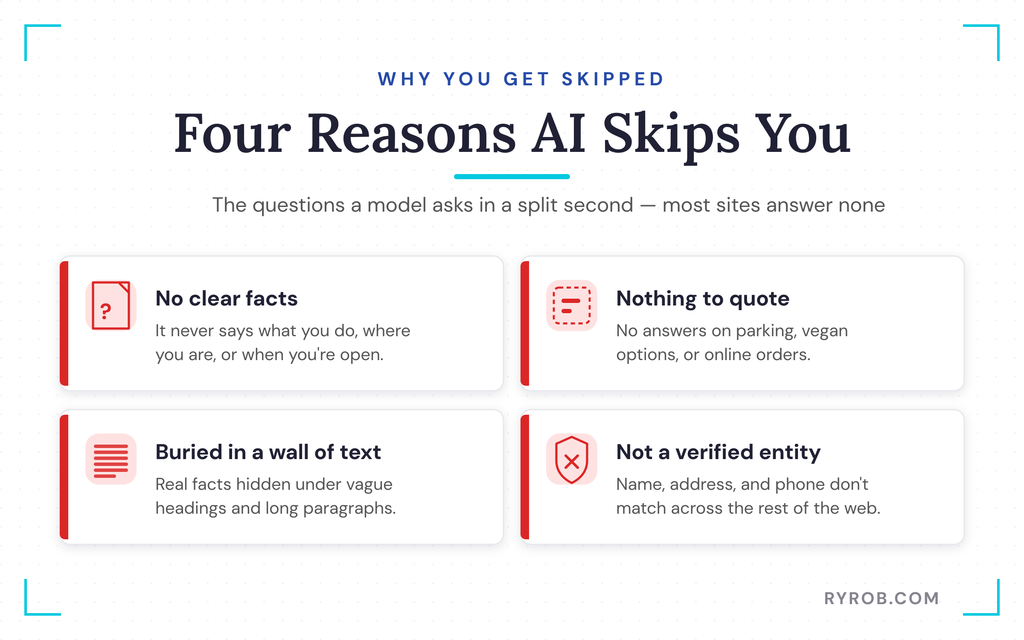
No Clear Facts for AI to Pull From
Your site might look great, but it never states what you do, where you are, or when you’re open. If those details aren’t there, the AI has nothing concrete to grab.
In my test with a local business like the breakfast burrito shop, the site looked fine at first glance. But if it doesn’t mention Telluride right at the top or spell out its operating hours, the system skips it for a spot that does.
Thin Content That Answers Nothing
Many sites lack real answers to the actual questions people ask about a business. If customers want to know about vegan options, parking, or reservations, and your pages don’t say, you won’t get cited.
AI tools look for specific details and content depth to quote. Thin content gives them nothing to work with.
Good Information Buried in Messy Structure
Even when the right info sits on your page, it’s often buried in a massive wall of text or hidden behind unclear headings. AI prefers scannable content with short paragraphs and direct phrasing.
If a machine can’t parse your page layout easily, it passes over your business for a cleaner competitor. This is where the basics of on-page SEO still do a lot of quiet work for you.
Not a Verified Business Entity Yet
AI systems check if your name, address, and details match across the entire web. If your website says one thing and your directory listings say another, the AI can’t confirm you’re real.
Without third-party corroboration from trusted directories, media, and external links, you won’t look legitimate enough to recommend.
What Changed About Search, and Why AEO Matters Now
For a long time across the search landscape, traditional search engine optimization meant tweaking meta tags and building backlinks to climb a list of blue links. That foundation isn’t going anywhere. But people have changed how they look for things, and a lot of them now want a direct answer inside a chat interface instead.
Whether someone turns to ChatGPT or Perplexity, AI-generated search results deliver one concise answer pulled from a handful of sources the AI trusts. The game isn’t just about grabbing the top spot anymore. It’s about being one of the first sources the AI chooses to pull from.
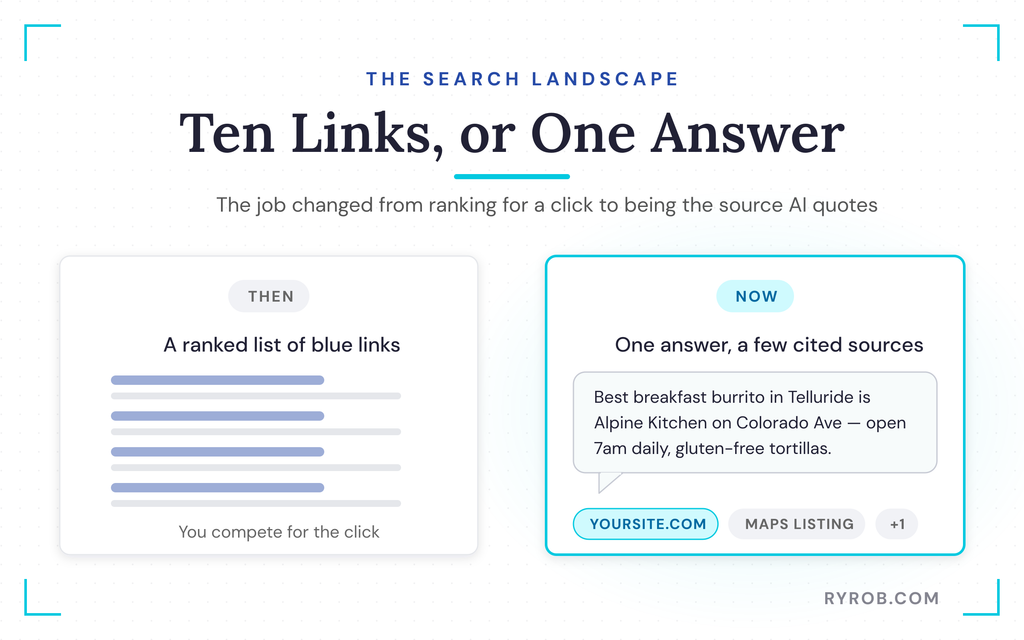
Search marketers call this answer engine optimization or generative engine optimization, but it’s really just the next chapter in the search playbook.
Run a local restaurant or manage B2B marketing campaigns, and the effect is the same. Getting cited inside those answers protects your traffic and keeps your brand visible right when customers are deciding.
4 Fixes That Make Your Site Readable to AI
You don’t have to guess why your pages get skipped anymore. You can make practical changes right now to help ChatGPT, Perplexity, and Google AI Overviews read and trust your site.
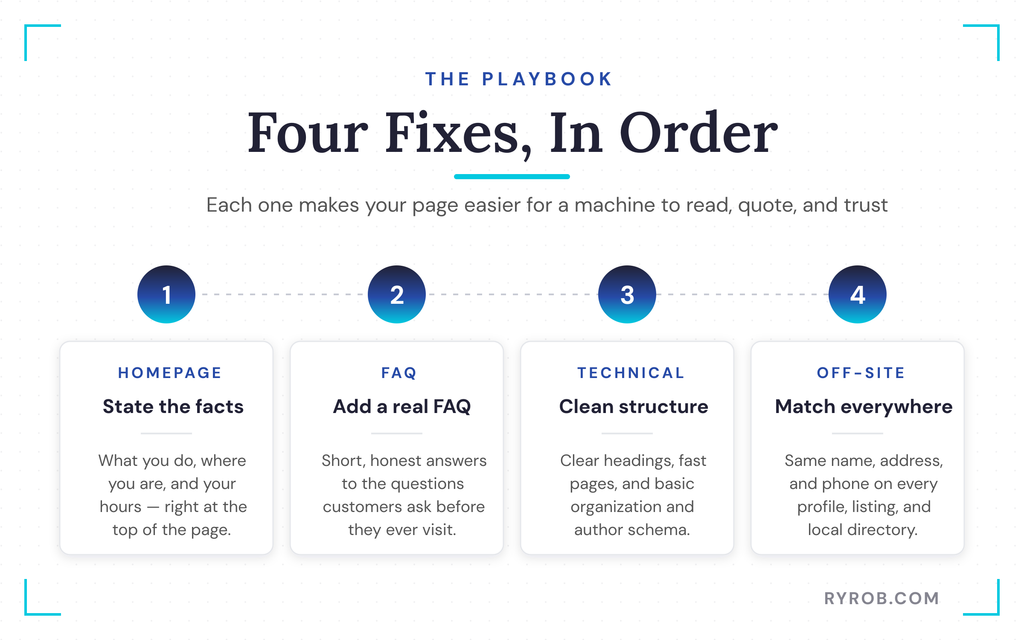
Let’s walk through the exact steps to fix your business information, add a smart FAQ section, clean up your technical setup, and match your details across the web.
1. Make Your Core Business Facts Impossible to Miss
Put your basic facts right at the top of your homepage in plain language. State what you are, where you’re located, what your hours are, and what makes you different. If a human can scan it in five seconds, an AI can extract it in milliseconds.
On the site I built with the WordPress AI website builder, I made sure Telluride and breakfast burritos appear immediately in the main text.
I also updated our story section to use short paragraphs and bullet points instead of a heavy block of text. Then I added real photos with clear captions, so both humans and machines know what they’re looking at.
2. Add an Honest FAQ Section AI Can Quote
Give AI tools something worth quoting by adding a short, honest FAQ section to your pages. Answer the questions customers actually ask before they visit, like whether you have gluten-free options, if you take online orders, or where to park.
Use a clean, collapsible format so the page stays neat while keeping the answers fully accessible. ChatGPT and other tools love to lift these Q and A pairs directly into their responses.
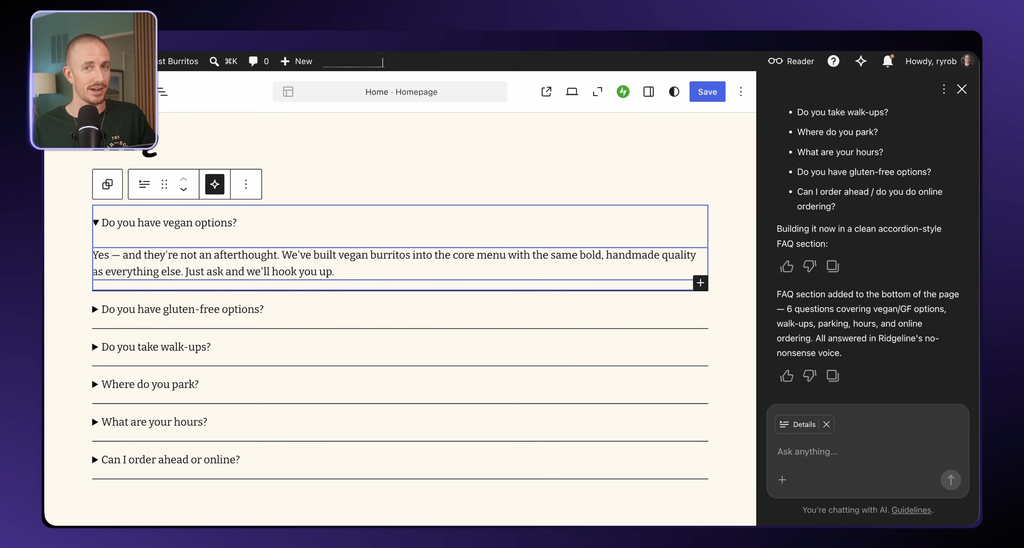
If you’re not sure what people ask, a bit of keyword research goes a long way. You can also try RightBlogger’s People Also Ask tool to source long-tail keyword opportunities and starter copy for your site.
3. Clean Up Your Headings, Speed, and Schema
The technical structure of your site determines whether crawlers can read your content without hitting roadblocks. Clean URLs, proper heading hierarchies, and fast page speeds make a massive difference.
Building on a solid platform like WordPress.com handles a lot of this automatically by providing clean semantic headings and fast performance. While schema markup isn’t the magic citation hack some claim it to be, adding structured data such as basic organization and author markup helps search engines parse your pages correctly.
For more on working with these tools day to day, I keep everything about using AI as a business owner in one place.
4. Match Your Business Details Everywhere Online
AI models verify your legitimacy by checking your brand across the entire internet. Maintain strict NAP consistency, which means your business name, address, and phone number all need to match across your Google Business Profile, social media accounts, data aggregators, and local directories.
Earning third-party corroboration from local publications and community guides, combined with steady review velocity, makes your brand appear far more trustworthy. My guide to link building walks through how to earn those mentions without spamming anyone.
If you want to dive deeper into growing your online presence, local SEO, and organic traffic, check out my complete guide to blog SEO strategies for a step-by-step roadmap.
How Long Until AI Search Starts Citing Your Site
Let’s be straight about expectations here. When you click save on your updated website, succeeding at large language model optimization won’t happen ten seconds later.
AI systems re-crawl and re-verify pages on their own schedule. Expect this process to take days, weeks, or even months before you see steady AI search visibility and consistent citations.
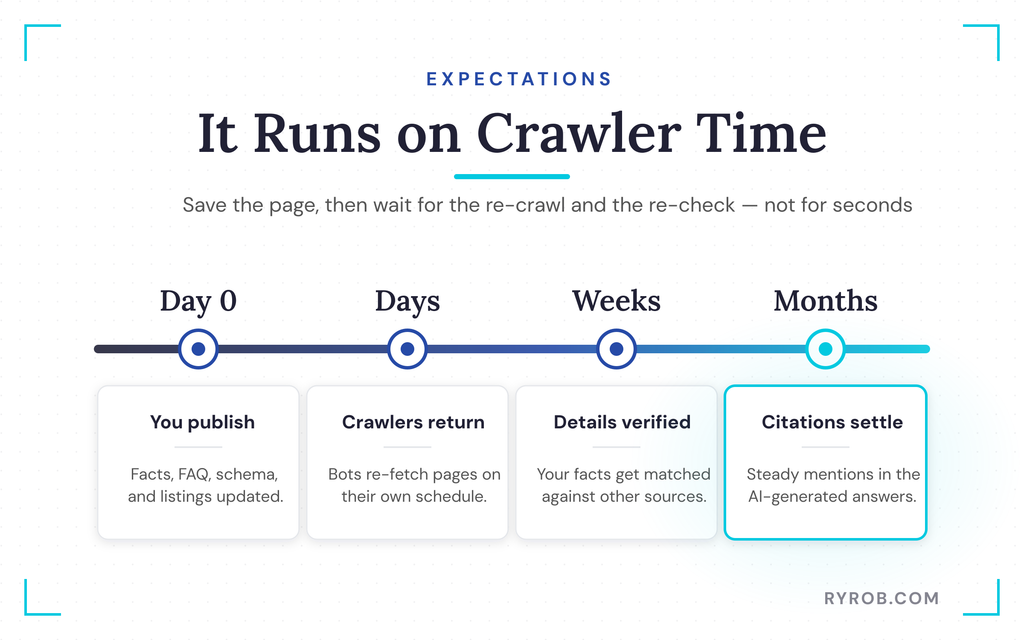
None of this speeds up how fast the crawlers come back around. What a fast, clean site does is give them less to trip over, which is the quiet argument for building on WordPress.com.
The good news is that you can test your progress early by feeding your newly structured page back into an AI chat tool and testing realistic search queries. Ask ChatGPT or Perplexity to evaluate your business, and you’ll quickly see if the AI can read your offerings clearly and where you still need to tighten up your messaging.
FAQs About Showing Up in AI Search
Here are the questions I hear most often about all of this.
Do I need to be on Bing for ChatGPT search?
Yes, ChatGPT search runs on Bing’s index rather than Google’s. If you haven’t submitted your sitemap to Bing Webmaster Tools, you won’t show up in ChatGPT answers no matter how well you rank elsewhere.
Does schema markup guarantee AI citations?
Not by itself. While schema helps search engines parse your content, data shows it has a minimal direct effect on AI citations compared to content quality, factual density, and clear page structure.
Why does AI choose pages that don’t rank on Google?
AI engines look for direct answers, specific facts, and scannable formatting rather than just traditional ranking signals. A page buried deep in traditional search results can still get cited if it answers a specific prompt better than the top-ranking pages.
How can I track my AI visibility?
You can use dedicated tracking platforms like Otterly.ai, Semrush AI Toolkit, or Ahrefs Brand Radar to monitor how different AI chat engines mention your brand and where your competitors are winning citations.
Final Thoughts on Showing Up in AI Search
You can’t control every word an AI model generates, but you can control how easy your site is to read and quote. That’s the part people miss when they go hunting for a shortcut, because there isn’t one to find.
Lay out clear facts, answer the questions your customers actually ask, and keep your details consistent everywhere you show up online. None of that is exotic. It’s just the stuff most small business sites never got around to.
If AI has never heard of your business, it’s almost never because you’re not good enough. It’s because your site isn’t readable enough yet, and that’s a much easier problem to solve than it sounds.
So start with your homepage this week… what you do, where you are, and when you’re open, written plainly enough that a machine can lift it in a second. Do that much and you’ve already passed most of your competition.
Make Your Site Easy for AI to Read With WordPress.com
An AI can only quote what it can actually read, and my own site taught me that lesson. WordPress.com handles the clean structure and fast pages from day one, so your content lands in a shape these tools can work with. That’s why I build here now, and it’s an easy place to start 👇

I’d add a step zero before the four fixes: check that the AI crawlers can actually reach the page. ChatGPT search uses its own crawler (OAI-SearchBot), and a CDN “block AI bots” toggle or an aggressive bot-protection rule can turn it away while the site looks perfectly normal in your own browser. All the FAQ and schema work in the world doesn’t help if the fetch fails.
And for anyone also testing ChatGPT’s paid ads: ad review uses a separate crawler again, so allowing one doesn’t cover the other. Passing the ad check also tells you nothing about whether the page gets cited organically. They’re two separate doors, and it’s worth testing both.