
Picture someone asking ChatGPT for the best tool in your niche… and your brand never coming up. You can rank number one on Google and still be invisible where the decision actually gets made. That gap is exactly why learning how to check AI visibility matters now.
I ran one of my own sites through this exact test and did not love what I found. Ranking at the top of Google didn’t mean ChatGPT would mention me, and my AI brand visibility was sitting near zero.
The good news is you can measure this and start showing up. Here’s the full video walkthrough I recorded on checking and fixing your AI visibility before we dig into the steps.
Key Takeaways for Checking Your AI Visibility
- AI visibility is a second scoreboard. It measures rank, citations, brand mentions, and sentiment across conversational engines like ChatGPT, alongside your usual LLM visibility.
- Ranking number one on Google isn’t enough. A top spot in traditional search does not guarantee that ChatGPT will mention your brand in its answers.
- AI visibility is built on classic SEO. Growing your presence in AI tools relies on SEO best practices rather than replacing them.
- Start with the prompts competitors already win. The fastest way to find opportunities is tracking search-backed prompts where your rivals get named and your business is missing.
- A handful of levers move the needle. Answer real questions clearly, add structured data, create an LLMs.txt file, earn citations from trusted sources, and lean on historical data to keep your SEO fundamentals strong.
See Where AI Is Skipping You with Rank Math
Rank Math is the tool I used to run every AI visibility check in this post. It tracks your rank, citations, mentions, and sentiment inside ChatGPT, then points you to the exact prompts worth chasing. You can check your own site in a couple of minutes below!
Why Ranking Number One on Google Doesn’t Mean ChatGPT Mentions You
The way people find answers has shifted hard over the last few years. Instead of clicking through traditional blue links, a huge chunk of your audience just asks their favorite AI assistant and takes its advice.
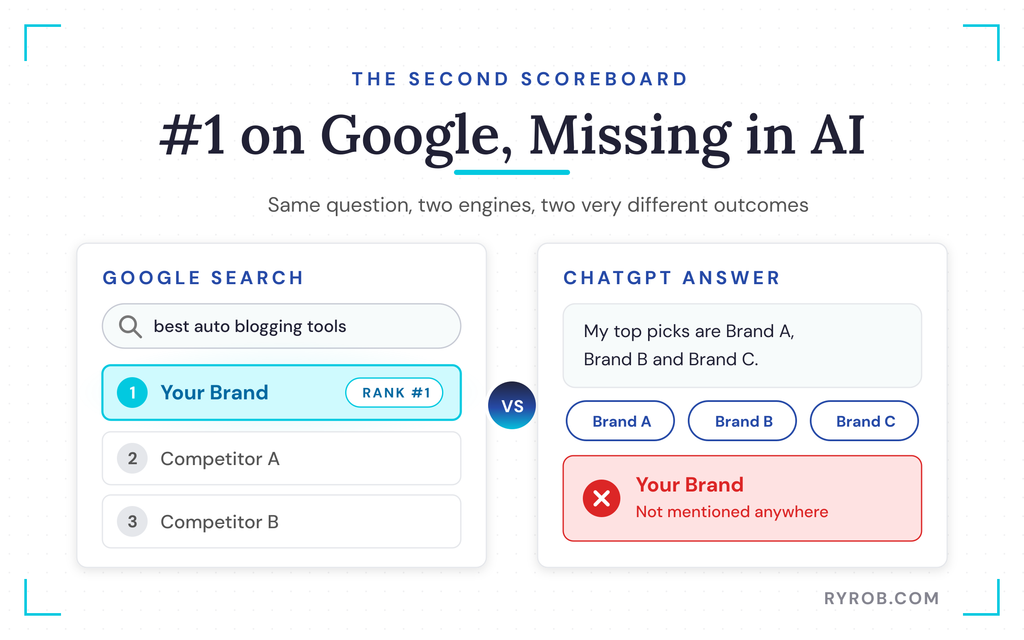
A classic Google search for auto blogging tools puts my software tool RightBlogger right at the top of the results page. Winning in traditional search feels great, right up until you ask ChatGPT the same question. Brand awareness doesn’t carry over.
The chatbot recommends three other brands in a single sentence and drops a comparison table below. My brand mentions are missing entirely, even though RightBlogger ranks number one in classic search for that exact query.
According to Ahrefs’ AI Overviews citation data, only 38 percent of cited pages rank in the top 10 for the same query. That gap proves you can dominate traditional search engines and still have close to zero AI brand visibility, even across cited domains.
If you’re still shoring up the traditional side, it’s worth brushing up on how to rank higher on Google first. Once that foundation is set, AI visibility becomes its own puzzle to solve.
What Google Says About Optimizing for AI Search
Most advice around AI search makes it sound like you need a brand new rulebook to compete. Fortunately, Google’s AI optimization guide clarifies that generative engine optimization is still optimizing for the search experience.
You don’t need a secret bag of tricks or complex hacks to get noticed. The fundamentals that make your site useful to humans are the exact same signals AI platforms look for when choosing sources. You can think of this as Answer Engine Optimization, which still leans on those same fundamentals.
Strong technical health, clear page structure, and genuine expertise form the foundation of both traditional and AI search engine visibility. AI crawlers rely on the same signals as traditional search engines, which is why solid SEO best practices still do a lot of the heavy lifting toward AI readiness.
How to Check Your Site’s AI Visibility
Measuring something that lives inside a chatbot used to feel impossible. Tools like Rank Math’s new AI visibility feature change that by acting like a rank tracker for AI answers.
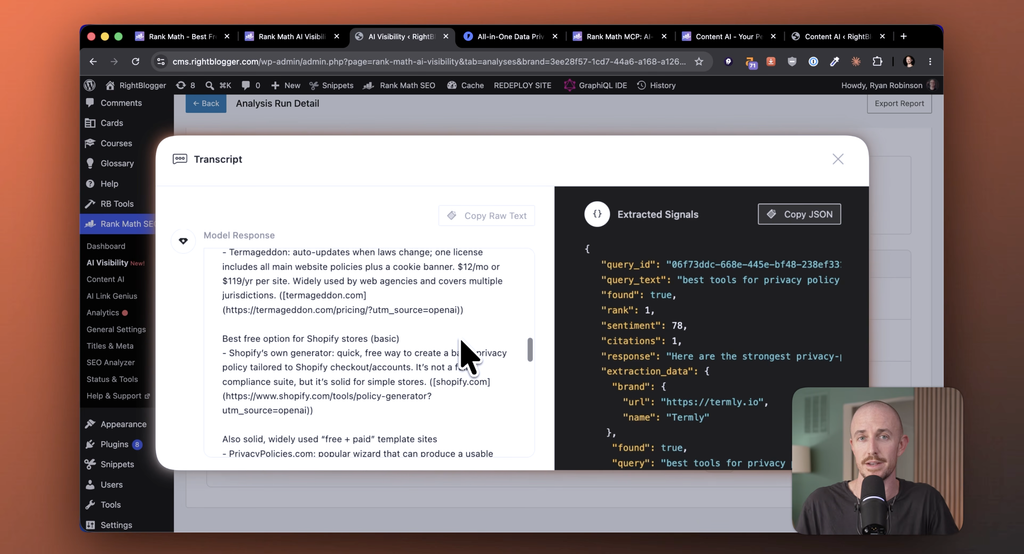
I teamed up with Rank Math on this one, and that feature is what I used to run every check you’ll see here. You enter your brand, and the tool identifies search-backed prompts your customers actually type into ChatGPT.
From there it tracks whether the AI mentions your business, links to your site, and talks about you in a positive light. Instead of a generic report card, that data works more like a treasure map. It shows you the exact gaps in your content and reveals which competitors are winning the answers you want to own.
Rank, Citations, Mentions, and Sentiment Explained
Your AI brand visibility score breaks down into four specific metrics that tell you how you’re performing.
- Rank. Where you land in the answer, because being named first carries far more weight than a stray mention at the very end.
- Citations. Citation rate tracks whether the AI links to your site as a source, and citation frequency shows how often it cites you across tracked prompts.
- Brand mentions. How many of the tracked questions name your brand at all.
- Sentiment. Whether the AI talks about you positively, neutrally, negatively, or ignores you entirely, which is a simple form of sentiment analysis.
Together, these four numbers give you a clear AI share of voice scoreboard, plus historical data to track over time.
How to Find the Exact Questions Where Competitors Beat You
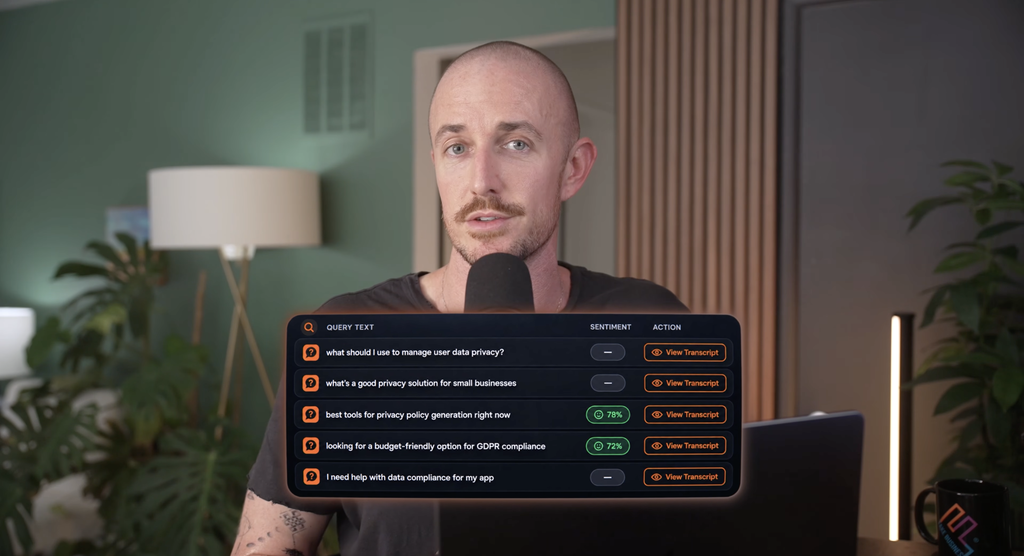
The competitor analysis tab inside your tracking tool reveals the major players showing up in AI answers. You can see the exact questions where your business is absent while your rivals take the top spots.
Clicking into the transcript of an AI run lets you read the exact response the model generated. Not every question needs to mention a brand, since some searches are purely informational.
When users ask for the best tools or budget-friendly options, those commercial queries are prime spots where your brand needs to appear. Treat that list as your working to-do list and turn it into a real SEO content strategy you can chip away at.
It also helps to pair those prompts with my free keyword research tool so you can size up demand before you commit to writing anything new.
Using Rank Math’s MCP Connector with ChatGPT and Claude
Rank Math connects directly to ChatGPT and Claude through an MCP connector. Instead of bouncing around inside a separate dashboard, you can ask your AI assistant for actionable insights right inside the chat window.
This connection lets you ask the AI to audit your site’s SEO and hand back the top three fixes based on your actual pages. Setting up the connector takes just a couple of minutes.
It’s a convenient way to pull data without breaking your workflow. You don’t need the connector to measure visibility, but it does speed up the audit.
Five Ways to Show Up in AI Answers (Even If You’re Starting Invisible)
You can’t force an AI model to mention your brand, but you can absolutely stack the odds in your favor. Showing up comes down to a handful of levers that stay entirely in your control.
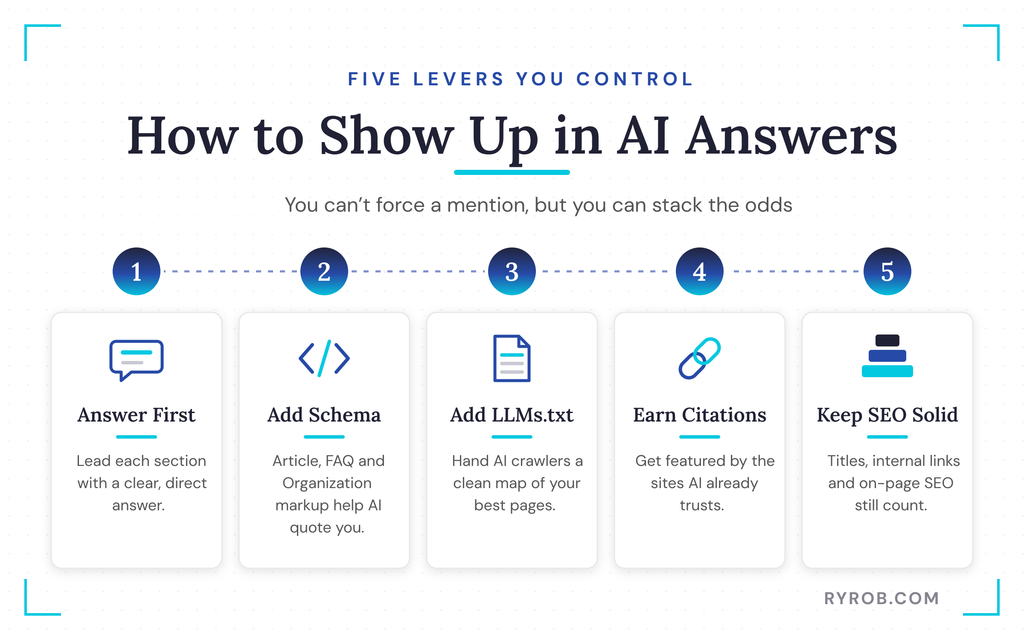
This takes real work rather than a magic button. Let’s walk through the five steps.
1. Answer Real Questions Clearly Near the Top of Each Section
AI models pull from content and brand mentions that directly answer search-backed prompts. If your answer is buried six paragraphs down the page, the crawler skips right over it.
Use clear headings and put your direct answer in the first sentence under each one. Tools like Content AI can help you rewrite sections and build outlines that satisfy search intent fast, and my free AI article writer is handy for drafting those answer-first sections too.
Since a lot of my best content starts as a video, I also run it through my free video to blog tool to get an answer-rich draft in minutes. Clear phrasing makes it far easier for an LLM to lift your text and use it in a generated response.
2. Add Schema Markup So AI Can Quote You
Schema markup is structured data that spells out what your page contains in a format machines understand. It makes your content easier for AI systems to parse, quote, and display correctly.
You can use schema types like Article, FAQPage, and Organization depending on the page. Most SEO plugins generate this code for you without any manual coding.
Schema alone won’t guarantee citations, but it removes friction and improves your overall AI readiness.
3. Make Your Site Legible to AI Crawlers with Clean Structure and LLMs.txt
AI crawlers need a clean site structure with logical headings and short paragraphs to read your content well. Creating an LLMs.txt file acts like a roadmap that hands ChatGPT a clean list of your best pages.
You also want to check your robots.txt file to make sure crawlers aren’t accidentally blocked. If an AI engine can’t crawl your site, you’ll never show up in its answers.
4. Earn Citations from Sources AI Already Trusts
AI borrows trust from the publishers, creators, review sites, and podcasts it already relies on for authority. According to industry reports, review sites and third-party publishers drive a significant share of total AI citations.
Your best move is finding where your competitors get cited and earning coverage through guest posts, interviews, and digital PR. No plugin can do this relationship work for you.
When you see which questions your competitors win, look at who is citing them and reach out to those same outlets.
5. Don’t Ditch SEO Fundamentals
AI visibility is built on top of classic SEO, not instead of it. Strong titles, descriptive internal links, and solid on-page SEO still form the foundation of organic success.
A weak SEO base makes it much harder for AI crawlers to discover your content in the first place. Keep your core optimization strong while you build out your AI strategy.
How to Track Your AI Visibility Over Time
Improving your AI brand visibility takes time and steady effort. You’re watching trends unfold over a month or more rather than expecting overnight miracles.
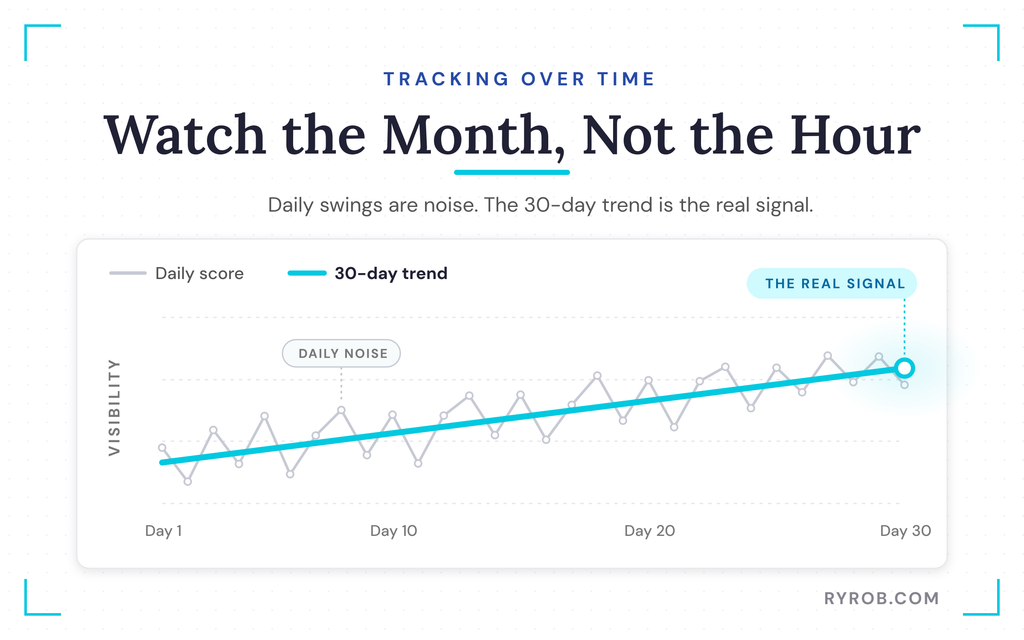
Dodging a few common pitfalls keeps your content moving in the right direction. Let’s look at how to track progress and what to avoid.
Track Trends Over a Month, Not Hours
AI engines update constantly, so daily score swings are usually just background noise. Set up a regular tracking schedule and review your historical data to see whether more pages are entering your citation mix.
Pay attention to whether the same competitor keeps beating you on high-value search-backed prompts. Expect less total traffic from AI search, but look for higher intent from the visitors who do arrive.
Refresh your pages regularly and run new audits to measure your momentum.
Mistakes That Keep You Invisible
A few habits keep creators stuck on the invisible side of AI answers.
- Chasing quick AI hacks instead of building genuine AI readiness.
- Ignoring the content gaps your competitors already dominate, which leaves your brand mentions behind.
- Publishing thin pages that cover the same topic with slightly different phrasing, which wastes time and hurts your site authority.
- Writing vague generalizations with no real facts, numbers, or dates, which makes your content forgettable.
- Leaving outdated articles unrefreshed or skipping basic author credentials, which stops AI engines from trusting your brand.
Clean up a few of these and you give the AI far more reason to pick you.
FAQs About How to Check Your AI Visibility
A few more questions come up a lot, so here are the quick answers.
Do I Still Need Traditional SEO If I’m Focused on AI Visibility?
Yes, traditional SEO stays essential because AI assistants lean on classic search foundations for AI visibility. Google’s own guidance confirms that optimizing for generative search uses the same core principles as standard optimization.
Does Ranking Number One on Google Help With AI Visibility?
Ranking high on Google helps your overall authority, but it doesn’t guarantee an AI citation. AI engines prioritize direct answers, specific data, clean formatting, and brand mentions over raw ranking position.
Does Structured Data Guarantee AI Citations?
No, schema markup helps crawlers parse your content, but it won’t guarantee citations on its own. Factual density, content quality, and clear answers carry far more weight than markup alone.
How Long Before I See Changes in AI Visibility?
Improving your AI visibility is a gradual process that usually takes several weeks to show measurable trends. Use an AI visibility checker to track consistent updates and strong entity signals that compound your gains over time.
Which AI Platforms Actually Cite Sources?
ChatGPT and Gemini, plus Claude, Perplexity, and Google AI Overviews all cite web pages in their generated responses. Making your site accessible to AI crawlers is the best way to earn those citations.
Final Thoughts on Your AI Visibility Check
There’s a second scoreboard running right now, and it measures whether AI assistants mention your brand in the conversations that matter. Those mentions feed straight into your brand awareness. You can’t force a chatbot to recommend you, but you can measure your visibility, find your content gaps, and take action.
Start by checking your own AI visibility today and reviewing the exact prompts where competitors are winning brand mentions. The map is sitting right there in your historical data, and the work starts with making your content clear, useful, and worth citing.
See Where AI Is Skipping You with Rank Math
Rank Math is the tool I used to run every AI visibility check in this post. It tracks your rank, citations, mentions, and sentiment inside ChatGPT, then points you to the exact prompts worth chasing. You can check your own site in a couple of minutes below!
