
A few minutes after my last YouTube video went live, a Slack message popped up saying my repurposing pack was ready. A full blog post, social copy for X and LinkedIn, an Instagram caption, and a newsletter draft in my voice, all sitting in a Google Doc for me to approve. I didn’t write a word of it… my own self-hosted n8n setup did, running on a server I control.
Most n8n tutorials stop at “just self-host it” and skip what that actually means if you’re not technical. Where does it live, and will setup take five minutes or five hours?
I’ve been building websites for over a decade, and this is the exact setup I now run my whole content engine on. Here’s the full video walkthrough I recorded, including the one-prompt workflow build.
Key Takeaways for Self-Hosting n8n
- n8n is free to run. The community edition costs nothing, so what you actually pay for is the server that hosts it.
- A VPS is the sweet spot. A virtual private server stays always on, has no per-run fees on top of your usage, and gives you full control of your environment.
- Hosting is cheap. Bluehost’s n8n VPS plans start at a little over $4/month, and the NVMe 4 plan I use is just over $9/month, with no execution caps or workflow limits on top.
- Installing takes no code. You pick the n8n template at checkout, or re-image an existing VPS, and the server comes preconfigured.
- The workflow has four moving parts. An hourly RSS trigger, Claude for drafting, Google Docs for output, and Slack for human approval before anything publishes.
- The downsides are real but small. You handle your own updates, Claude’s API runs a few cents per run, and first-time setup takes some patience.
Self-Host Your Own AI Automations on Bluehost
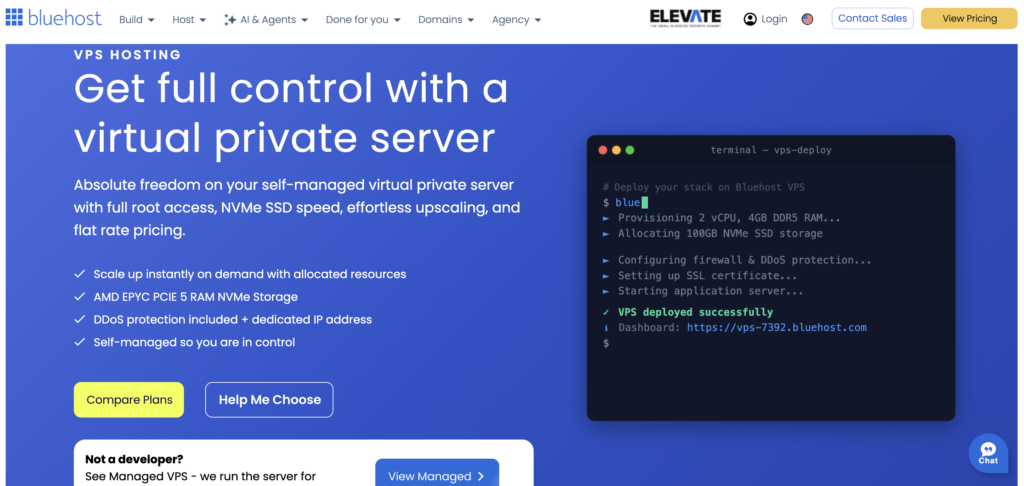
Bluehost is where I run my own n8n server and a couple of my other AI agents. The n8n VPS comes preconfigured, so there’s no code and no manual server setup to wrestle with. Plans start at a little over $4 a month, and using my link helps support the channel at no extra cost to you.
Where You Host n8n Matters More Than the Automation
Here’s the thing about n8n. It’s one of the most popular automation tools right now, and it’s open source, which means you get to choose where it lives.
That choice dictates how effective your AI agent can be for your business. It decides whether your workflow automation keeps running while you sleep, what you pay every time it fires, and how much control you have over the whole setup.
The automation is the fun part. The hosting decision is the part that can save you money and headaches for years.
The Three Places n8n Can Live, and the Tradeoff of Each
Because the tool is open source, you’ve got three options.
- Your own laptop. A local install works great until you close the lid for the night, or take a vacation and step away for a few days. The moment it sleeps, every automation stops, so it isn’t scalable.
- A hosted plan that runs n8n for you. Super convenient, but most of these platforms charge by how many times your workflows run. Your bill climbs the more useful your automations get, and trust me, you’ll want to use this a lot.
- Your own server with a VPS. It’s always on, there are no per-run fees stacked on top of your usage, and you get full control over the whole environment. This is the route for anyone planning to run a lot of automations, especially if you’re privacy and security conscious like me.
Some DIYers rent an EC2 instance on AWS and manage every update by hand, but that’s the kind of server admin most people are trying to escape.
If the whole idea of running software on your own server is new, here’s a primer on what a self-hosted setup actually is. Option three is what we’re setting up here.
What a VPS Actually Buys You for AI Automations
A virtual private server wins for AI agents for a few plain reasons.
- No caps on usage. There are no execution caps or workflow limits stacked on top of the server cost, so your only real ceiling is the size of the server itself.
- Full control and root access. You decide where your data lives, which matters if privacy is on your mind.
- It runs 24/7. The agent keeps working whether your laptop is open or not, which is the whole point of something meant to run while you’re on a plane.
Self-Hosting n8n on Bluehost
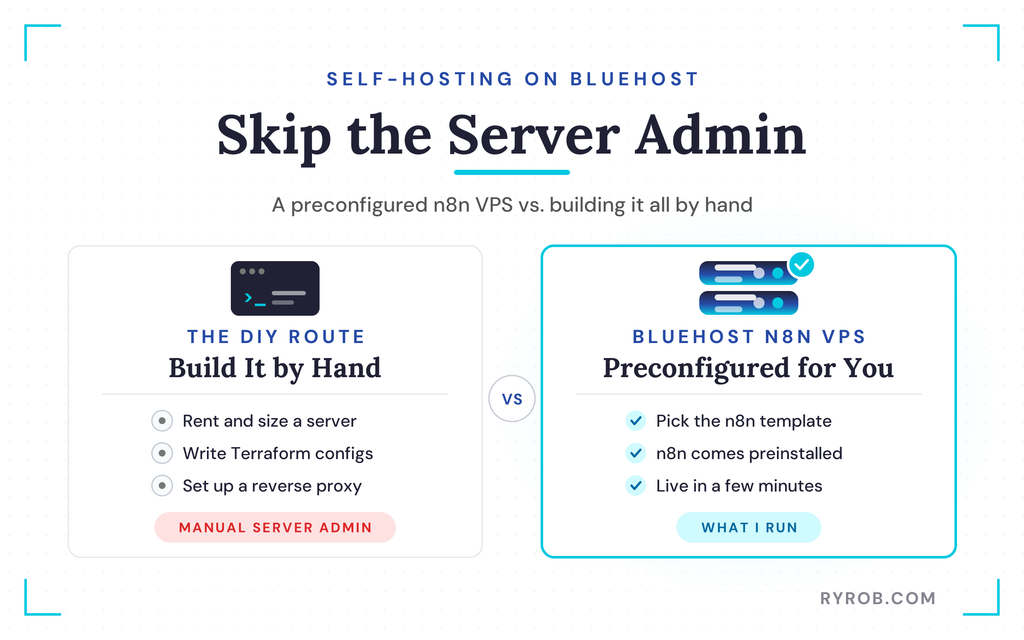
I run my n8n setup on Bluehost, and they also have one of my favorite AI website builders out there today. Their n8n VPS hosting gets you a preconfigured server without the manual server admin work most self-hosting guides assume you already know.
If you want a full site on that same hosting too, here’s how I install WordPress on a self-hosted setup.
What n8n Hosting Really Costs Each Month
The software itself is free with the community edition, so what you’re paying for is the server that hosts it. Bluehost plans start at a little over $4/month, and the NVMe 4 plan I use is just over $9/month.
That plan gives you more breathing room if you anticipate running a few different automation workflows. Here’s the part I like most. There aren’t execution caps or workflow limits on top of that server cost.
For setting up content repurposing automations for one site, or even a handful of sites, you’ll have more than enough room to grow.
Getting n8n Onto Your VPS Without Touching Code
There are two install paths, both code-free.
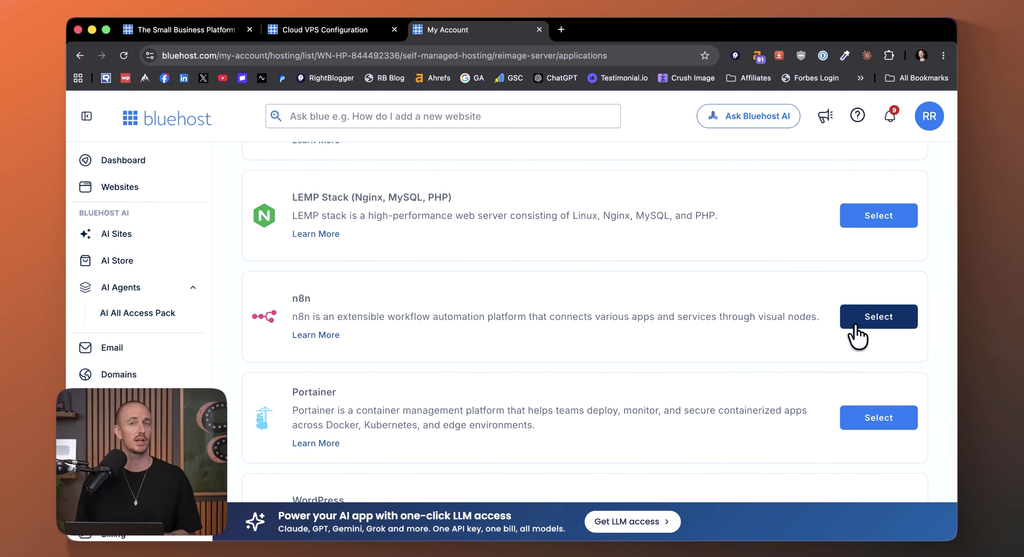
- Pick the n8n template right at checkout.
- On an existing Bluehost VPS, go to Hosting, then My Plans, then Manage, then Re-image, and choose the n8n option from the Applications tab.
Quick warning. Re-imaging wipes anything already on that server, so if you have something running you want to keep, do this on a fresh server instead.
Worth knowing, n8n also publishes a Self-Hosted AI Starter Kit, a Docker Compose bundle that pairs the platform with Ollama for local models and Qdrant for memory. That’s handy if you ever want to experiment beyond cloud AI APIs.
I set up a brand new VPS for this install, so I went through checkout. I chose the NVMe 4 server because I want room to grow, picked the server location closest to me, confirmed the n8n software, and continued through checkout.
A few minutes later, the VPS was provisioned with n8n already installed, without touching a line of code.
The DIY route goes deeper. Builders who want full control often provision with Terraform or its open-source fork OpenTofu, which lets you:
- Define the server, security group, and DNS record in one config file.
- Set your values in terraform.tfvars and run terraform apply.
- Let a cloud-init script handle first-boot setup.
The nice part is repeatability, since rerunning the config reproduces your exact setup on any new server.
The first time you open your instance, it asks you to create your account. That’s you, the admin of your own automation server. To log in, I just copied my VPS’s IP address into my browser, though on a fully manual install you’d reach the editor at localhost:5678 behind a reverse proxy instead, and then I landed on a blank canvas ready for building.
One note on locking this down. A fresh IP is fine for testing, but before you treat the setup as production ready, point a DNS record at the server and serve it over HTTPS. If your host’s template doesn’t handle the certificate automatically, n8n’s docs cover the SSL step, and it’s worth doing no matter where you host.
This whole build runs on the VPS I spun up with Bluehost, who I teamed up with on this one, so if you want to follow along on the same kind of server you can grab it through my Bluehost n8n hosting link.
Building the Content Repurposing AI Agent Workflow
Before touching a single node, here’s the map of what we’re building, in four steps.
- A trigger that notices when a new video goes up on my YouTube channel.
- Claude as the AI step takes the title, description, and link, then drafts the five pieces of repurposed content I use to promote each video.
- n8n creates those content assets in a fresh Google Doc.
- Slack pings me with the link to review.
Nothing gets posted anywhere until I say so, and that’s on purpose. I want a human in the loop on anything going out under my name, no matter how good the drafts get.
Creating the Whole Workflow With One Prompt
First, I dropped in the Claude API key I created for this instance of n8n and selected the model I wanted. Then I described the automation in one prompt. Scrape my YouTube channel’s RSS feed every single hour, and use my Claude connection to create five content assets for each video, the blog post, an X post, a LinkedIn post, an Instagram caption, and a full newsletter draft in my voice.
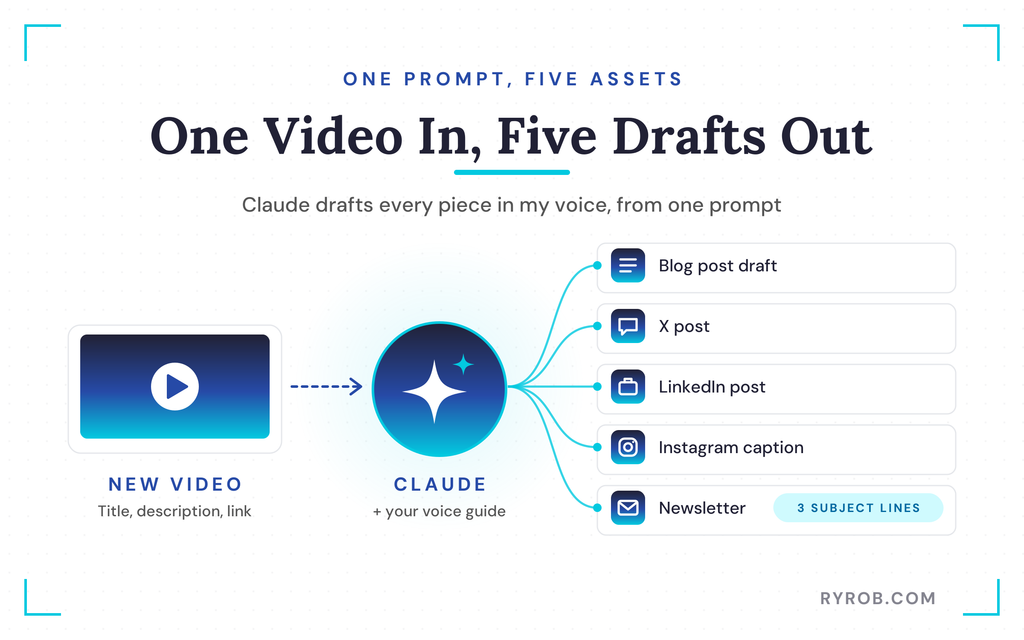
The part that matters most here is the bottom of the prompt, where I pasted in a short guide for how to write in my voice. That’s what makes the output sound like me instead of an AI-written press release.
If you’re still choosing which model to lean on for this, here’s my rundown of the best AI writing tools I’ve tested.
Worth noting, n8n has a library of pre-built workflow templates people have already made, and you can import from file if you find one shared as a JSON download. It’s a great place to get ideas for what else you can automate in your business.
One of the coolest things about the tool is that it problem-solves its way to the conclusion you want. When it hit a hiccup, it walked me through the fix right in the chat interface. It asked for my YouTube RSS feed URL, gave me a link to connect my Anthropic account, and built the whole workflow in about 4 minutes.
Testing, Reviewing, and Publishing the Workflow
The first test ran successfully, but I’d forgotten to connect the last piece, pinging me in Slack when content is ready for review. Kind of an important step. n8n also flagged that I hadn’t authorized my Google Drive connection.
Both fixes took a couple of minutes in the chat interface. n8n’s assistant walked me through creating a simple Slack app, and I authorized Google Drive’s API service so it could speak directly with my automations. Then I ran the full test.
The workflow completed, and the results landed where I actually look, in Slack. The message dropped a link to a Google Doc built for the video we published that morning. Inside:
- A blog post draft that did a pretty good job on the first pass.
- My X post and LinkedIn post, each with references to the video’s URL.
- A newsletter with three subject line options I didn’t even ask for, plus the video link placed right where I usually add a call to action.
That newsletter piece was the one I was most curious about, since I’ve already written up how to automate an email newsletter with AI, and it held up well.
Is all of this content perfect from the first pass? Not quite… I can keep refining the prompting and instructions Claude works with inside n8n to dial in my voice better. But for a first deliverable with zero refinement time, I give it an A minus.
I published the workflow and named it “content repurposing Ry Rob.” From now on, it scans my channel’s RSS feed every hour, and when a new video shows up, the pack gets drafted and Slack pings me for review.
Editing a draft takes me way less time than writing five separate pieces from scratch or manually prompting Claude every time, which is the whole point. This kind of repurposing is also the core of how I use free AI tools for SEO to stretch one piece of content into many.
The Honest Limits of Self-Managed n8n
I’d rather you hear the downsides from me up front than find out halfway through.
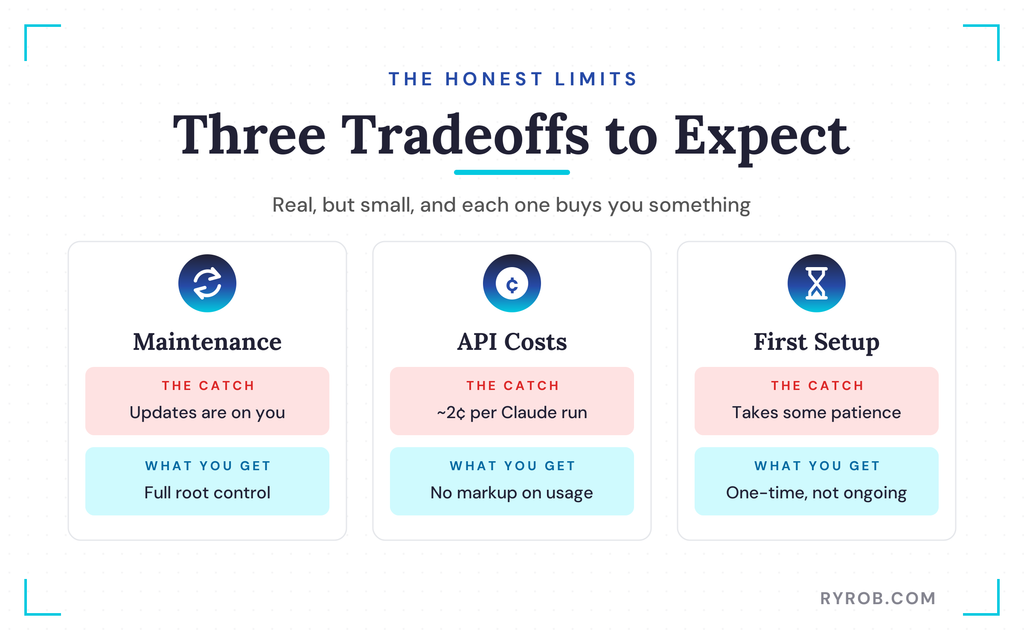
You’re the One Handling Updates and Maintenance
This is a self-managed server. Bluehost handles the hardware and the network, but updating n8n and managing the steps in my workflow is on me.
That’s how self-managed hosting works pretty much everywhere, and it’s exactly what buys you full control and root access to the whole stack. If you provisioned with Terraform or OpenTofu, a config change is a reapply rather than a rebuild.
Claude API Costs and First-Time Setup Patience
Then there’s the bill that doesn’t go away. Claude charges for the AI step through your API key, usually a small cost per run, like a couple of cents, and you’re paying the model directly with nothing marked up in between. That’s another place the self-hosted setup saves you money compared to platforms that mark up usage.
And I’ll say this one plainly. The first-time setup takes some patience, since the Google connection and the Slack bot each take a few minutes of clicking through settings pages.
It’s not a one-click job, but you do it once and mostly never think about it again. Honestly, n8n was great at walking me through every small issue I ran into.
Who Should Self-Host n8n, and Who Shouldn’t Bother Yet
If you’re a creator or entrepreneur who publishes regularly and you’re tired of turning your main content asset into the five things you need to promote it by hand, this is one of the most useful automations I’ve built.
For agencies and teams running content for multiple sites or clients, it gets even better, because you can set up automations for every account you manage. It pairs nicely with the other free SEO tools I lean on, like my free keyword research tool.
If you only publish once in a while, you might not need a server for it yet. Though I’ll admit it’s pretty fun once you roll up your sleeves and see what’s possible.
Either way, the setup we just walked through is one you can copy right now. Swap in your own feed, your own voice guide, and your own channels, spin up the same Bluehost VPS I use, and you’ve got it.
FAQs About Self-Hosting n8n
A few of the questions I get most often about running this setup yourself.
Is n8n really free to self-host?
Yes. The community edition is free, so what you pay for is the server it lives on, not the software itself.
How much does self-hosting it cost?
Bluehost’s n8n VPS plans start at a little over $4/month, and the NVMe 4 plan I use is just over $9/month. On top of that, expect a few cents per Claude API run.
Do I need to be technical to self-host n8n?
No. With Bluehost, you pick the n8n template at checkout and the server comes preconfigured. The n8n assistant walked me through every connection, including Google Drive and Slack, without me touching code.
What happens if my laptop is off?
Nothing. The automation runs on your VPS, not your computer. My laptop can be closed and the workflow still scans my feed and drafts content.
Why not just use a hosted n8n plan?
Most hosted platforms charge per workflow run, so your bill climbs as your automations get more useful. A VPS has no per-run fees stacked on top of the server cost.
Can I run this for multiple sites or clients?
Yes, and that’s where a VPS really pays off. There’s room on a server like this for automations across a handful of sites, and I plan to onboard more of mine over time.
Final Thoughts About Self-Hosting n8n
Now that this self-hosted automation is live, every time I publish a video my n8n server notices it within the hour. Claude drafts the pack, the Google Doc gets made, and Slack pings me for review.
My laptop can be closed. I can be on a plane or a remote desert island, because everything runs on my own VPS.
The hosting choice is what makes this reliable and affordable, and the workflow itself is copyable. Start with one automation, swap in your own feed and voice, and let it earn more responsibility from there.
When you’re ready to spin up your own, you can grab the same Bluehost n8n VPS I run this on and work through the steps above.
Self-Host Your Own AI Automations on Bluehost
Bluehost is where I run my own n8n server and a couple of my other AI agents. The n8n VPS comes preconfigured, so there’s no code and no manual server setup to wrestle with. Plans start at a little over $4 a month, and using my link helps support the channel at no extra cost to you.
