
Starting a blog (or website) on a budget can be tricky. There are so many hosting options at a wide range of price points — enter our comparison of Bluehost vs. HostGator, updated for 2026 with current pricing, AI website builder differences, and a major HostGator policy change (the Hatchling plan now allows 10 sites instead of 1).
You’d like to keep your blogging costs as low as possible, but you’re worried some offers are too good to be true.
You may also be unsure what exactly you need to pay for. For example, you may know you need a domain name but be unsure what web hosting is or whether that should be included.
In this comparison article, we’ll explain everything you need about two popular web hosting companies: Bluehost and HostGator.
We’ll examine web hosting, how these companies compare, and—most importantly—what exactly you’ll be paying.
Here’s what we’re going to cover. You can use the quick links here to jump straight to different parts of the article:
Bluehost vs HostGator: Which Hosting Plans are Better (on a Budget) in 2026?
- Our Pick
- Features
- Domain Name
- Number of Websites
- Storage Space
- Bandwidth
- Control Panel
- SSL Certificate (HTTPS)
- CDN (Content Delivery Network)
- Performance
- User Experience
- Customer Support
- Pricing
- Bluehost vs HostGator: Which is the Best Plan if You’re On a Budget?
Disclosure: Please note that some of the links below are affiliate links, and at no additional cost to you, I’ll earn a commission. Know that I only recommend products and services I’ve personally used and stand behind. When you use one of my affiliate links, the company compensates me, which helps me run this blog and keep my in-depth content free of charge for readers (like you).
Our Pick
When it comes to Bluehost vs HostGator, I recommend Bluehost if you’re new to blogging and website creation.
They offer superb customer service and technical support, which is very useful for a beginner.
You can get HostGator hosting for a little less than Bluehost (when comparing the cost of a 36-month plan with each company).
If you’ve created a blog or website in the past or are pretty confident with technical things, HostGator may be the better option for you.
If you’re currently on a tight budget, you may also want to consider HostGator, which offers a month-by-month plan.
With Bluehost, you have to pay for a year upfront. If you choose monthly payments, you’ll end up paying quite a bit more overall.
Ultimately, both these web hosts are great choices, so you can’t go wrong, regardless of your choice.
Features
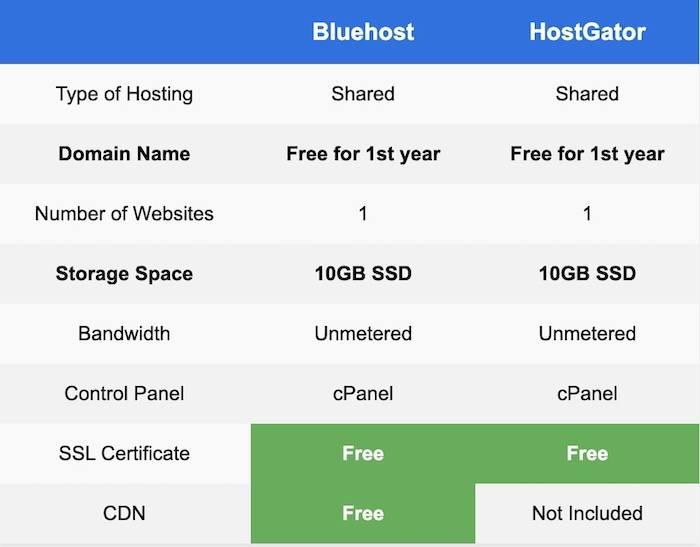
Bluehost and HostGator are both web hosts. This means they “host” your website on their servers (big, specialized computers) so that people can visit it from all over the world at any time of the day or night.
In both cases, their cheapest plans are for shared hosting, where your website is stored alongside other people’s websites on a shared server.
This type of hosting is perfect when you’re on a budget. If your site grows very large and gets a lot of traffic, you might want to upgrade to dedicated hosting instead. It’s easy to upgrade with both Bluehost and HostGator.
Winner: Tie
Domain Name
A domain name is a website’s address, like ryrob.com. You get a free domain name included with both, Bluehost and HostGator’s annual (or 3-year) plans.
Domain names are always registered for at least 1 year, so HostGator doesn’t offer a free one with their monthly plan.
With Bluehost, you can choose your domain name when you first create your web hosting account or after signing up, which is helpful if you’re not quite ready to settle on a name for your website.
HostGator requires you to create your free domain before paying for your web hosting.
Winner: Bluehost
Number of Websites
Bluehost’s cheapest “Basic” plan limits you to a single website. HostGator’s cheapest “Hatchling” plan now allows up to 10 websites (a 2025 upgrade — it used to be 1) — a meaningful advantage if you plan to run multiple sites from one hosting account.
(Keep in mind that each additional website will need its own domain name. You get one domain name for free; additional domains can be purchased separately.)
Winner: HostGator (10 sites vs Bluehost’s 1 on the cheapest tier)
Storage Space
Your web pages take up storage space, especially with many large images. While this isn’t usually a big concern when you’re first starting, it will need extra space if your site gets very big.
With Bluehost’s cheapest plan, you get 10 GB of storage space, far more than you’ll need when starting.
HostGator’s plan also gives you 10 GB, but you’ll be contacted if your website uses more space than standard small business websites.
Winner: Tie
Bandwidth
Bandwidth measures how much data is transferred between your website’s server and people’s computers or devices.
If you get lots of website visitors, you use lots of bandwidth. You don’t need to worry about this, as Bluehost and HostGator give you unlimited bandwidth.
Like HostGator’s storage space policy, both Bluehost and HostGator have fair bandwidth usage plans.
However, if you’re simply running a regular small business website, you’re unlikely to run into problems here.
Winner: Tie
Control Panel
All web hosts have a control panel, an online dashboard that lets you change your web hosting settings and set up new email addresses (e.g., you@yourwebsite.com).
Both Bluehost and HostGator use cPanel, which is the industry standard.
Although it can seem a little technical at times, many online tutorials, plus plenty of help and support, make it easier for you to change your web hosting settings.
Winner: Tie
SSL Certificate (HTTPS)
Modern websites should have an SSL certificate to provide a secure (HTTPS) connection. This is good for your visitor’s safety and privacy.
Google prefers SSL websites, so having a valid SSL certificate is important for boosting search engine optimization.
Bluehost and HostGator provide a free SSL certificate for your website, provided by the third-party service Let’s Encrypt. Adding this to your website is easy; Bluehost and HostGator provide full instructions.
Winner: Tie
CDN (Content Delivery Network)
A Content Delivery Network (CDN) uses worldwide servers to speed up your website. Visitors automatically access the website from the geographically closest server.
It’s essential to make your website as fast as you can, as this improves your search engine optimization.
With Bluehost’s starter plan, you get a free, built-in CDN. HostGator doesn’t provide one.
Winner: Bluehost
Performance
Your website’s performance takes into account two main factors:
- Uptime (is your website available, or has it gone offline?)
- Speed (does your website load quickly, or is it too slow?)
You want your web hosting company to provide excellent uptime. This is essential because you’ll lose visitors and customers if your website isn’t available.
All well-known web hosts have a very high annual uptime, typically 99.9% or higher.
Bluehost has an uptime of about 99.98% (this means your website would be unavailable for about 1 hour and 45 minutes each year).
HostGator’s uptime is slightly lower at around 99.95% (this means your website would be unavailable for about 4 hours and 20 minutes each year).
They guarantee an uptime of 99.9%, and if uptime falls below that, you can claim a month’s credit on your account.
Bluehost’s load speed is very fast, 0.72 seconds, while HostGator’s is a little slower, 0.87 seconds.
Winner: Bluehost
User Experience
Bluehost and HostGator both aim to make using their systems as easy as possible for beginners. Signing up for an account and installing WordPress on your website is straightforward.
It’s easy to install the WordPress software on your site whether you opt for HostGator or Bluehost — you don’t need to do anything complicated or technical.
You can sign up for many optional extras with Bluehost and HostGator. However, if you’re on a very tight budget, you’ll want to stick to the minimum package.
Remember, you can always upgrade or add extras after signing up for web hosting.
The online interface for your Bluehost or HostGator account will be straightforward and quick to use. HostGator’s customer portal, in particular, has been praised for being uncluttered and easy to use.
Winner: Tie
AI Website Builders & Tools (Bluehost vs HostGator in 2026)
This is the section that didn’t exist when most Bluehost vs HostGator comparisons were written, and it’s now one of the more important differences between the two hosts.
Bluehost WonderSuite: Bluehost’s AI-powered onboarding experience asks you a series of questions about your site (purpose, audience, style) and then generates a starter WordPress site with theme, pages, and copy already populated. You keep editing in regular WordPress afterward — nothing is locked into a proprietary builder. Bluehost AI also drafts blog posts and product descriptions right inside the WordPress editor. It’s a genuinely useful 2026 feature.
HostGator (no AI builder): HostGator’s Gator Website Builder — their previous drag-and-drop solution — has been discontinued for new customers as of 2025-2026. New HostGator signups don’t have a comparable AI-assisted site builder. You’re expected to use WordPress (free, one-click install) or bring your own builder. This is a notable gap if you’re looking for an “AI-helps-me-launch-the-site” experience.
Winner: Bluehost (WonderSuite is a real differentiator, especially for non-technical bloggers)
Security & Backups
Both hosts include baseline security on their cheapest plans, but the depth of what’s covered differs.
SSL certificate: Both Bluehost and HostGator include a free Let’s Encrypt SSL certificate (auto-installed and auto-renewing) on every plan. Industry-standard 2048-bit encryption.
Daily backups: HostGator includes free daily automated backups via CodeGuard Basic on the Hatchling plan. Bluehost also includes CodeGuard Basic backups. Both let you restore a single backup with one click; more advanced restores require an upgrade.
Malware scanning: Bluehost includes SiteLock Lite scanning automatically. HostGator includes basic monitoring; deeper SiteLock features are a paid add-on on both hosts.
Free domain privacy: Bluehost includes free domain privacy with most plans (typically a $9.99/year value). HostGator charges a separate fee for domain privacy on the cheapest tier.
Two-factor authentication (2FA): Both hosts support 2FA on account login — table stakes in 2026 and you should enable it.
Winner: Bluehost — slightly better defaults at the entry price, particularly with included domain privacy.
Customer Support
Bluehost is known for its superb customer support. Its staff will be delighted to help you with any WordPress-related issues and questions (as well as any Bluehost-specific problems).
Both Bluehost and HostGator offer impressive customer support. You can use live chat, email, or call them at any time of the day or night to get your questions answered.
You may find that wait times are a little longer with HostGator than Bluehost and that the quality of customer service can vary with them, too.
If you think you’ll need a lot of help with your website, it’s probably best to choose Bluehost.
Winner: Bluehost
Pricing
Web hosts aren’t always as transparent about hosting costs as you might like, especially when budgeting carefully. We will break down the difference between Bluehost vs. HostGator when it comes to your hosting cost — not just initially, but over the longer term.
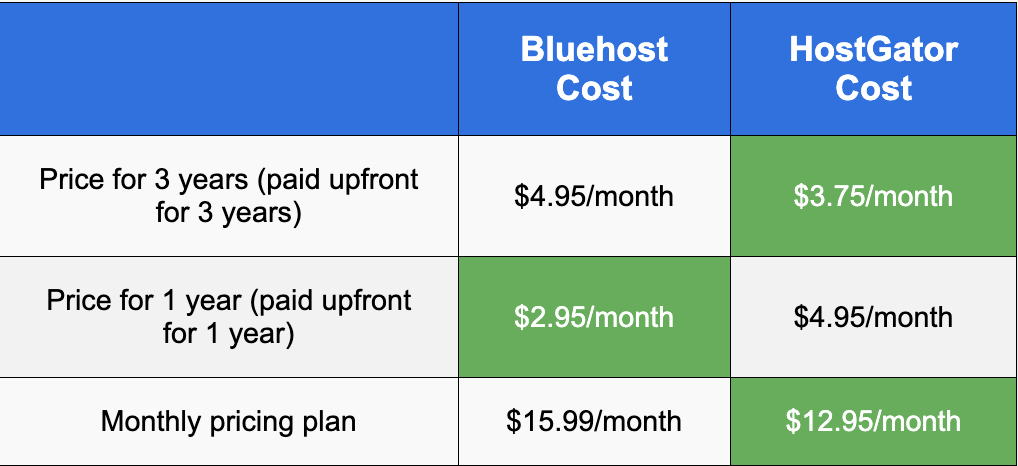
Both companies advertise monthly rates, but their lowest prices are only available with a long-term upfront payment. As of 2026, HostGator’s month-to-month Hatchling plan is around $17.59/month, while Bluehost’s monthly option is around $15.99/month. Both providers offer substantially better rates when you commit to a 36-month plan (Bluehost: $2.95/month intro, HostGator: $3.75/month intro). Renewals after your initial term are significantly higher (Bluehost renews around $11/month, HostGator around $13.19/month).
With both HostGator and Bluehost, you’ll get the best value if you sign up for 3 years in advance.
The “introductory” price will only apply for your initial 3 years (or 1 year if you sign up for a single year instead). After that, you need to pay the standard rate. This is standard across all web hosts.
You’ll have a larger bill after your initial term. By that point, you’ll probably be making money from your website. Still, it’s essential to know what you’ll need to pay.
Here’s the initial price, assuming you opt for the cheapest plan in each case.
And here’s the pricing comparison between Bluehost and HostGator once your initial term expires:

When comparing HostGator’s and Bluehost’s pricing, HostGator is generally more affordable across most plans. Therefore, if minimizing costs is your priority, HostGator is likely your best option.
HostGator also offers a slightly more generous money-back guarantee than Bluehost, offering 45 days to claim a refund—Bluehost’s guarantee is limited to 30 days.
However, it’s worth remembering that you don’t have to take up your free domain straight away with Bluehost. You can use this 30-day period as a Bluehost free trial.
(With HostGator, you need to either miss out on a free domain completely or register it, then risk paying for it if you decide to get a refund.)
Winner: HostGator
Bluehost vs. HostGator: Which is the Best Plan if You’re On a Budget?
Both Bluehost and HostGator offer great value and high-quality web hosting.
There’s not much to choose between them, as Bluehost’s slightly more expensive hosting is made up for by its superior customer service and slightly better performance.
If you’re new to websites, I’d recommend picking Bluehost. They’re a great company if you’re a beginner, as their support team will patiently talk you through anything you need to know.
If you’re a bit more experienced, then go with HostGator. They’re cheaper, and their performance (uptime and speed) is very good, even though it falls just a little short of Bluehost’s.
Ready to create your website? Head over to Bluehost or HostGator to buy your hosting package and get started.
Bluehost vs HostGator: Frequently Asked Questions
Is Bluehost or HostGator better for WordPress?
Is Bluehost or HostGator better for WordPress?
Bluehost is generally the better choice for WordPress. It’s one of just three hosts officially recommended by WordPress.org, and its WonderSuite onboarding is built specifically around WordPress. HostGator supports WordPress just fine (one-click installer) but doesn’t have a comparable AI-assisted WordPress setup experience.
Is HostGator cheaper than Bluehost?
Is HostGator cheaper than Bluehost?
HostGator is slightly cheaper on the entry-level shared hosting tier (Hatchling at $3.75/month vs Bluehost’s Basic at $2.95/month — though Bluehost is technically cheaper on the 36-month intro). Both renew at higher rates after the initial term ($11-13/month). HostGator’s Hatchling does allow 10 websites (vs Bluehost Basic’s 1), which can be a bigger value if you run multiple sites.
Can I run multiple sites on HostGator’s cheapest plan?
Can I run multiple sites on HostGator’s cheapest plan?
Yes — as of 2025, the HostGator Hatchling plan allows up to 10 websites. This is a 2025 upgrade; the plan used to be limited to a single site. If you’re planning to run a few sites from one hosting account, this is a meaningful Hatchling advantage over Bluehost’s Basic plan (which still limits you to 1 site).
Does HostGator have an AI website builder in 2026?
Does HostGator have an AI website builder in 2026?
Not for new customers. HostGator’s Gator Website Builder has been discontinued for new shared-hosting signups as of 2025-2026. If you sign up today, you’ll be expected to use WordPress (one-click install) or bring your own builder. Bluehost’s WonderSuite is the main AI-assisted setup experience between these two hosts.
Do Bluehost and HostGator have the same uptime?
Do Bluehost and HostGator have the same uptime?
Both are excellent and very close. Bluehost averages around 99.98% uptime (about 1 hour 45 minutes of potential downtime per year) while HostGator averages around 99.95% (about 4 hours 20 minutes/year). The difference is negligible for a typical blog. HostGator offers a service credit if monthly uptime drops below 99.9%.
Can I migrate my site from HostGator to Bluehost (or vice versa)?
Can I migrate my site from HostGator to Bluehost (or vice versa)?
Yes. Both hosts support WordPress migrations. Bluehost includes free WordPress site migration on most plans (handled by their team). HostGator also offers a migration service, sometimes free with promotional plans. If your site already runs on WordPress, moving between hosts is usually a 1-2 day process and your domain stays the same.
Want to Build Your Website with WordPress?
Follow along with my guide—3 Easy Steps to Make a Website.
