

Does keyword research matter in 2026? Well, many SEO experts will tell you that the foundation of an effective SEO content strategy starts with keyword research. Open Ahrefs or SEMRush, find high-volume search terms, and start publishing immediately.
That’s the playbook most people follow, because it’s what we were taught… in 2016.
The problem is, this is exactly why so many SEO strategies look good in a spreadsheet, yet fail to drive real results. Prioritizing keyword research above all else often leads to generic output that ignores the user journey, misses the deeper intent needed to build authority, and it doesn’t make your brand stand out from the crowd at all.
Search in 2026 is more crowded & fragmented than ever. Between the rapid rise of AI search, video discovery, and persistent advertisements, grabbing user attention has become increasingly difficult.
Generic SEO plans simply can’t compete with the nuanced signals that modern algorithms prioritize. To succeed, you need to shift your focus toward high-quality content that solves specific user problems.
By developing a comprehensive SEO strategy that prioritizes value over mere volume, your brand can effectively cut through the noise and capture more meaningful traffic. You might get less traffic overall, but you’ll get more business from those website visitors… which is what matters most.
Key Takeaways About Keyword Research in 2026
- Starting with keywords is backwards if you don’t understand how each website visitor contributes to your overall SEO content strategy and real business goals.
- The best SEO plans move readers through four distinct stages: visibility, trust, conversion, and retention.
- A strong topical map begins with one pillar page supported by a series of keyword clusters, each built around one clear search intent.
- Long-tail topics almost always offer a better opportunity for rankings (and lead generation) because the user problem is more clear and the underlying search intent is stronger.
- Publishing is only half the job. Regular updates, smart internal linking, and the consolidation of high-quality content are where you secure long-term wins.
Why a Keyword Research-First SEO Strategy Fails in 2026
Keyword research still matters. It shouldn’t be the starting point for all your content decisions, though.
The old model was simple. Find search volume —> publish content —> hope traffic shows up. That strategy worked well when search engine results consisted primarily of ten blue links and a few obvious winners could capture most of the clicks, but that’s not the environment you are competing in anymore.
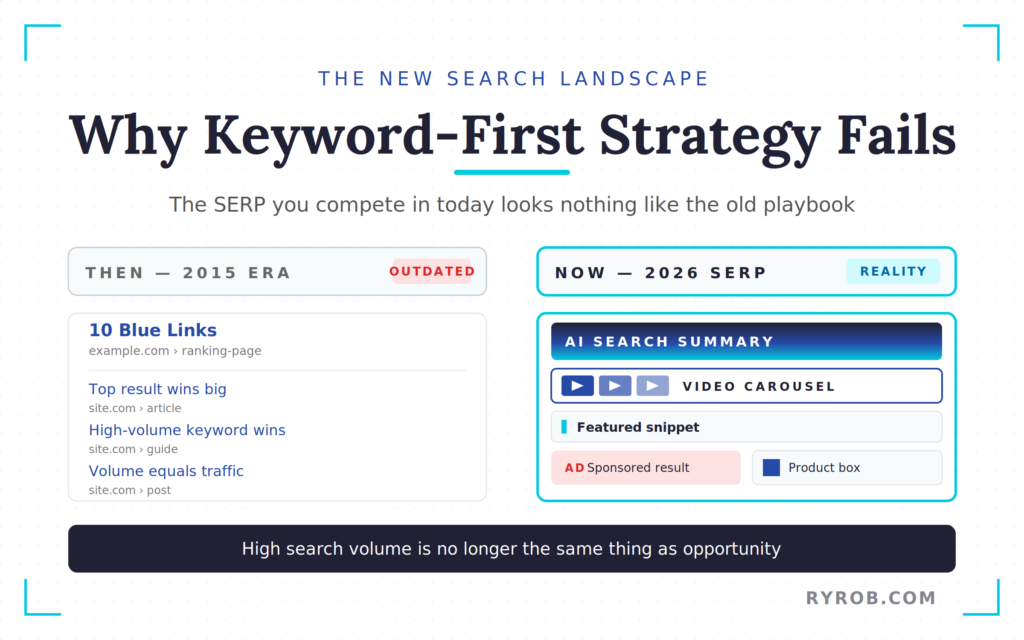
Today, your effective SEO content strategy must account for a much more crowded digital space where search engine results are dominated by diverse formats. Before a reader ever reaches your site, they are scanning:
- AI search summaries
- Videos
- Featured snippets
- Product boxes
- Ads
If your article is just another recycled version of what already ranks, Google does not need it, and neither does your audience. Producing high-quality content requires more than meeting a word count. It requires a perspective that resonates with your target audience.
That is the fundamental problem with placing keyword research at the front of your planning. It mistakes traffic potential for actual business value.
I have managed posts that pulled in tens of thousands of visits in organic traffic every month while doing next to nothing for email signups or revenue. On paper, those pages looked like successes. In reality, they were weak assets because visitors arrived, skimmed the content, and left.
If your conversion rates stay flat while pageviews rise, that is not a win. It is just noise.
High search volume tells you whether a topic has demand, but it cannot tell you if that visitor will subscribe, start a trial, or become a loyal customer.
This is also where the rise of AI changes the math. Because anyone can generate a passable article in seconds, the internet is becoming flooded with content that lacks a unique point of view or firsthand experience. That is not a strategy. It is merely content production.
The better way is to prioritize your desired outcomes first, then use keyword research as a secondary validation tool. When looking at the evolution of modern marketing, the biggest shift is clear: authority and usefulness are now the primary drivers of success.
By focusing on the EEAT framework, you ensure that your content provides the depth and credibility that today’s search environment demands.
Step 1: Start With Outcomes, Not Keywords
Before you touch a keyword tool, answer one question: What should happen after the organic traffic arrives?
That question changes everything. It forces you to stop thinking like a publisher chasing pageviews and start thinking like a business owner building assets.
Maybe the goal is an email signup, a free trial, or getting someone to use a tool, book a call, or move deeper into your ecosystem. Whatever it is, you need to define your key performance indicators for the desired next step before you choose the topic, angle, and structure of the page.
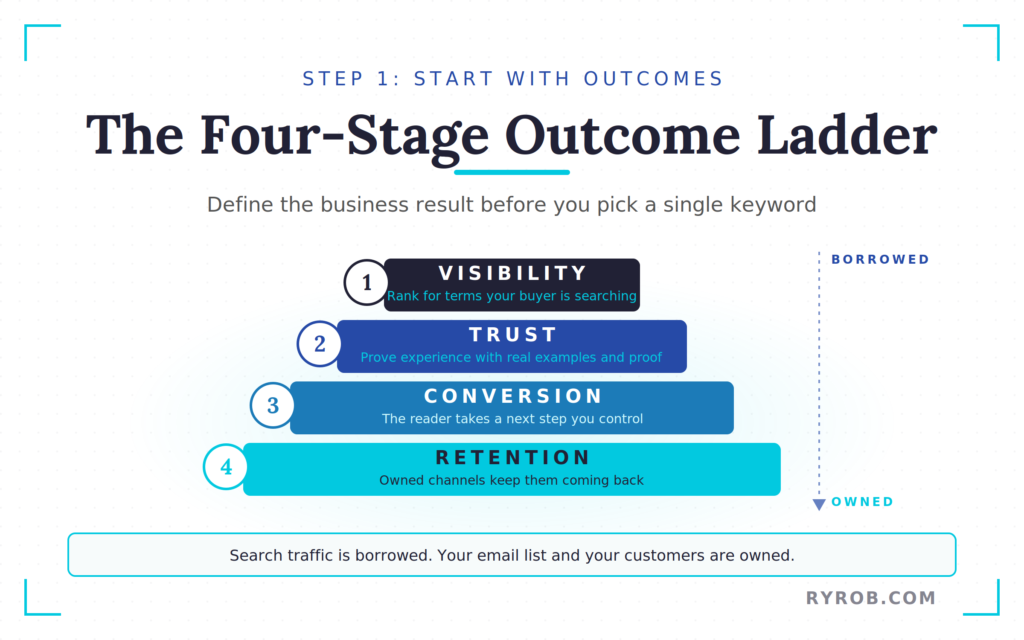
I use a simple outcome ladder for this:
- First comes visibility, which means ranking for terms your target audience is already searching.
- Next comes trust, where the page proves you have experience through examples, screenshots, opinions, or real-world context.
- Then comes conversion, where the reader takes a next step you control.
- Last comes retention, where your follow-up content, emails, and updates give them a reason to stick around.
That sequence matters. A lot of content gets stuck on step one.
Search traffic is borrowed. Your email list and your customers are owned.
If you are building a content machine for the long haul, this belongs inside a real blogging strategy, not as some disconnected SEO task sitting off to the side.
Why Owned Audiences Matter More Today Than Ever
Rankings can disappear fast. One algorithm update, one SERP redesign, or one stronger competitor can cause your traffic to drop quickly.
Your list does not work like that. Your customers do not work like that.
That is why the best content marketing strategy does not just try to rank and stop there. It is built to move your specific buyer personas into channels you own. A helpful article can become a subscriber, a subscriber can become a repeat reader, and a repeat reader can become a customer.
That is the compounding loop you want.
When people skip this step, they end up publishing random posts with no real path forward. The page might rank, but it has nowhere useful to send the reader next. That is how you get vanity pageviews and low conversion rates instead of strong business results.
Step 2: Build a Topical Map, Your SEO Foundation
Once the outcome is clear, the next move is building your topical map. Implementing a comprehensive SEO content strategy at this stage gives your brand a roadmap and helps establish long-term topical authority in your niche.
That sounds more complicated than it is. A topical map is simply a structured set of pages around one topic, organized by search intent. It tells you what to publish, why it exists, and how each page connects to the others.
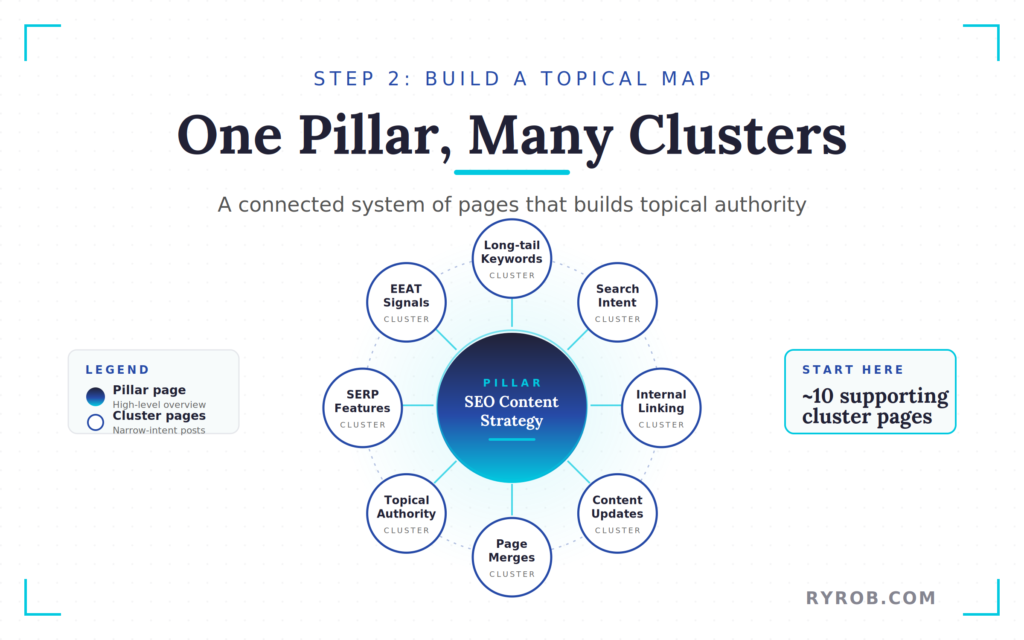
This is where a lot of content plans finally start making sense. Instead of publishing whatever keyword looks attractive this week, you are building a system.
Pick one pillar topic first. That is your main page, the page that covers the big idea at a high level. Then build supporting topic clusters around it, where each cluster page goes deeper on one sub-question that a reader would naturally ask next.
Done well, this gives readers a cleaner path through your content. It also helps search engines understand the relationships between your pages, which is a major factor in building topical authority.
Pillar Pages vs Cluster Pages
Your pillar pages serve as the home base for your domain. These pages are broad, comprehensive, and designed to orient the reader.
They should help someone understand the whole topic without trying to answer every small question in painful detail.
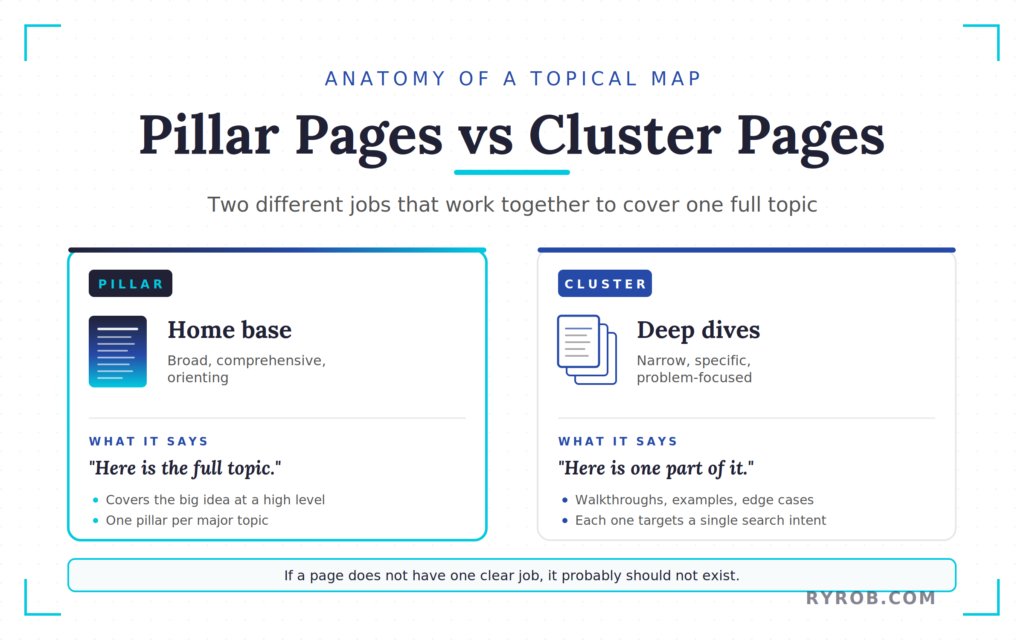
Your cluster pages do the deeper work. These are the posts that handle specific problems, edge cases, examples, walkthroughs, and narrow-intent searches.
These topic clusters support the primary content but also stand on their own. By incorporating semantic keywords into these supporting pieces, you provide more context to search engines about your main pillar pages.
A good way to think about it is simple. The pillar says, “Here is the full topic,” while the cluster says, “Here is how to solve this one part of it.”
That structure makes planning easier because every page has a role. No filler, no duplicate topics, and no random publishing just to stay consistent.
Three Rules for a Strong SEO Content Map
A well-structured content map is built on three core rules.
1. One Page Means One Intent
Every page needs one clear job. If you cannot explain what the page is supposed to do in one sentence, it is probably too broad and needs to be narrowed, split, or removed.
The fastest way to weaken a content library is to publish multiple pages targeting the same search intent. When that happens, your own content starts competing against itself.
If two pages are chasing the same goal, merge them. Keep the stronger URL, fold the useful parts into that page, and redirect the weaker one to protect both SEO performance and user experience.
2. Add Something Only You Can Add
If a reader can get the same value by skimming the SERP for 60 seconds, your page does not deserve to rank. This is where most AI-generated content falls apart because it repeats what already exists without adding anything new.
Add your perspective. Show the process, include a walkthrough, use a screenshot, or share the mistake that changed your thinking. Give the reader something they cannot get from the tenth article paraphrasing the first nine.
That level of specificity is a big reason fresh, useful pages continue to win. Clarity, structure, and actual value will always outperform keyword stuffing.
3. Internal Links Should Help Humans
Internal linking matters, but not for the reasons most people think. A link belongs when it makes the next step easier for the reader.
If someone lands on your pillar page and needs a template, link them to the template. If they need an example, send them to the example.
When you prioritize helpful internal linking, you guide the reader through a logical journey. If the link does not solve a real problem, leave it out.
If a page does not have one clear job, it probably should not exist.
Step 3: The Simple 90-Day SEO Content Plan
A topical map in a spreadsheet is harmless. A topical map that never gets published is useless.
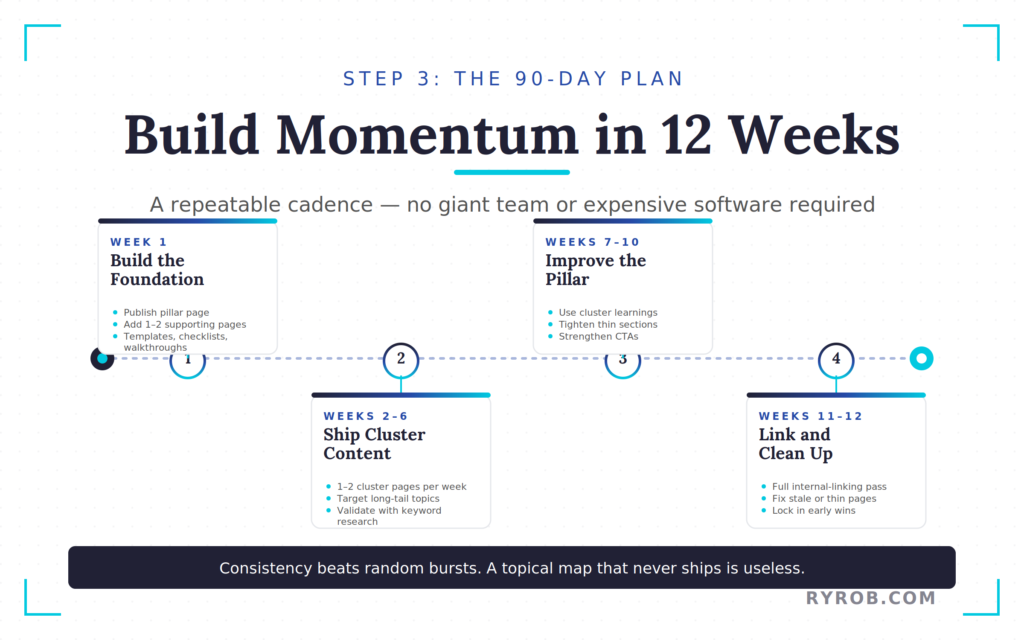
This 90-day content calendar works because it is simple enough to follow and strong enough to build momentum. You do not need a giant team or expensive software. You need a plan you can repeat to drive consistent organic traffic to your site.
Week 1: Build Your Foundation
Start by publishing your pillar page and one or two supporting pages that remove friction.
Those first supporting pages should make the pillar more useful right away. Good candidates are templates, examples, checklists, or walkthroughs. They give readers something concrete to act on.
The goal in week one is not to finish the whole cluster. It is to give your main topic a center of gravity.
Weeks 2 Through 6: Keyword Research and Cluster Content
Now you start shipping one or two cluster pages per week.
This is where long-tail topics become your best friend. They usually have clearer search intent, less competition, and more obvious pain behind the query. When someone searches a specific question, they are telling you exactly what they need help with.
That is also why long-tail pages tend to do better in AI search environments. Specific problems with specific answers are easier to understand, cite, and trust.
Once your outcomes are locked in, keyword research gets a lot easier because you are no longer chasing everything. You are using keyword research to validate the terms that support your bigger goal. If you want a practical process for that, here is a free keyword research workflow that uses real search data instead of guesswork.
Weeks 7 Through 10: Improve the Pillar Page
Your pillar page should not stay frozen while the cluster grows around it.
By this point, you have learned a lot from writing the supporting content. You will see where readers need more context, where the structure feels thin, and which subtopics deserve stronger treatment.
Use that information to improve the pillar. Add better examples, tighten vague sections, and improve the next-step calls to action. Make the page more useful than it was on day one.
This is how a good pillar becomes a strong one.
Weeks 11 Through 12: Add Internal Links and Update Weak Spots
At this stage, run a full internal linking pass to ensure your site architecture is optimized.
- Every cluster page should link back to the pillar when it helps
- The pillar should link out to relevant cluster pages
- Cross-links between cluster pages should only exist when the reader benefits
Then do a content update pass. Fix anything that already feels stale, thin, or unclear.
That early clean-up matters because weak pages do not usually get stronger by being ignored.
If you want a second opinion on publishing cadence and clustering, this SEO content strategy playbook for 2026 lines up with the same idea. Consistency beats random bursts.
Step 4: Why Updating Content Is Where You Actually Win
Publishing gets all the attention, but updating is where most of the gains show up.
I have a content library of more than 350 articles on my blog, and more than half of them have not been touched in six months. Some have not been updated in even longer. That is not a small issue. It is a reminder that even good content can go stale if nobody maintains it.
Freshness matters more now because AI search features pull information from pages that are current, well structured, and easy to understand. When a page looks abandoned, it gets passed over. When it is current and clear, it has a much better shot at being cited, which directly improves your search engine results.
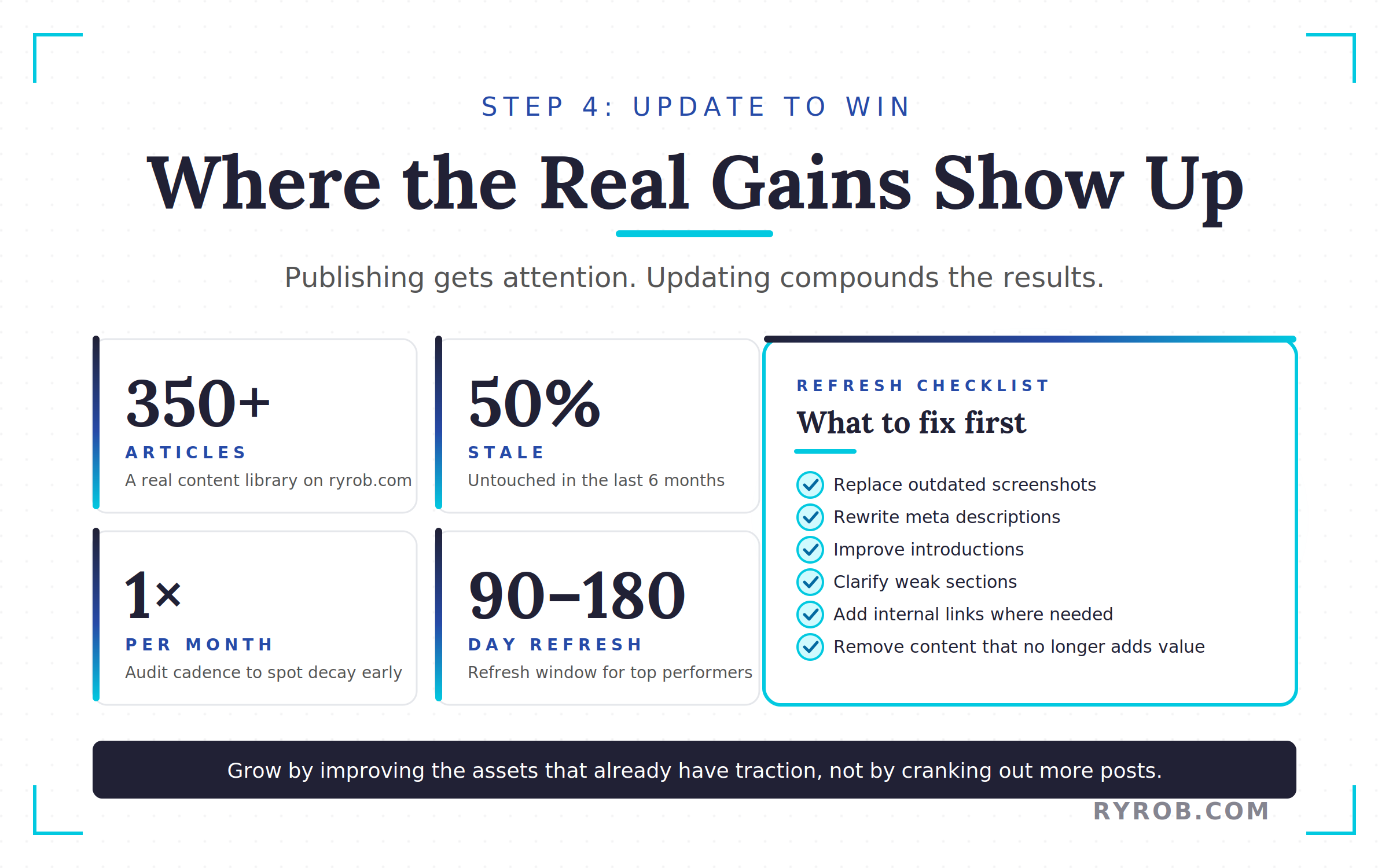
A good update cadence does not need to be complicated. Perform a comprehensive content audit monthly to see what needs attention. You should use Google Search Console to identify which pages are stale or suffering from keyword cannibalization. If you spot pages stuck in “discovered, currently not indexed” status, follow a diagnostic framework to find the root cause and get them indexed.
If two pages are competing for the same terms, combine them into one stronger page instead of making Google guess which one matters. During your next scheduled content audit, prioritize pages that are trending downward in traffic.
This does not mean rewriting everything all the time. It means tightening what already works, which may include minor technical SEO fixes like improving page speed or mobile responsiveness. Beyond these technical SEO adjustments, focus on refining your on-page SEO to ensure your content remains relevant to user intent.
When you refresh your pages, look for specific areas to improve:
- Replace outdated screenshots
- Rewrite meta descriptions
- Improve intros
- Clarify weak sections
- Add internal links where needed
- Remove content that no longer adds value
That is how results compound. You grow not by cranking out random blog posts forever, but by improving the assets that already have traction.
FAQs About Keyword Research First in SEO
Here are some of the related questions you might ask:
u003cstrongu003eShould I Stop Doing Keyword Research Altogether?u003c/strongu003e
No, you should not stop doing keyword research. Keyword research still matters for your overall strategy, but the shift is about timing.
You should conduct keyword research only after you have decided what business result a page should drive. By framing your process this way, you ensure you are choosing terms that support a specific goal rather than chasing traffic for its own sake.
When you combine this outcome-led approach with a thorough competitor analysis, you can identify high-value opportunities that others might be missing. If you want the full nuts-and-bolts process for keyword research, here is my guide.
u003cstrongu003eHow Many Cluster Pages Should One Pillar Page Have?u003c/strongu003e
A good starting point is around 10 supporting pages. The exact number matters less than comprehensive coverage and search intent.
You want enough cluster content to answer the major sub-questions around the topic without padding the map with filler posts that do not add anything useful to the user experience.
u003cstrongu003eDo I Need Expensive SEO Tools to Do This Well?u003c/strongu003e
No, you do not need expensive SEO tools to do this well. Paid tools can save time, but they are not required to build a smart content strategy.
A clear outcome, a strong topical map, real examples, and consistent updates matter much more than fancy dashboards.
u003cstrongu003eWhat Should I Do If Two Pages Target the Same Intent?u003c/strongu003e
You should merge them. Keep the better page, fold in anything useful from the weaker one, and redirect the old URL.
Letting both pages compete usually weakens both of them in the eyes of search engines.
u003cstrongu003eHow Often Should I Update SEO Content?u003c/strongu003e
You should check your content monthly and prioritize updates based on value. Hub pages deserve a quarterly refresh, while top-performing pages usually need attention every 90 to 180 days.
Pages with outdated examples, broken links, or weak structure should move up the list quickly.
u003cstrongu003eDo I Need to Worry About Technical SEO?u003c/strongu003e
Yes, you do need to worry about technical SEO, but it should not overshadow your content strategy.
While focusing on your topical map, ensure your technical SEO is solid by checking site speed and crawlability. Implementing structured data can help search engines better understand your content, while maintaining a mobile-first indexing mindset ensures your site remains accessible to the majority of your audience.
u003cstrongu003eHow Do I Get More Backlinks?u003c/strongu003e
The best way to get more backlinks is to create content that provides genuine value that others want to cite.
With the rise of zero-click search results, focusing on building brand authority has become more important than ever. When your content becomes the go-to resource in your industry, backlinks will follow as other publishers look to cite your expertise.
Final Thoughts on Keyword Research for SEO Traffic
If you change one thing about where keyword research lives in your SEO planning process, change the order.
Don’t let search volume make the first decision. Start with the outcome, build your topical map, publish the pillar, add the clusters, and keep updating the pages that matter. Tools like RightBlogger’s Site Agent that connect to your site and automatically update your content library (based on Google Search Console data insights) make this easier with the help of AI.
When you stop chasing isolated terms and prioritize a comprehensive SEO content strategy, you move beyond simple rankings.
This is how you transform vanity metrics into organic traffic that actually drives subscribers, leads, and customers. By shifting your focus toward a robust content marketing strategy, you ensure that every piece of high-quality content you produce serves a clear business objective.
Building a sustainable SEO content strategy is the only way to ensure your efforts deliver real value, which is the whole point of investing in search engine optimization.
Use My 50+ Powerful Free Blogging Tools Today
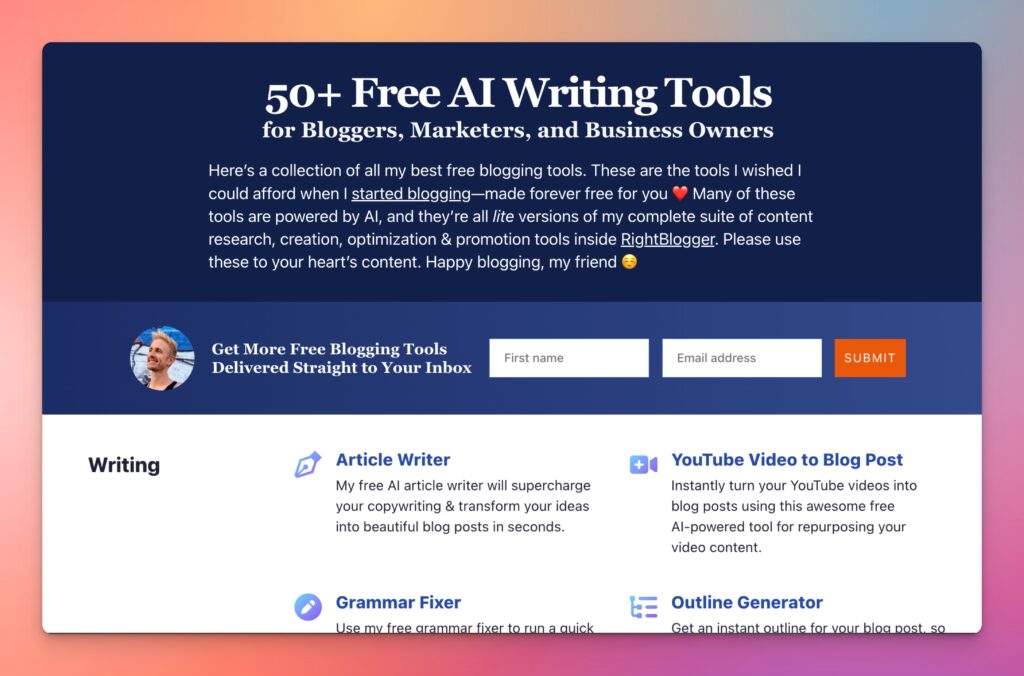
When I first started blogging, I couldn’t afford fancy tools. That sucked. And that’s why I’ve built a stable of powerful free blogging tools ranging from keyword research to an AI article writer, blog idea generator and more. Forever free for all to use—no strings attached.

Excellent insights! I completely agree that keyword research should support a content strategy, not drive it entirely. The focus on user intent, topical authority, and creating content that moves readers through visibility, trust, conversion, and retention is especially relevant in today’s AI-driven search landscape. The 90-day content planning framework and emphasis on updating existing content are practical takeaways that many marketers overlook. Thanks for sharing such a thoughtful perspective on modern SEO.