
You’ve probably heard about ChatGPT in the news if you’re here. It’s making waves as an easy-to-use AI copywriting tool that can produce almost any content. Enter the question: What is AI copywriting?
Or maybe you have friends running an eCommerce store who’ve been raving about how quickly they can create product descriptions using AI copywriting software (like my own, RightBlogger: the AI-powered content creation platform for bloggers).
But what exactly is AI copywriting? And how can you use it for your website or business?
What is AI Copywriting in 2026? How it Works, Best Practices & 10 Best AI Copywriting Tools
- What is AI Copywriting?
- 6 Best AI Copywriting Tools to Use Today
- How to Get Started with AI Copywriting (5 Top Use Cases)
- Creating Prompts for an AI Copywriter (with Real Examples)
- Tips to Get the Most from Your AI-Generated Content
- 3 Big Questions About AI Copywriting (FAQs)
Disclosure: Please note that some of the links below are affiliate links, and at no additional cost to you, I’ll earn a commission. Know that I only recommend products and services I’ve personally used and stand behind. When you use one of my affiliate links, the company compensates me, which helps me run this blog and keep my in-depth content free of charge for readers (like you).
What is AI Copywriting?
AI copywriting is writing produced by a machine (using artificial intelligence-powered tools).
AI isn’t a new concept. The idea of artificial intelligence has been around since the 1950s. But it’s only been in recent years that AI technology has become powerful enough to produce human-like writing.
To produce AI copywriting, all a human needs to do is give the software a prompt, like “write a product description for a plain black cotton t-shirt for men” (which has become much easier with seamless AI copywriting tools today).
For example, RightBlogger‘s AI-powered product description tool then responds:
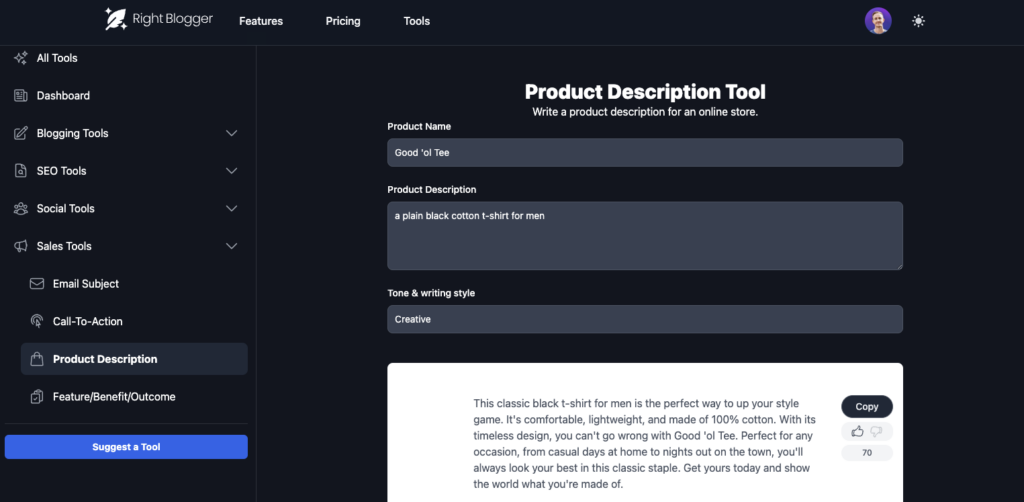
The end result is that in just a few seconds, you’ve generated a unique product description: “This classic black t-shirt for men is the perfect way to up your style game. It’s comfortable, lightweight, and made of 100% cotton. With its timeless design, you can’t go wrong with Good ‘ol Tee. Perfect for any occasion, from casual days at home to nights out on the town, you’ll always look your best in this classic staple. Get yours today and show the world what you’re made of.”
Pretty cool, huh? That’s just a glimpse of the power AI copywriting has in store for bloggers & content teams alike.
How Does AI Copywriting Work?
AI copywriting tools are trained on a huge dataset of existing written material. Essentially, they read many other copies and learn how it works through AI algorithms (machine learning). They can then produce unique copies that are plagiarism-free.
AI tools can understand how language is used, called natural language processing. That understanding applies to the prompts you give the AI tool and the content they create. You can imagine that the AI copywriter is a young, keen writing assistant: just ask them what you want, and they’ll try their hardest to deliver it.
AI copywriting tools understand grammar and spelling rules. You’ll still need to check for any clumsy sentences—but you won’t need to correct typos like you might with a human writer.
AI Copywriting vs. AI Content Writing
If you’re already familiar with AI writing tools, you might wonder what the difference is between AI copywriting and AI content writing.
- Copywriting involves sales-focused writing, like product descriptions, ads, landing pages, and promotional emails.
- Content writing can help drive sales, but it’s not overtly promotional. It includes blog posts, articles, and social media posts—types of content marketing that can help you attract your target audience to your website.
Most AI writing tools are useful for copywriting and content creation, but some tools are designed more for one type of writing than the other.
What’s Different About AI Copywriting in 2026
Before we get to the tools, a few major shifts in 2026 that change which AI copywriting setups actually work now:
- The model landscape opened up. ChatGPT is no longer the only serious option. Claude (Anthropic) became a real contender, especially for longer-form copy and brand voice work. Google Gemini reached parity for general use cases and integrates natively with Google Docs and Workspace. Most serious copywriters in 2026 keep at least two of these open and route different tasks to each.
- The “AI humanization” question matters now. Generic AI-written copy gets flagged by readers, Google’s helpful content systems, and increasingly by AI detection tools. The 2026 workflow isn’t “generate copy with AI and ship” — it’s “generate with AI, humanize, edit, ship.” See my full guide on how to humanize AI content for the framework.
- Purpose-built copywriting tools got specialized. While general AI tools (ChatGPT, Claude, Gemini) cover most use cases, purpose-built tools like Hypotenuse for e-commerce, Anyword for marketing teams, and tools like Wordtune for rewrites have carved out specific niches where they outperform general-purpose AI.
- Brand voice profiles became a feature, not a workflow hack. Most serious AI copywriting tools now let you save custom voice/style profiles so the output sounds consistent across campaigns. If you’re doing more than one-off copy generation, look for tools that support this — it’s the single highest-ROI feature for serious AI copywriting work.
With that context, here are the 10 AI copywriting tools worth knowing in 2026.
10 Best AI Copywriting Tools to Try in 2026
Before we dig into how exactly you can use AI copywriting to scale your content efforts, let’s take a quick look at some of the most popular AI copywriting tools on the market today.
1. RightBlogger
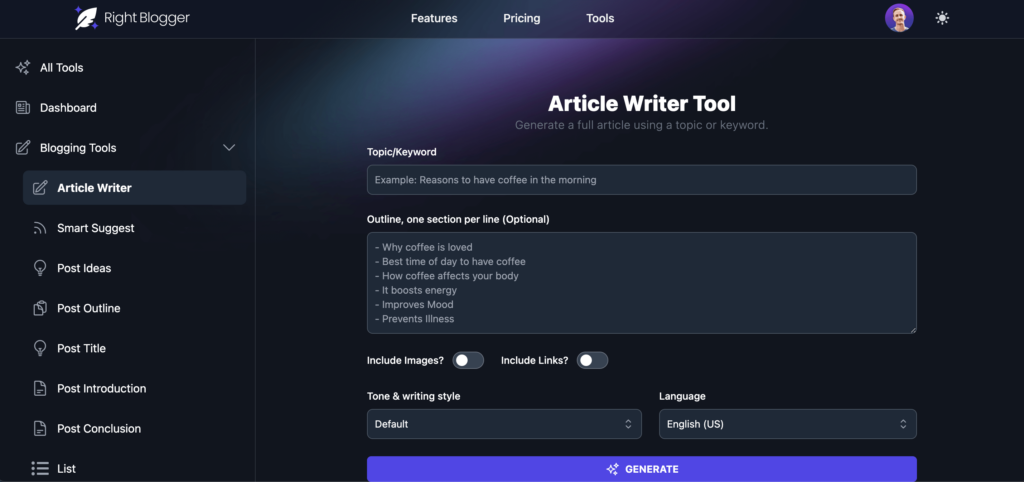
We built RightBlogger to simplify how bloggers & content teams use AI-powered tools to scale their content creation processes (on a tight budget). With advanced AI-assisted writing tools like automated content creation, outlining, idea generation, automated SEO optimization, and streamlined workflows for team collaboration, RightBlogger will help take your blog to the next level.
2. Jasper
Jasper, formerly called Jarvis, is an advanced and widely used copywriting tool. It has a range of “recipes” (pre-built workflows) available to produce specific types of copy, such as a “cold email” that uses the AIDA copywriting model.
3. Writesonic
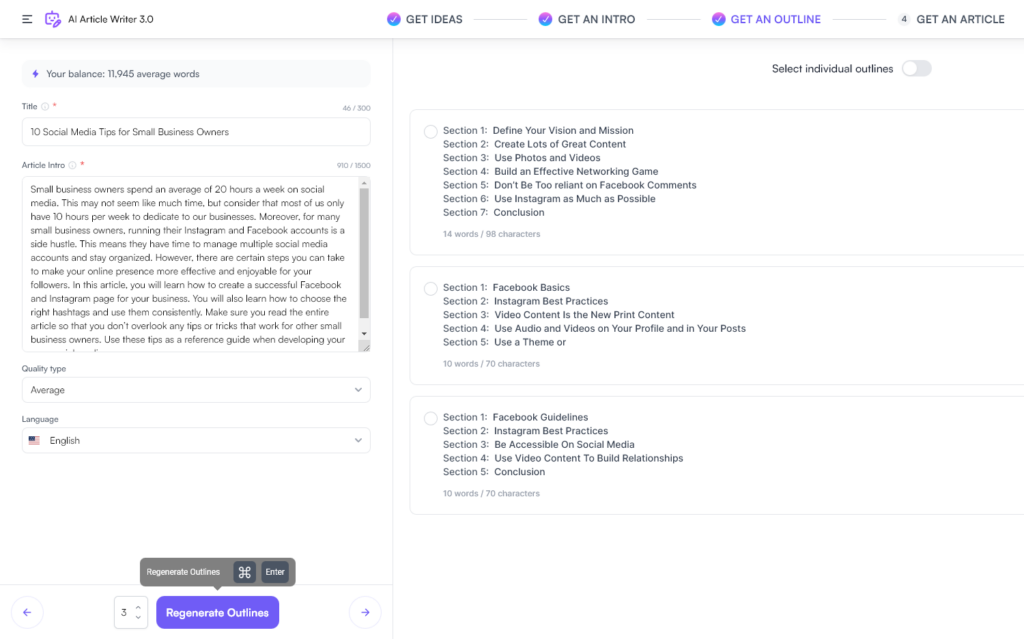
Writesonic can easily create an ad and email copy. It also has a special product description generator to set the tone of voice (e.g., professional, excited, witty, and more). You can even use this to create product descriptions in 25+ different languages.
4. Copy.ai
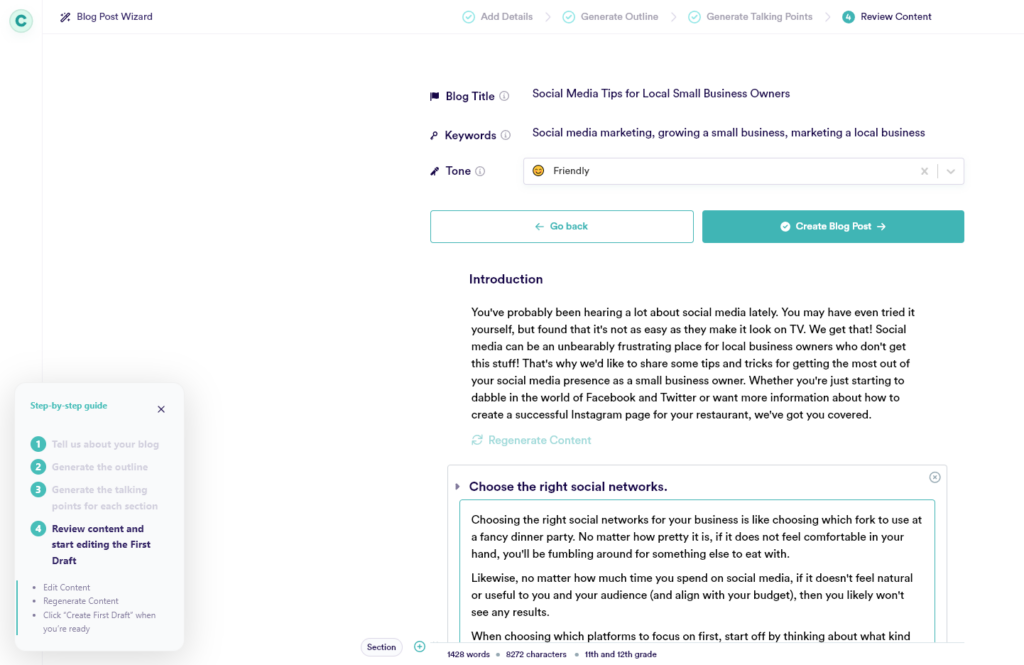
Copy.ai is particularly well positioned in AI copywriting, with lots of help creating email campaigns. The Copy.ai team offers free weekly demos and on-demand video guidance.
5. ChatGPT
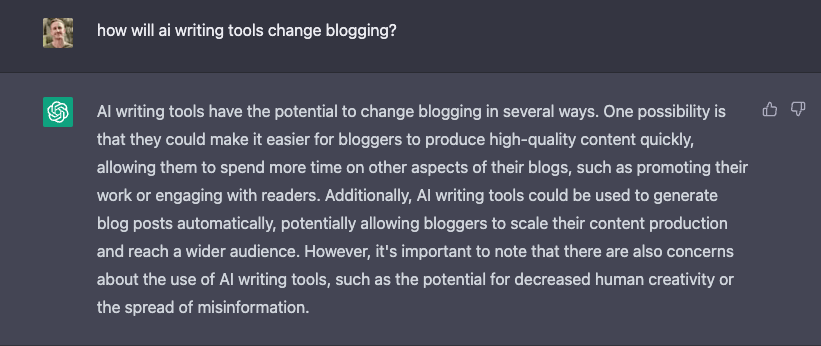
ChatGPT from OpenAI is now the default AI tool most people reach for, with hundreds of millions of weekly users in 2026. The free tier handles most copywriting tasks well; the paid tier (ChatGPT Plus) gives you access to the latest GPT models, custom GPTs, and Deep Research. While ChatGPT isn’t purpose-built for copywriting, it handles emails, ads, product descriptions, social posts, and landing pages competently — especially when you give it specific prompts, brand voice context, and clear examples of what good output looks like. See my best ChatGPT prompts for writing for the prompts I actually use.
6. Anyword
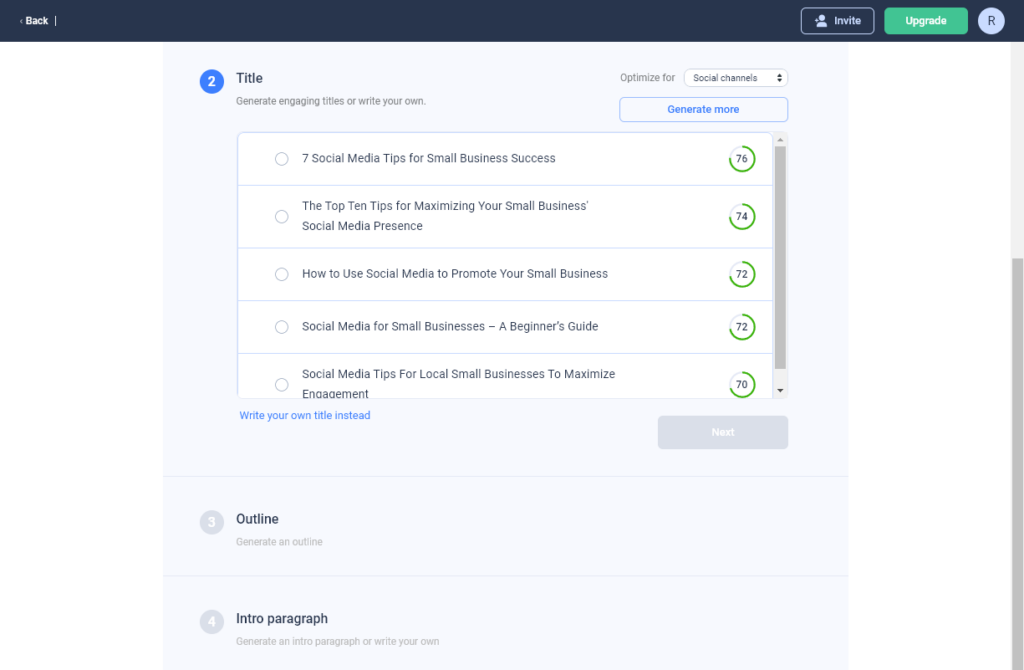
Anyword is another solid copywriting-focused AI tool that lets you create anything from ad copy to whole landing pages. It also has a sentence rewriter to help you optimize the copy that you’ve already written.
7. Claude (Anthropic)
Claude — made by Anthropic — is now one of the strongest AI tools for longer-form copywriting in 2026. Where ChatGPT excels at quick generation and research, Claude tends to produce more naturally voiced first drafts that need less humanization editing afterward. It handles long copy (2,000+ words) more coherently than most competitors, which makes it the tool many serious copywriters keep open alongside ChatGPT specifically for drafting longer pieces.
8. Google Gemini
Google’s Gemini reached real parity with ChatGPT and Claude for general copywriting in 2026. It’s particularly strong if you’re already inside the Google ecosystem — Gemini integrates natively with Google Docs, Workspace, and Search, which can dramatically speed up copywriting workflows that involve research, collaboration, or pulling from existing documents. Worth keeping as a third option if you write across multiple environments.
9. Hypotenuse AI
Hypotenuse is a purpose-built AI copywriting tool focused on e-commerce product descriptions, marketing copy, and bulk content generation. It’s particularly popular with online stores managing large product catalogs (think 100+ SKUs that all need unique descriptions). The bulk workflow features are stronger than most general-purpose AI tools for that specific use case, and the output tends to be more on-brand for product copy than what you’d get pasting individual prompts into ChatGPT.
10. Wordtune
Wordtune is technically a “rewrite and polish” AI tool more than a pure copywriter, but it earns a spot on this list because it’s one of the best AI tools in 2026 for refining existing copy — making it punchier, more concise, or shifting the tone. It works as a great companion to any of the generation-focused tools above: use ChatGPT or Claude to draft, then run sections through Wordtune to tighten. Particularly useful for ad copy where every word counts.
How to Get Started With AI Copywriting
Are you considering trying AI copywriting to help you sell your products or services—or as part of your affiliate marketing efforts? Here’s everything business owners need to know about creating different content formats.
5 Use Cases for AI Copywriting
1. Product Descriptions
One of the best ways to use AI copywriting is when you need to write a bunch of product descriptions. Perhaps you’ve got dozens of products in your online store, and you want to flesh out their descriptions to help with your SEO (search engine optimization)—but you don’t have hours to spend writing lots of copy.
Many of the best AI copywriter tools also offer Amazon-specific product descriptions, saving you a lot of time if you’re getting ready to list your whole catalog on Amazon.
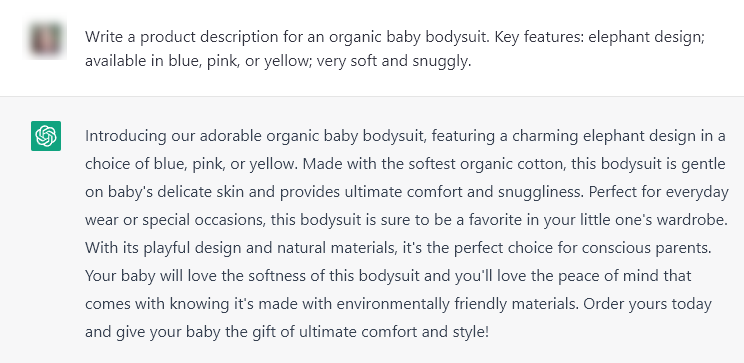
Example of an AI-powered product description:
For this example, we gave ChatGPT the prompt “Write a product description for an organic baby bodysuit. Key features: elephant design; available in blue, pink, or yellow; very snuggly.”
2. Ad Copy
You might struggle to write ad copy that converts if you’re not a trained copywriter. An AI copywriting tool can take over this task, producing compelling ad copy to the required length. You can generate many different options, too, and split-test your ads to see which are the most effective.
You can use an AI writer to create Facebook, LinkedIn, Google, or any other type of ad you might want.
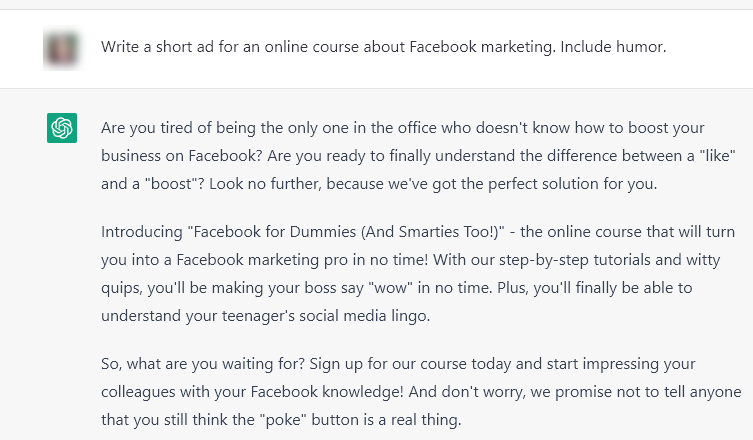
Example of AI-written ad copy:
For this example, we asked ChatGPT to “Write a short ad for an online course about Facebook marketing. Include humor.”
3. Landing Pages
AI copywriting software can also create landing pages or sales pages—extended copy about a product designed to drive sales. This could also be a great way to brainstorm ideas for a product: by having AI create the sales page first, you can design a product that meets your audience’s most pressing needs.
If you want the software to include specific details, you can simply add that to your prompt or input.
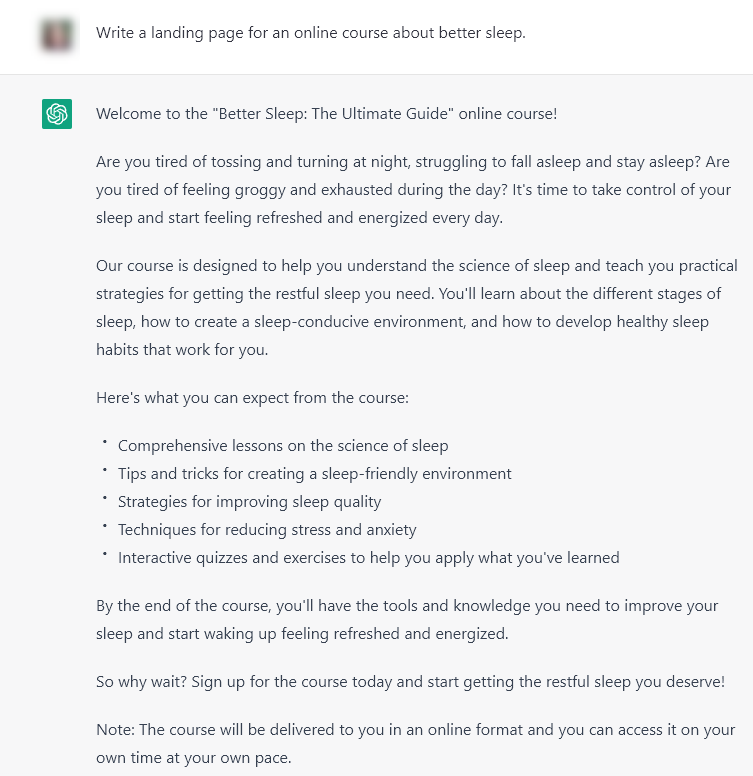
Example of a landing page written by ChatGPT:
For this example, we asked ChatGPT to “Write a landing page for an online course about better sleep.“
4. Social Media Posts
Promoting your products or services on social media can take a surprising amount of thought. Social media posts are often short—but getting just the right words can take time. If you have to develop several posts daily, you’ll save a lot of time by enlisting an AI copywriter to help.
Many AI writers can produce multiple social media posts from a single prompt.
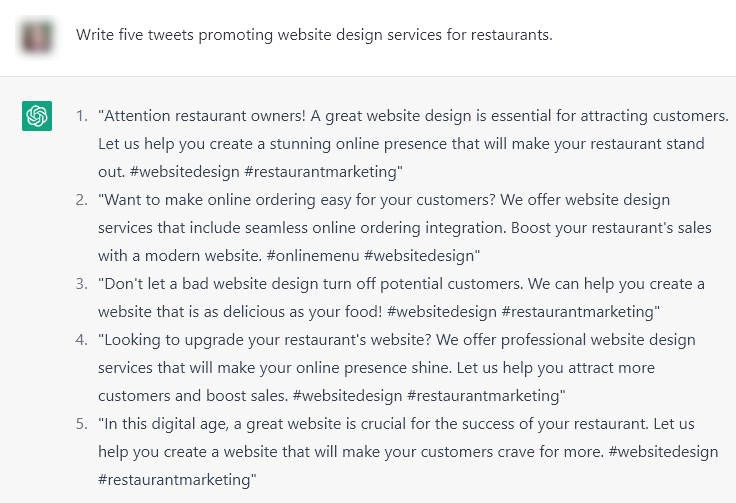
Example of social media posts (tweets) written by ChatGPT’s AI bot:
For this example, we gave ChatGPT the prompt, “Write five tweets promoting website design services for restaurants.”
5. Marketing Emails
Email marketing is a fantastic way to make sales—but it can also be hard to create an excellent email copy, especially if you’re sending several emails about the same product launch or promotion. You can use an AI tool to generate an email copy for you.
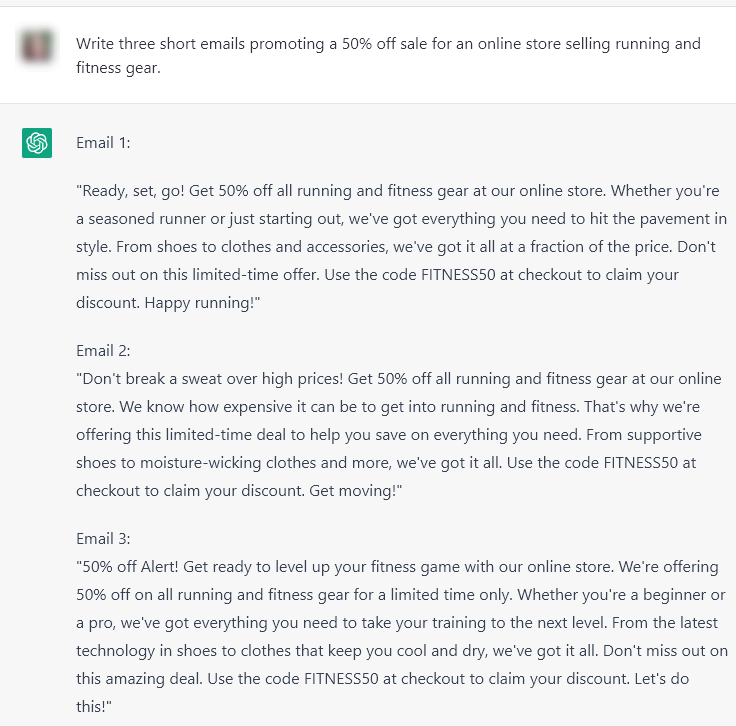
Example of marketing email copy written by ChatGPT:
For this example, we gave ChatGPT the prompt, “Write three short emails promoting a 50% off sale for an online store selling running and fitness gear.”
Creating Prompts for an AI Copywriter (with Real Examples)
The output you get from your AI tool will only ever be as good as the input.
That might seem obvious—but it’s something that some website owners and bloggers don’t realize. You can get a vastly better output quality by spending an extra minute or two giving the AI more information about what you want.
Some AI copywriting tools guide you through giving prompts to the software. For instance, if you use Writesonic to create a product description, you’ll be prompted to enter:
- The name of the product/service
- Key characteristics of the product/service
- The tone of voice (chosen from a dropdown menu)
With other tools, you’ll need to think carefully about what to include in your prompt.
Let’s take a look at how this works with ChatGPT using a series of different prompts:
Example 1: Very Basic AI Writing Prompt
In this example, we’ve simply used the prompt “ski vacation.” Chat GPT has given a brief definition and explanation:
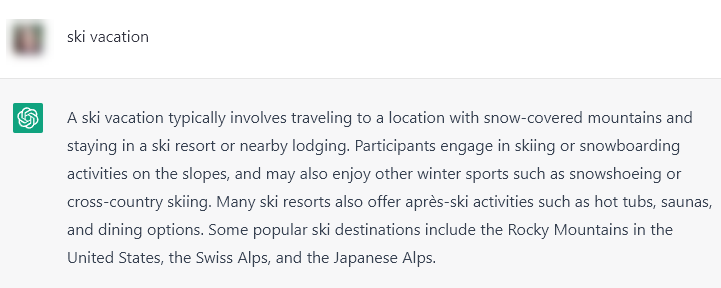
This output might be helpful if you’re trying to create a glossary to link to other content or resources on your site. However, it’s unlikely to be a great fit for your marketing efforts.
Let’s try giving ChatGPT a little more to work with.
Example 2: Making a Clearer Request of the AI
This time, we’ve used the prompt “Write an advert about ski vacations.” This gives ChatGPT an idea of the type of content we want—advertising copy.
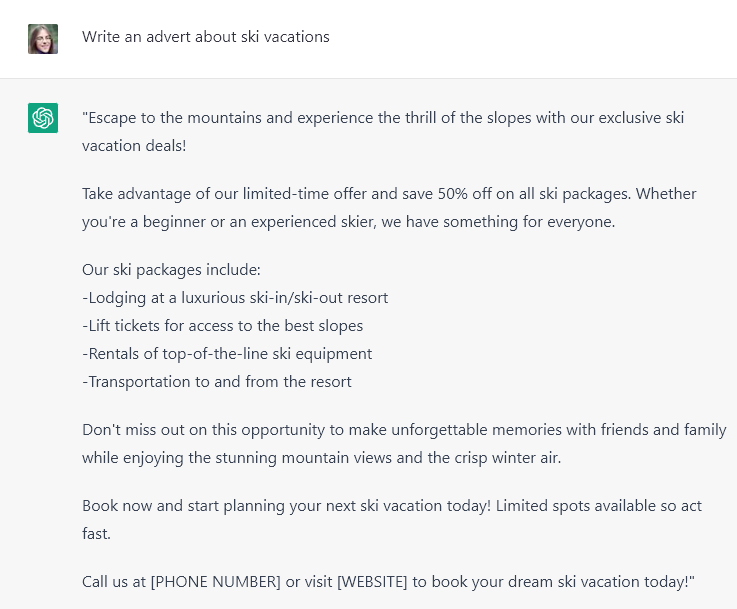
Obviously, if your company doesn’t offer 50% off or doesn’t include everything in those bullet points, you’d need to edit this advert quite a bit.
Example 3: Giving the AI Software More Details to Work With
If you’ve already got the details of an offer set up, give those to the AI copywriting tool to include in your ad. You’ll also want to include any specific requests and mention the type of tone you’d like for your ad.
Here’s the prompt we used this time:
“Write an advert about ski vacations in Canada. Include a 30% off coupon, ‘SKI30.’ Mention that packages that include flights are available, too. The tone of the advert should be exciting and daring.“
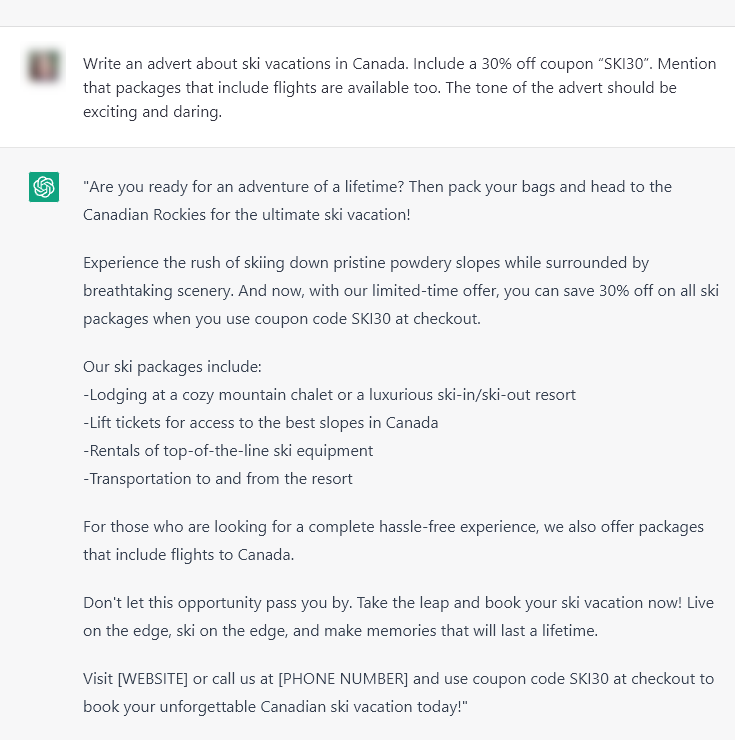
As you can see, the more information you give the AI tool, the better the output quality. The bullet points in this ad might need a little tweaking to suit exactly what the company offers, and the company’s website and phone number need adding … but it’s otherwise ready to be edited and published.
Tips to Get the Most from Your AI-Generated Content
Once you’ve got some AI-generated content, it’s a good idea to:
- Carefully review the AI copy for any factual errors. The AI may have picked up misinformation online.
- Ask the AI for multiple options where appropriate. For instance, you might want to ask for several email subject lines so your marketing team can choose their favorite.
- Run the content through a plagiarism checker and an AI checker (if the AI tool doesn’t have built-in versions). This lets you be confident that you haven’t plagiarized from other content creators.
You can also use AI tools at a much earlier stage of the writing process. You might try them out for brainstorming when you’re coming up with ideas, e.g., to plan out your next few months of marketing content.
AI Copywriting FAQ
The most common questions I get from readers about AI copywriting in 2026, answered.
Can AI copywriting tools really replace human copywriters?
No — but they’re absolutely replacing a specific tier of human copywriting work. Generic blog posts, basic product descriptions, simple ad copy variations, and high-volume listicle content can all be produced faster and cheaper by AI than by humans in 2026. What AI can’t replace: strategy, brand voice development, original concepts, emotional nuance, and any copywriting that requires deep understanding of a specific business or audience. Real copywriters in 2026 use AI as an accelerant for their work — the ones being replaced are the ones doing the work AI does better.
Is AI copywriting good or bad for SEO?
Neither — what matters is the editing. Google’s helpful content systems specifically target lazy, unedited AI content at scale, but AI-assisted content that’s been thoughtfully edited and includes real expertise performs the same as fully hand-written content. The line isn’t “AI” vs “human” — it’s “helpful” vs “unhelpful.” AI copywriting that ships without editing tends to be unhelpful (and gets filtered). AI copywriting that’s been humanized with real opinions, specific data, and original framing performs well.
What’s the best AI copywriting tool in 2026?
The answer depends on what you’re writing. For general copywriting workflows, RightBlogger is what I built specifically for bloggers and content creators (with 75+ writing tools, SEO optimization, and custom voice profiles). For raw model power, ChatGPT and Claude are both excellent — most serious copywriters use both. For e-commerce, Hypotenuse handles bulk product descriptions better. For team marketing, Jasper and Anyword are tuned for that workflow. Try free tiers of 2-3 tools and pick the one that fits your actual workflow.
What’s the difference between AI copywriting and AI content writing?
Copywriting is short-form, persuasion-focused writing — ads, landing pages, product descriptions, email subject lines, social posts. AI content writing is longer-form, information-focused writing — blog posts, articles, guides, tutorials. The tools that handle each overlap (ChatGPT and Claude do both well), but purpose-built tools tend to specialize: Anyword and Hypotenuse lean copywriting, RightBlogger and Jasper lean content writing. For a deeper breakdown of content-writing-specific tools, see my best AI writing tools guide.
Will my AI-written copy get flagged by AI detectors?
Possibly, if you ship unedited output. AI detectors (GPTZero, Originality.ai, Copyleaks) got meaningfully better in 2025-2026 at flagging unedited AI text. But the goal shouldn’t be “bypass detectors” — it should be “produce good copy.” Heavily edited AI-assisted content with real personalization, specific opinions, and varied sentence rhythm tends to read as human regardless of how it was generated. For the full breakdown, see my guide on how to humanize AI content.
Is AI copywriting good for ads and marketing campaigns?
Particularly good, actually. Short-form ad copy is where AI tools shine — you can generate dozens of variations in seconds for A/B testing, which would take a human writer hours. Anyword and Persado are specifically tuned for marketing teams running performance ads at scale. Even with general tools like ChatGPT, “write me 20 variations of this Facebook ad headline” produces useful options to test. The caveat: AI-generated ad copy still needs human review for brand fit and accuracy before it ships.
Can I make money as an AI copywriter in 2026?
Yes, but the work shifted. Traditional “I’ll write your blog posts for $50 each” copywriting is largely gone — clients generate that themselves with AI now. What still pays well: AI-assisted copywriting workflows for businesses that don’t want to manage AI tools themselves, AI prompt engineering for marketing teams, conversion-focused copywriting that combines AI speed with real strategic thinking, and specialized vertical copywriting (B2B SaaS, healthcare, finance) where domain expertise matters. The freelance writers thriving in 2026 are the ones using AI as an accelerant for their own expertise. See my full take in how to start a freelance writing career in 2026.
Final Thoughts: AI Copywriting in 2026
AI copywriting matured from “novel hack” to “default workflow” between 2023 and 2026. The bloggers, marketers, and creators winning with it aren’t the ones trying to replace themselves with AI — they’re the ones using AI to do more of their own work faster, while focusing their human time on the strategy, voice, and judgment AI can’t do.
If you’re getting started, pick one general-purpose tool (ChatGPT, Claude, or RightBlogger) and one specialized tool that matches your specific use case (Anyword for marketing, Hypotenuse for e-commerce, Wordtune for editing). Spend a week getting comfortable, build a custom voice profile, and run every draft through a real editing pass. That workflow produces dramatically better copy than any “set it and forget it” approach.
For deeper dives on adjacent topics: my best AI writing tools guide covers content-writing-specific tools, ChatGPT prompts for writing gives you the actual prompts I use, and how to humanize AI content is essential for any AI copywriting workflow that ships externally. And RightBlogger is the AI writing platform I co-founded specifically for bloggers and content creators — built around the workflow patterns this guide describes.
Ready to Use AI Copywriting to Grow Your Business?
AI copywriting could help you grow your business faster—particularly if you need to create a lot of website copy. If you’ve got dozens of product descriptions to churn out, a good AI copywriter could get that done for you in a fraction of the time.
You can also use AI copywriting tools to create content fast: this could be a huge help with your content marketing strategy.
This week, try out at least one AI tool. Experiment with different prompts and see what sort of output you get.
Keep in mind that even the most intelligent AI isn’t going to replace a human writer completely. Rather than seeing AI copywriting as a replacement for human copywriting, see the AI writer as an assistant. The AI can do much of the grunt work… while the human adds the magic.
Try My AI Writing Tool: RightBlogger
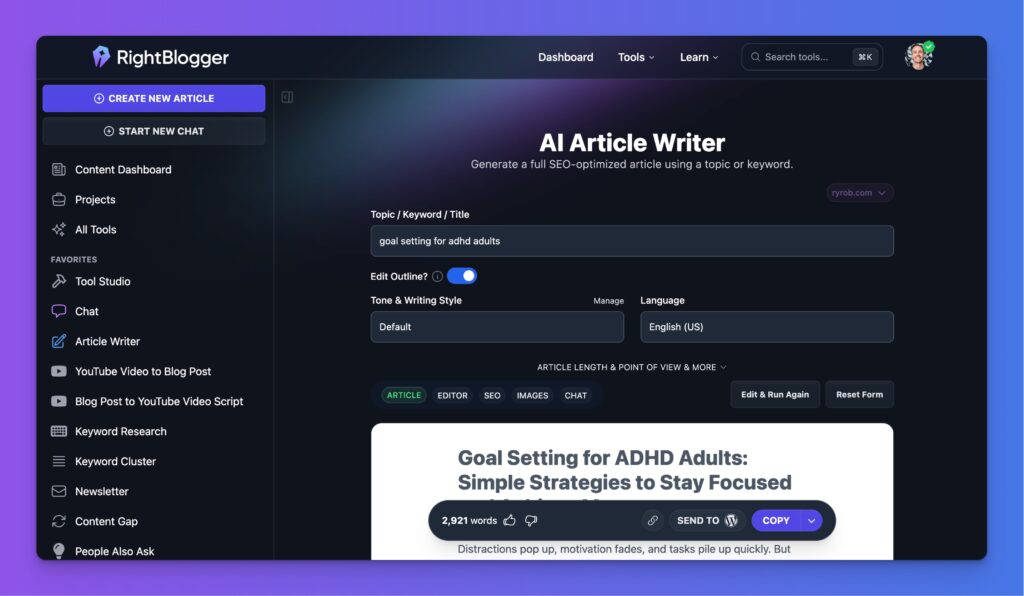
Try my very own AI-Powered Content Creation Toolbox for Bloggers: RightBlogger, to get access to 30+ blogging, SEO, marketing, sales and productivity-focused tools to blog faster & more effectively today.
