

There’s money sitting in your business bank account right now, and some of it is probably yours. The catch is that nobody really tells you how to pay yourself from an LLC the right way for tax purposes… so most owners just move some cash and hope it counts. Whether it actually does comes down entirely to how your LLC is set up.
Most LLC owners I know just send themselves a transfer and call it a day. It sort of works, and it sort of doesn’t. The rules are completely different for a single-member LLC than they are for one with multiple owners.
Quick disclaimer before we get into it. This is general education, not tax, legal, or accounting advice. I’ve run businesses for over a decade, but I’m not a CPA, so talk to a qualified tax professional about your own situation.
Here’s the full video walkthrough I recorded on paying yourself from an LLC, if you’d rather watch me set it up.
Key Takeaways for How to Pay Yourself from an LLC
- With a single-member LLC, the IRS treats you as a sole proprietor by default, so you’re not an employee of your own business.
- The main way to pay yourself from a solo LLC is an owner’s draw, which has no taxes withheld because you’re taxed on the business’s profit either way.
- Multi-member LLCs default to partnership treatment, and you get a second tool, guaranteed payments for work, which are taxed differently than draws.
- 50/50 ownership rarely means 50/50 work, so document who takes what in your operating agreement early on.
- At tax time, a single-member LLC files a Schedule C, while a multi-member LLC files a partnership return and each owner gets a K-1.
- Clean records are what turn tax season from a scramble into a simple handoff to your accountant.
- If you later elect S corp status, you become an employee of your own company and pay yourself a reasonable salary through payroll, with draws handled separately.
Set Up Clean Owner Pay With Gusto
Gusto is what I lean on to keep paying myself clean and documented, and it’s the tool I walked through in this whole guide. It flags you as an owner, unlocks the owner’s draw, and quietly logs every payment so tax season is a non-event. My link gets you your first month completely free, so you can set yours up without paying a thing to start!
How to Pay Yourself from an LLC Depends on Your Setup
Here’s the part that trips up most business owners. Almost every answer you’ll find online quietly assumes you own the entire entity yourself.
If there are two or more owners in your LLC, a lot of that advice is going to be wrong for you. Not slightly wrong. Wrong enough that your accountant will have a lot of questions in April.
So your setup matters first. The liability protection that makes an LLC worth having doesn’t decide how money reaches your pocket. The tax classification does.
There are two setups to know, and they change everything about how you pay yourself.
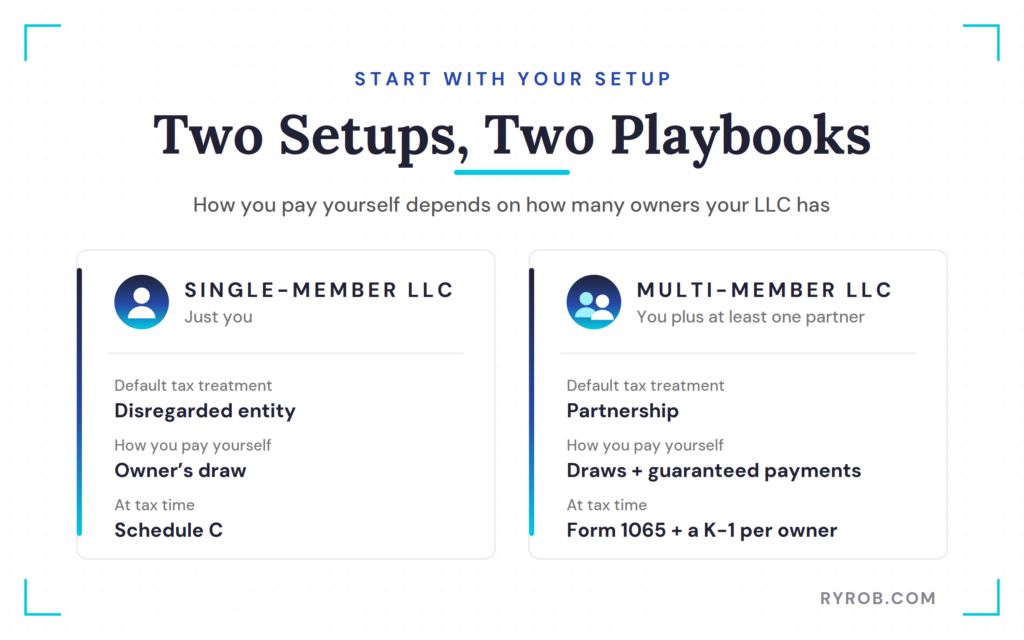
- A single-member LLC is just you. The IRS treats it as a disregarded entity by default, which is the simplest case, and you take an owner’s draw.
- A multi-member LLC is you plus at least one other owner. It defaults to a partnership for tax purposes, though you can elect corporate classification by filing Form 8832, and you now have two instruments to pay yourself instead of one.
There are really only two ways money leaves an LLC and lands in an owner’s pocket. Let’s look at each one.
Paying Yourself from a Single-Member LLC
When it’s just you, paying yourself is about as straightforward as it gets, so let’s start here. It’s the setup most people land in when they start freelancing or strike out on their own.
How an Owner’s Draw Works
An owner’s draw, which some accountants call a distribution, is exactly what it sounds like. You’re pulling out money that’s already yours.
No taxes get withheld when you take it, and that surprises most new LLC operators I talk to about this, whether they’re running a side business or doing this full-time. The reason is that you’re taxed on the business’s profit whether you take money out or not.
You don’t get taxed because you paid yourself. You get taxed on what the business makes. Because the IRS treats you like a sole proprietor, that profit carries both income tax and self-employment tax whether you pull money out or not.
This is why the random transfer thing is only half wrong. The money moving from the business into your personal account isn’t the problem. The problem is what happens six months later.
Keeping a Clean Record of Every Draw
Picture the scene. Six months in, you’ve got 12 transfers out of your business bank account, no labels, and no way to tell your accountant which ones were owner draws and which one was you buying a laptop and paying yourself back for it.
That’s the real reason to set this up properly. It’s not that paying yourself is complicated. It’s that in January, you can hand your accountant a clean set of documentation instead of a bank statement and a shrug.
If you’re treating a side project like a real business for the first time, that same habit of labeling every dollar is one I walk through in my guide on how to start a business on the side.
Here’s what it looks like when there’s an actual record behind paying yourself. I run this side of my business through Gusto, and everything below is a demo setup with made-up information, not my real payroll, as fun as it would be to dox myself.
- Set the company up as an LLC, a partnership, or a sole proprietorship in Gusto, because that’s what unlocks the owner’s draw option.
- Add yourself as a person and classify yourself as an owner rather than an employee. That’s the switch.
- Once you’re flagged as an owner, Gusto offers the owner’s draw as a payment type instead of a salary.
- Run payroll like you normally would, except what goes out is a draw with no tax withheld.
The draw lands in the owner’s connected account, and the record of it lives in Gusto instead of in your head. That’s the entire single-member LLC version of paying yourself.
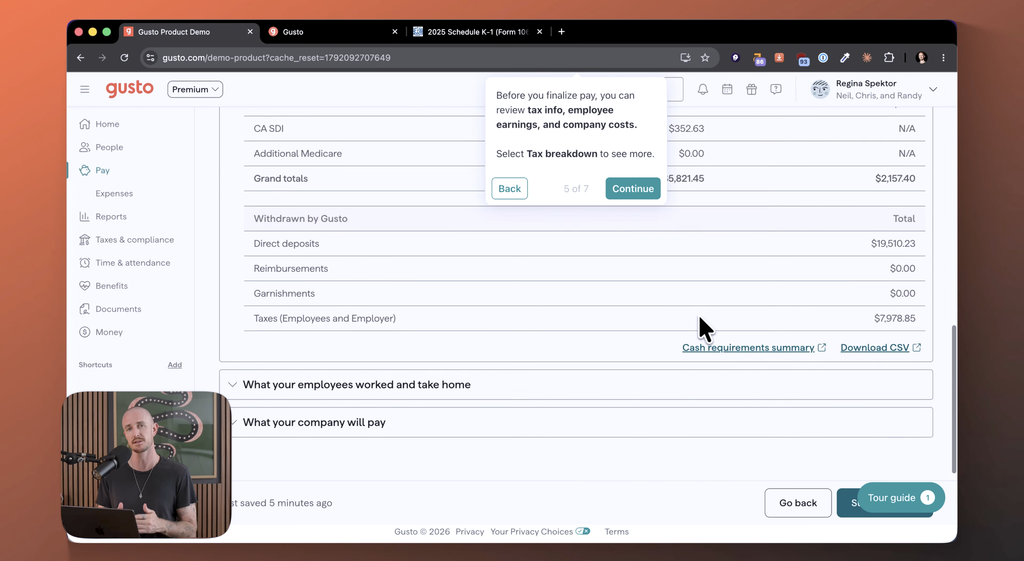
Gusto is the platform I actually use for this, and I teamed up with them so you can run the same setup. New users can get their first month free and keep every payment documented from day one.
Paying Yourself from a Multi-Member LLC
Everything above still applies once you bring on a partner, but it isn’t the whole picture anymore. This is the part that actually needs a real conversation between business partners.
Owner’s Draws vs Guaranteed Payments
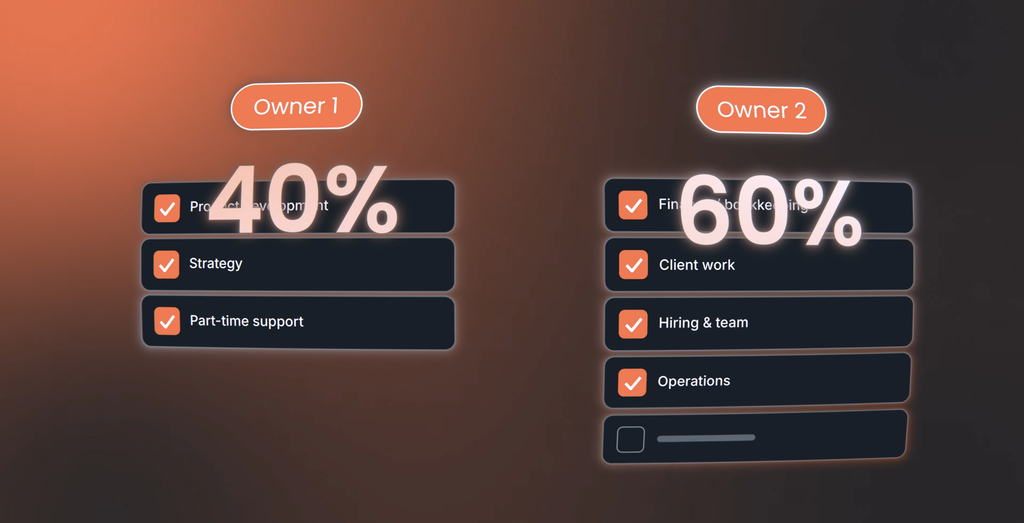
Say you and a partner split profits 50/50, like my business partner and I do. Owner draws work the same way as before, where you each pull against your share of ownership.
The complication is that 50/50 ownership rarely means 50/50 work. Someone’s almost always doing more, especially early on. That’s what a guaranteed payment is for.
It’s money paid to a partner for work rather than for ownership. It gets paid whether or not the business made a profit, which is the whole point. The partner doing the day-to-day isn’t waiting on a good quarter to get paid for their time.
Here’s why getting this right matters. Guaranteed payments carry different income tax treatment than a draw does. Two owners, same company, different payment amounts, different tax treatment.
If nobody wrote down which was which, somebody’s reconstructing it later from memory and hoping it doesn’t get lost in translation during tax season.
Because the two are taxed differently, I keep each draw and guaranteed payment recorded in Gusto so neither of us is guessing at tax time.
Why Your Operating Agreement Matters
Honestly, the most useful thing I can tell you here has nothing to do with software.
Whatever you and your partner agree to, who takes what, who gets a guaranteed payment, what happens if one of you steps back, write it down in your operating agreement early on. And if it’s not in there yet, the best time to add it is today.
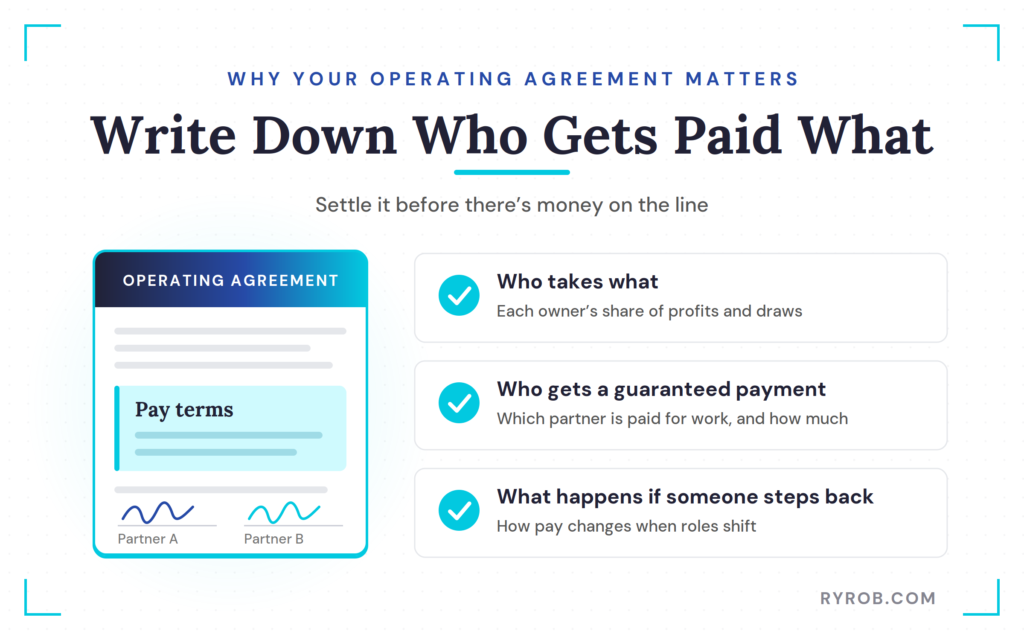
Otherwise, the year you have a disagreement about who’s paid what is the year you have to settle those things. Having those conversations early is essential.
The split between an owner’s draw and a guaranteed payment is a conversation with your accountant and your partner, not a setting you flip in software. Get it in writing before there’s money on the line.
K-1 vs Schedule C at Tax Time
A multi-member LLC is a pass-through entity by default, so it files a partnership return on Form 1065, and each owner gets a Schedule K-1. That’s the form that tells you and the IRS what your share of the business actually was. Your draws don’t change that number.
Your guaranteed payments, however, do show up on your return separately. And there’s a real advantage to them. Your partnership gets to deduct the guaranteed payment as a business expense, which reduces the partnership’s business income, so your entity is taxed on a lower amount.
As you grow and earn more, this typically becomes a more tax-advantaged way to pay yourself. A single-member LLC, on the other hand, uses a Schedule C at tax time instead, and there’s no K-1 at all.
If you want the full rundown of how this plays out for creators, I put together a detailed primer on how taxes work for bloggers and creators.
That’s about as far as I’m going on tax forms, because this is where it stops being mechanics and starts being about your specific situation.
Your operating agreement matters. The state you live in and do business in matters. Get a professional to look at your situation and advise you on the best way to pay yourself while limiting your tax liability.
The One Limitation to Know Before You Start
Here’s the limitation nobody mentions until you’ve already run into it.
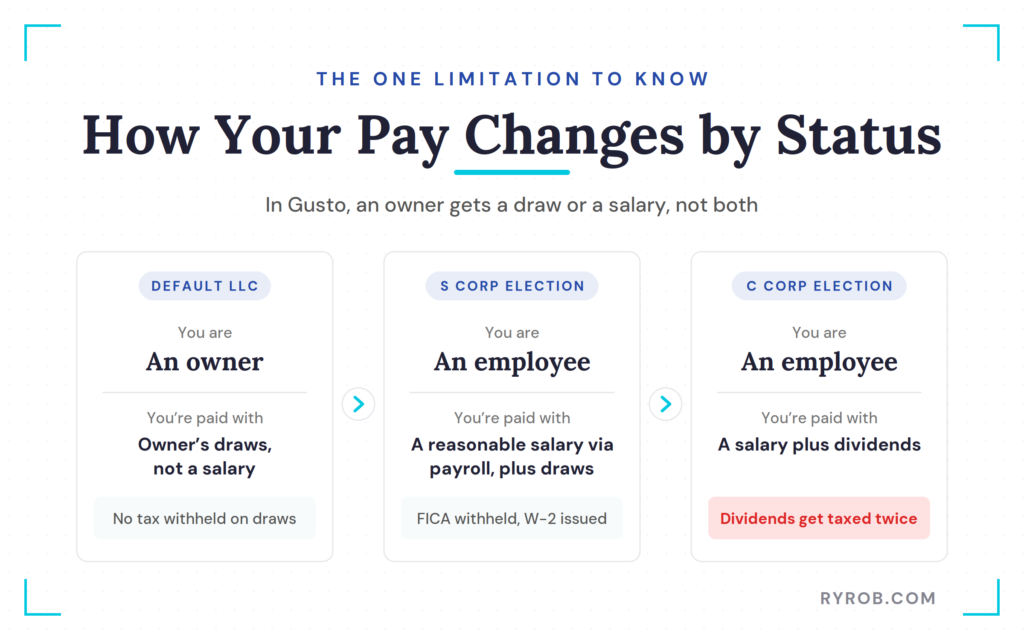
In Gusto, an owner can be set up to take a non-taxed owner’s draw, or to be paid a taxable salary. Not both in the same setup. For most people that’s a non-issue, because if you’re taking owner draws, you’re not on a salary anyway.
But if you ever elect S corp status, which is a whole other explainer, you become an employee of your own company. The IRS expects that salary to reflect reasonable compensation before draws come into play. That salary runs through payroll with FICA taxes withheld, and draws get handled separately.
If you ever elect C corp status instead, the picture changes again. You’d take a salary plus dividends, and those dividends get taxed at the corporate level and again on your personal return.
A couple of other notes while we’re here. Software is great at recording what you did, but it doesn’t decide what you should have done.
And none of this changes your tax bill. It changes whether you can explain and justify what you did.
What this does do is make the next thing easier. The second you pay a contractor, bring on an employee, or change your entity structure, the record is already there, and you’re not starting from a pile of confusing transfers that need to be reconciled.
FAQs About How to Pay Yourself from an LLC
A few of the questions I get asked most about paying yourself from an LLC.
Do I Pay Taxes When I Take an Owner’s Draw?
No taxes are withheld when you take a draw, because you’re already taxed on the business’s profit whether the money leaves the account or not. The draw itself is just moving money that’s already yours.
Can an LLC Owner Be on Payroll?
With a single-member or multi-member LLC under default treatment, you’re not an employee of your own business, so you pay yourself through draws, plus guaranteed payments for multi-member LLCs, instead of a salary. If you elect S corp status later, that changes. You become an employee of your company, your salary runs through payroll, and you get a W-2 at the end of the year instead of a draw record.
What’s the Difference Between a Draw and a Guaranteed Payment?
A draw is money you pull against your ownership share. A guaranteed payment is money paid to a partner for work, and it gets paid whether or not the business made a profit. They’re taxed differently, which is exactly why you don’t want to be guessing about which one you took months ago.
Do I Need to Pay Quarterly Estimated Taxes on Money I Take Out?
Your draws don’t come with withholding, so the tax gets paid on the business’s profit through estimated payments during the year instead of through a paycheck. Your CPA should confirm the specifics for your situation.
As with everything above, these are general answers, not advice for your specific business. Confirm the details with a qualified CPA.
Final Thoughts on Getting Paid the Right Way
Paying yourself the right way from an LLC is about recordkeeping and clarity, not complicated tax moves. Label every draw, document your partner arrangements in the operating agreement, and let a qualified tax professional look at your exact setup before you build habits around it.
My suggestion for a next step is simple. Set up a tracking system this week, whether that’s Gusto or another tool, so every transfer out of your business account gets a name.
Then tax season becomes a handoff instead of a scramble, and you can get back to the work that actually grows your income.
Set Up Clean Owner Pay With Gusto
Gusto is what I lean on to keep paying myself clean and documented, and it’s the tool I walked through in this whole guide. It flags you as an owner, unlocks the owner’s draw, and quietly logs every payment so tax season is a non-event. My link gets you your first month completely free, so you can set yours up without paying a thing to start!
