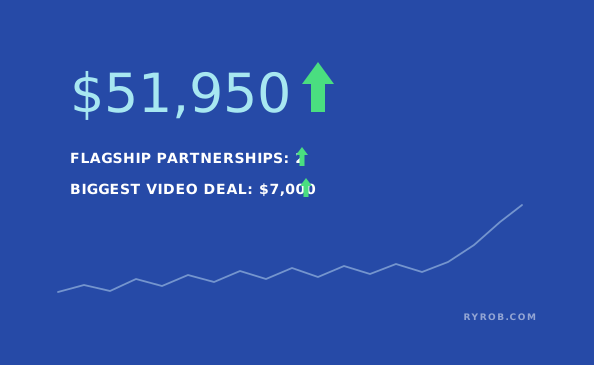

We finally cracked $51,950 in a single month, and honestly… it happened faster than I planned for. Every dollar came from sponsorships and affiliate income, with nothing from ads. This is my full YouTube income report for August 2026, and the first time we’ve ever gone this far.
I’m not flying solo on it either. My business partner and COO Matt Feldman jumped in to break down every dollar with me, the deals, the expenses, and what we actually kept.
The short version is that two flagship deals and a few trade show handshakes carried the whole month. Here’s the full video walkthrough where Matt and I break down every number from the month:
Key Takeaways for Building a YouTube Income Report
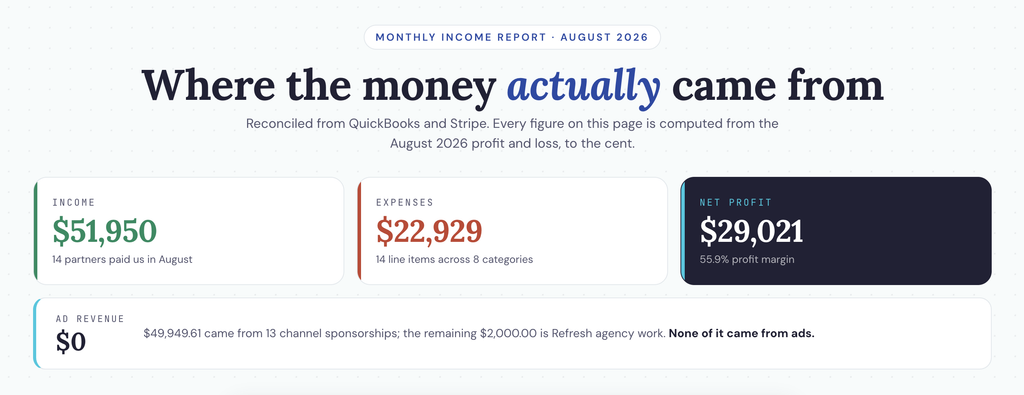
- $51,950 in gross revenue, and every bit of it came from sponsorships and affiliate partnerships rather than ad revenue.
- Two flagship partnerships closed this month, both growing out of smaller three-pack deals and in-person trade show meetings.
- Our costs stayed lean, which let us move spare cash into a money market account earning around 4%.
- Trade shows were our most reliable pipeline, turning face-to-face meetings into high-value corporate deals.
Disclosure: Please note that some of the links below are affiliate links and at no additional cost to you, I’ll earn a commission. Know that I only recommend products and services I’ve personally used and stand behind. When you use one of my affiliate links, the company compensates me, which helps me run this blog and keep my in-depth content free of charge for readers (like you).
Income Breakdown for August 2026
Here’s the month at a glance before we get into the line items. Our revenue comes down to brand partnerships and affiliate deals, with nothing from the YouTube Partner Program or ad revenue.
Now here’s exactly where every dollar came from. Matt handles most of the renewals and closing calls, which frees me up to focus on production, and this month’s total came from a mix of recurring clients, new three-packs, and trade show residuals.
REVENUE MIX
Where every dollar came from in August 2026
- DreamHost23.1%
- Bluehost19.2%
- Hosting.com9.6%
- Circle9.6%
- DataForSEO7.7%
- Yoast7.7%
- Otterly AI4.8%
- Other (7 partners)18.2%
14 partners paid us in August. Links go to the tools we use and recommend.
Reconciled from QuickBooks + Stripe · ryrob.com/income
On the other side, we keep things lean, so expenses stayed low across a handful of categories.
EXPENSE MIX
Where every dollar went in August 2026
- Advertising & Marketing46.7%
- Professional Services & Contractors30.2%
- Travel11.8%
- Payment Processing & Transfers3.4%
- Entertainment3.0%
- Software & Tools2.8%
- Payroll & Benefits1.6%
- Events & Education0.4%
14 line items across 8 categories. Tap a category to open its line items.
▶ Advertising & Marketing 46.7% $10,706.58
▶ Professional Services & Contractors 30.2% $6,919.86
▶ Travel 11.8% $2,701.19
▶ Payment Processing & Transfers 3.4% $785.10
▶ Entertainment 3.0% $697.75
▶ Software & Tools 2.8% $649.45
▶ Payroll & Benefits 1.6% $377.86
▶ Events & Education 0.4% $91.00
Reconciled from QuickBooks + Stripe · ryrob.com/income
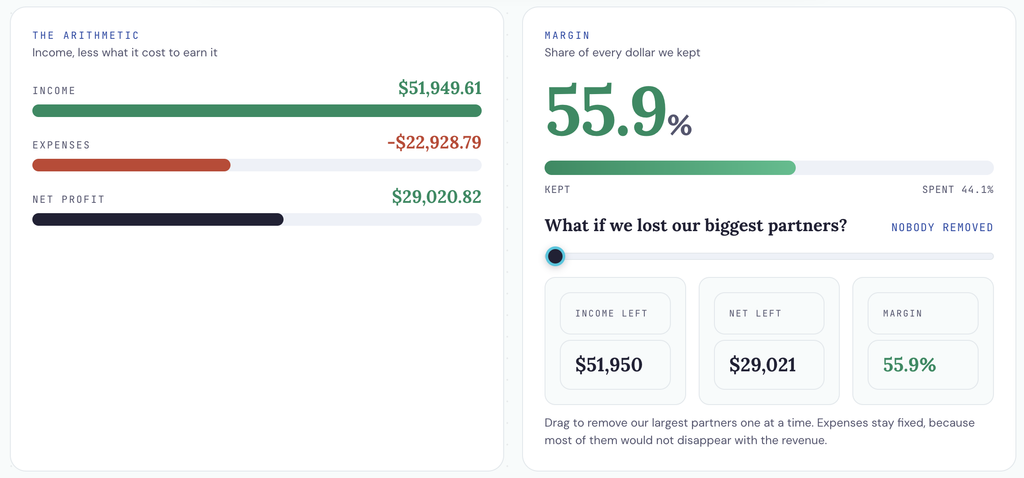
And here’s what actually stayed in the account after everything was paid out.
Being able to pull a clean breakdown like this every month is exactly why we run our books through Xero.
Where Every Dollar from Our Revenue Sources Came From in Our First $51K+ Month
Residuals from trade shows keep paying off long after we pack up. A booth we stumbled on at Affiliate Summit in New York turned into a deal with Taboola, the content discovery platform.
We figured out their product on the fly, pitched a three-pack, and landed a $7,000 single video package, our biggest single-video deal yet.
We also closed two big three-packs with DreamHost and Bluehost, both web hosting companies. Bluehost liked the early results enough to sign on for six more videos, which grew into one of our flagship partnerships.
How We Keep Our Expenses Lean While Scaling
Running a lean team is the whole reason our margins stay healthy. Matt and I handle the core business ourselves, backed by a few freelance editors, thumbnail designers, and an admin. Keeping the crew tight while revenue climbs is a big part of what makes a month like this work.
Our expenses were pretty straightforward too. We caught up on marketing by rolling two months of Google ads into August. Everything else stayed low, mostly travel to WordCamp US in Phoenix, team meals, software, and a little entertainment.
Putting Our Profit to Work in a 4% Money Market Account
Sitting on a pile of cash in a basic checking account doesn’t do much for you. Since our revenue keeps climbing, we started moving that extra cash into a money market account instead of letting it sit idle.
For a business like ours, an account earning around 4% beats letting cash gather dust. This isn’t financial advice, it’s just the move that made sense for us. Honestly, it’s the kind of thing I never bothered with before Matt pushed for it.
What a Flagship Partnership Is and How We Land Them
A flagship partnership is our biggest package by far. It’s six videos paired with six companion blog posts, rolled out over a quarter with one video every two weeks. We even repurpose each video into a written post so the sponsor gets mileage on both fronts.
Both of our newest flagship clients, Automattic and Bluehost, started small before scaling up. Automattic, the company behind WordPress, came out of relationships we built in person, while Bluehost grew straight out of its three-pack.
We’ve also got a third flagship on the doorstep with Gusto, after meeting the right person at a show and following up on a call. The bigger the company, the bigger the budget, but the slower things move, since there’s a lot more legal and finance in the mix.
How Trade Shows Became Our Best Source of Sponsorship Deals
Face-to-face meetings beat cold emails every single time. Going to events like WordCamp US in Phoenix let me meet existing clients and build real relationships. We’re talking about kids and weekend plans, not just being a face on a screen.
Automattic sealed their flagship with us partly because of those in-person conversations. That said, not all trade shows are created equal. The ones with great apps for filtering and following up make a huge difference in how many deals actually close.
Why We Stopped Second-Guessing Our Prices
Raising prices used to feel uncomfortable, but this month made it clear we were undercharging. What finally clicked is that we’re charging for a service, not just access to an audience.
Brands care about engagement, good-looking content, and tutorials that show their customers how to use the product. Once we understood that’s what they’re paying for, the higher numbers stopped feeling like a stretch.
What Changes When You Work With Bigger Brands
Working with enterprise companies means strict legal reviews and a lot more people in the room. They rarely accept a standard creator agreement and almost always bring their own paperwork, which stretches the timeline out.
The main thing is protecting your business along the way. We make sure our agreements don’t lock us into restrictive exclusivity terms that would limit who we can work with later.
How I’m Outsourcing My Briefs to Spend More Time Creating
As the channel grows, parts of my process started slowing us down. I used to spend one to four hours prepping a brief before I even turned on the camera. That was quietly eating into how much I could actually shoot.
So at the end of August, we started outsourcing the initial briefing. Now once we pick a topic, a teammate drafts what the video should look like, so I can step in and record. It frees me up for the part that matters, the actual producing and editing with tools like Riverside.
That’s It for Our August YouTube Income Report
Crossing $51,950 in a single month proves that treating sponsorships like a professional service works. It didn’t come from ads or a viral fluke. It came from showing up prepared and pricing our work like it matters.
Whether you’re building a channel or figuring out how to make money blogging, consistency and preparation are everything.
FAQs About Our YouTube Income and Sponsorship Strategy
A few quick answers to the questions that come up whenever we share numbers like these.
How do you price your sponsored YouTube videos?
We price based on the value of the service and the engagement we deliver, not just view counts. Our three-pack packages give brands multiple touch points across the channel and companion blog posts.
Do you make any money from AdSense?
No. We don’t use AdSense on YouTube at all. Every dollar comes from channel sponsorships and affiliate partnerships, with zero from ads.
How do you calculate the numbers in a YouTube income report?
We track income as it comes in through the month, then reconcile it through our books in Xero. Gross revenue is the total before fees and expenses, and net is what we actually keep.
What is a flagship partnership?
It’s our highest-tier package, built around six videos and six companion blog posts over a quarter. That gives a sponsor ongoing exposure instead of a one-off mention.
How do you manage your business finances?
We run our books through Xero to keep everything clean and tax-ready. Any excess cash goes into a money market account rather than sitting in a zero-interest checking account.
Final Thoughts About Our August YouTube Income Report
Looking back on August, the number I’ll actually remember isn’t the $51,950. It’s that nearly every deal this month traced back to a real conversation, a handshake at a trade show, or a client we finally got in a room with.
The thing I keep coming back to is that the relationships do the heavy lifting. You can have sharp content and fair pricing, but the deals that grew into flagships happened because we showed up in person and took the time to actually know people.
We’re committing to publishing one of these every single month from here on, the strong months and the slow ones alike. If they’re useful to you, let me know, because that’s the only signal that tells us to keep sharing the numbers this openly.
