

Free keyword research tools are often enough when you’re starting out. While they don’t offer the same depth and insights as paid tools, they’ll still let you get content ranking well … especially for low-difficulty keywords.
You’re looking for two things with free keyword research:
- Proof that people are searching for something
- Probability that you can actually win a spot on page one of Google search & earn AI citations in ChatGPT, Claude, Gemini, Perplexity, and Google’s AI Overviews
I’ll take you through a workflow you can use to figure out what you’re already close to ranking for, as well as helping you dig into new keywords to target.
We’ll start with Google Search Console (what your site’s already showing up for), then pressure-test ideas in the SERPs (what Google is rewarding right now). We’ll also take a look at my powerful free Keyword Research Tool, plus handy free browser add-ons to speed up the boring parts of keyword research.
Use My Free Keyword Research Tool
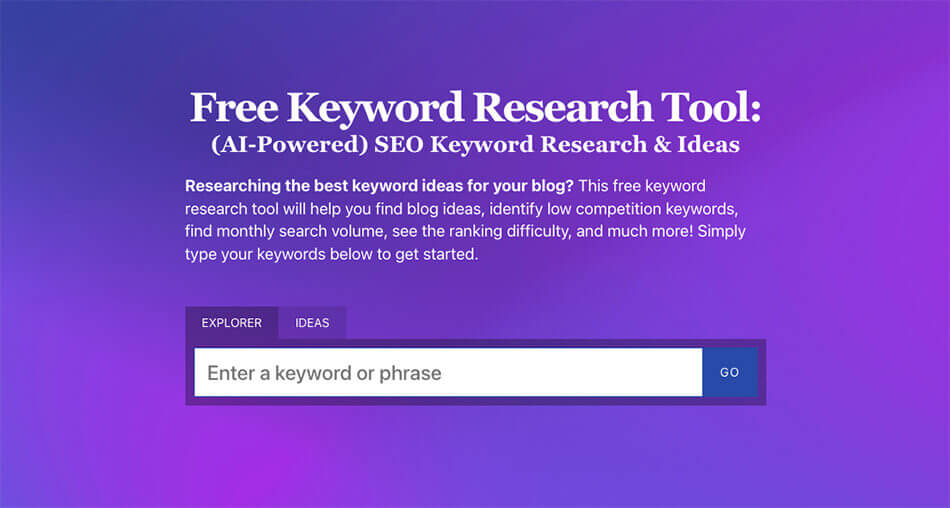
Try my free AI-Powered Keyword Tool to get dozens of research-backed ideas for keywords & topics to write about on your blog today.
Start With Google Search Console Because It’s Real Data From Your Site

Google Search Console shows what Google already tested your pages for, even if you’re stuck on page two.
Here’s how to use it for keyword research.
First, head to Performance → Search results in Google Search Console, then take a look at the Queries tab.
Your goal is simple: find queries where you’re already close, then nudge those pages over the edge.
Here’s how to do it:
- Filter to the last 28 days. You want to see what’s currently ranking well, not what had a weird spike a year ago.
- Sort queries by impressions (this is essentially search volume).
- Find high-impression, low-CTR queries. High impressions signal strong search volume. Low CTR means you’re getting seen but not clicked, so the title and snippet are usually wrong for the intent.
- Click a query, which will take you to the Pages tab. Now you know which URL(s) Google matches to this query, even if you didn’t plan it that way.
- Decide: refresh or create. If the page is close to matching the search intent, update it. If it’s the wrong fit, write a new page and internally link them.
- Write down the exact wording Google shows. These are your raw keyword ideas: what people are actually typing in, right now, to find your content.
In February 2026, Google rolled out a Discover-focused core update that targeted clickbait and pushed more local and original content in the Discover feed. It doesn’t change Google Search Console’s keyword reports, but it does mean you may want to pay closer attention to the Performance → Discover report if you rely on that traffic. If you publish newsy or trend content, keep your headlines honest and your content specific.
Want to go further with digging into search volume and keyword difficulty? Use my AI-powered free keyword research tool, or try Google Keyword Planner (estimates difficulty) and/or Google Trends (checks for seasonality).
Read the SERPs Like a Researcher, Not a Tourist
Search Console tells me what’s possible for my site. The SERPs (search engine results pages) tell me what Google wants to rank today.
My rule is: I don’t commit to a keyword until I’ve looked at page one and asked, “What is this results page really made of?”
Here’s an example for the query “how to make money blogging”:
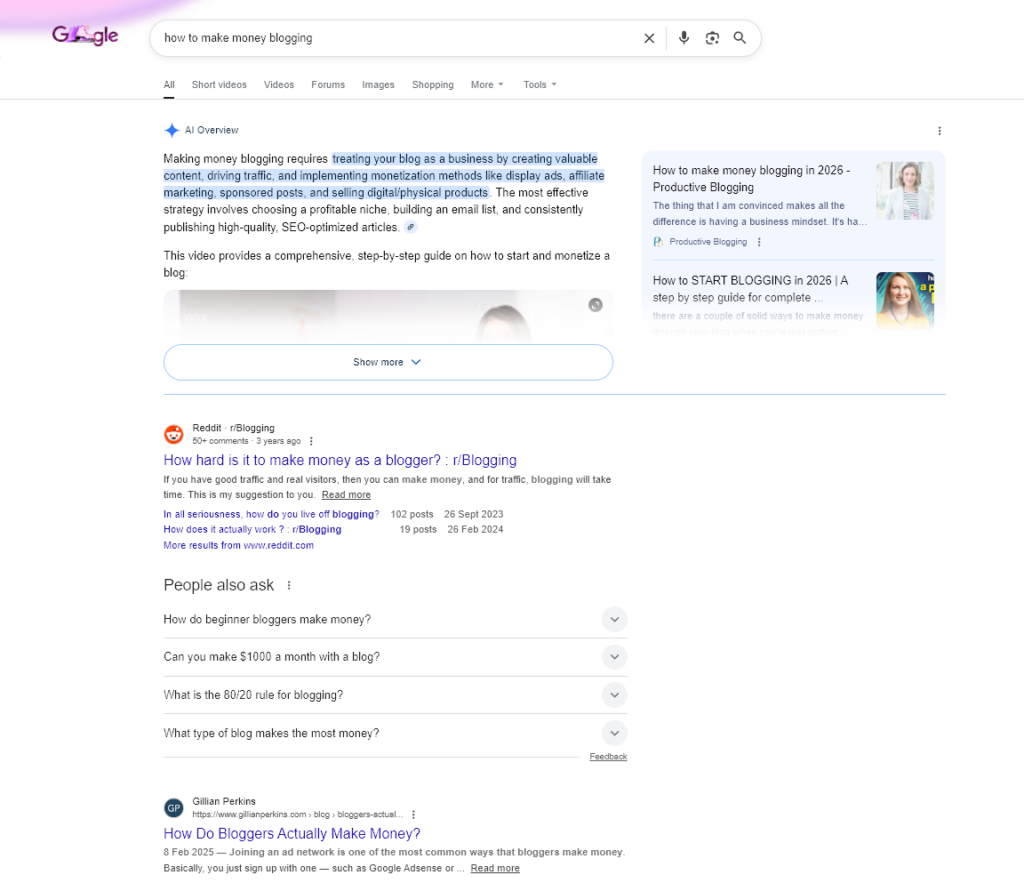
When I Google a query, I perform competitor analysis on the SERPs. I look for patterns to decode user intent. Here’s how you can do the same:
- Content type: Are the top organic search results blog posts, category pages, product pages, tools, videos, or forums?
- Content angle: Are they “beginner,” “cheap,” “best,” “near me,” “for small business,” “2026,” or something else?
- Freshness: Do I see lots of recently updated dates? If yes, Google expects new info.
- Brand dominance: If page one is stacked with huge brands and government sites, I’ll look for a narrower keyword to target, so it’s more achievable.
- SERP features: People Also Ask, the local pack (vital for Local SEO), featured snippet, and videos are clues. They’re basically Google showing how they want that query to be answered.
This competitor analysis gets me a ton of “free” keyword research variations without any tool. I pull phrases from:
- People Also Ask questions (great for subheadings).
- Related searches at the bottom (great for spin-off posts).
- The exact wording used in top-ranking H2s and intros (great for matching intent).
- Google Autocomplete and Google Suggest (type your query to uncover more user intent signals).
For even more keyword research ideas, use the Ideas tab of my free keyword research tool to surface related keywords and keyword suggestions fast, like this:
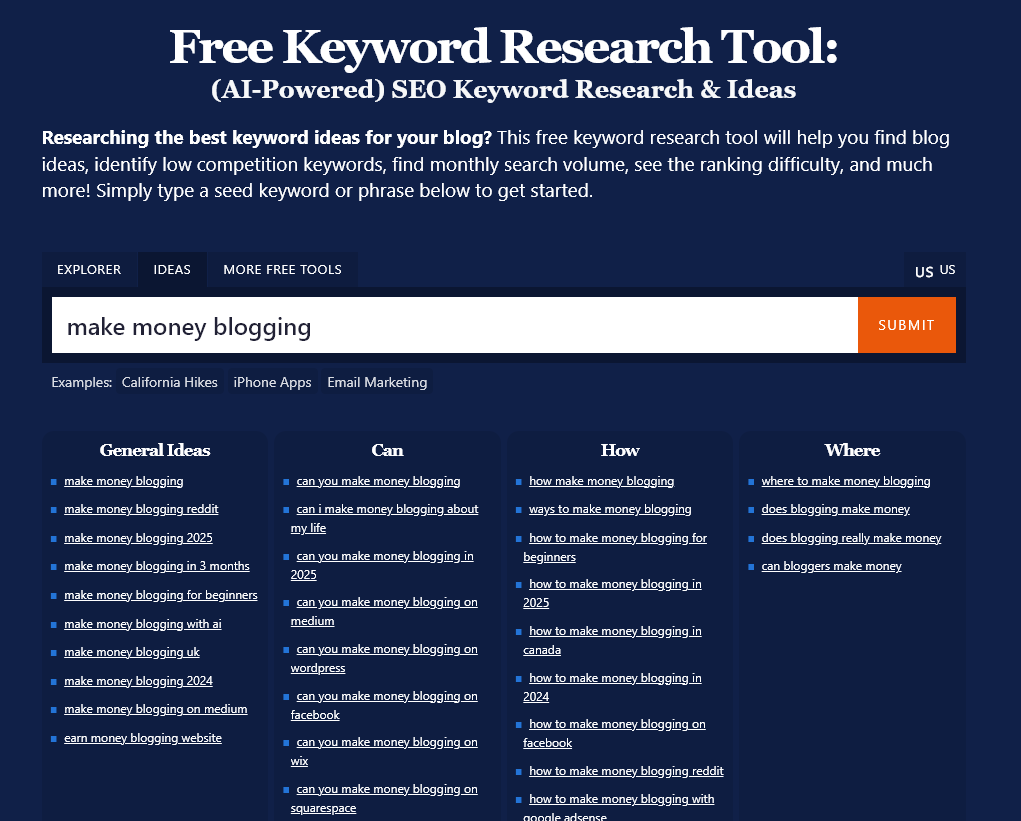
After I’ve collected a handful of related keywords, I organize them into clusters so I’m not writing random one-off posts. That’s the difference between “I published content” and “I built topical authority.” If you want help grouping terms fast, my keyword cluster tool is a solid free way to map what belongs together.
Use Free Browser Extensions to Speed Up the Work (Without Trusting Them Blindly)
Once I know what I’m targeting, I want to move fast. What I want from free keyword research browser extensions is instant page-level context while I’m scanning the SERPs and competitor content. A good extension can save me a ton of time.
Here’s what I look for in free browser extensions:
- On-page basics: word count, headings, title tag, meta description, canonical.
- Indexability signals: noindex tags, robots directives, render checks.
- Link clues: internal links out, external links out (I’m not counting every link, I’m spotting patterns).
- Schema and SERP feature hints: FAQ markup, review markup, breadcrumbs.
Some of my (free) favorites are:
- Keyword Surfer — shows search volumes and related keyword ideas right there in the SERP
- MozBar — gives Page Authority, Domain Authority, and more
- SEOquake — gives backlinks, keyword difficulty, social stats, and more
All these tools can help you discover why a particular page is ranking high for a query, and how you can match it.
Of course, some queries are going to be tough to rank for, especially if your blog is very new. That’s where long-tail keywords (low-competition keywords) come in: they’re specific and usually have clearer intent. Use my long-tail keyword generator for keyword suggestions and related keywords, then check these in the SERPs to get a clear idea of the SEO difficulty.
Conclusion: Free Keyword Research Tools Can Take You a Long Way
You don’t need paid tools for keyword research that brings traffic. You just need Search Console to show you what content Google already trusts, the SERPs to show you what Google rewards, Chrome extensions to make everything easy, and crucially, my free Keyword Research Tool to get data on search volume and difficulty … plus long-tail ideas.
Solid keyword research will take your blog or website from virtually invisible to ranking well and bringing in consistent leads and customers. It’ll be well worth the time you invest, and with all the free options out there, you’ve got nothing to lose.
Use My 50+ Powerful Free Blogging Tools Today
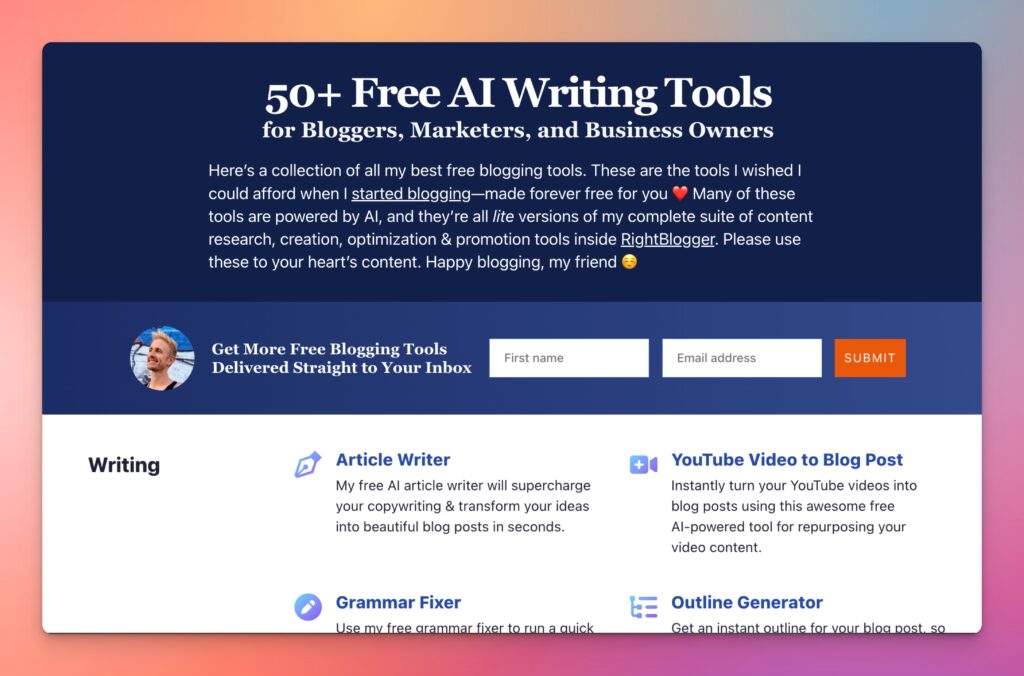
When I first started blogging, I couldn’t afford fancy tools. That sucked. And that’s why I’ve built a stable of powerful free blogging tools ranging from keyword research to an AI article writer, blog idea generator and more. Forever free for all to use—no strings attached.

Great walkthrough! I love the emphasis on using Google Search Console first it’s real data from your own site, making it easier to spot low-CTR, high-impression keywords you can quickly optimize and push onto page one without paid tools.
This was such a practical breakdown of doing free keyword research without paid tools. A lot of beginners struggle with not knowing which queries in Google Search Console are actually worth building content around, so your SERP analysis tips really help.